
How Does a Japanese Sword Get Its Curve? Katana Sori Explained
How Does a Japanese Sword Get Its Curve? The Science Behind Katana Sori
One of the most recognizable features of a Japanese sword is its elegant curved blade. Whether you are looking at a traditional katana, tachi, or wakizashi, the curve gives the sword a distinctive appearance and plays an important role in its handling and cutting characteristics.
But how does a Japanese sword get its curve?
Many people assume that a swordsmith simply hammers the hot blade into a curved shape. While a blade can be adjusted during forging, the characteristic curvature of a traditionally hardened Japanese sword often develops during the heat-treatment process.
This curvature is called sori (反り).
In this article, we'll look at how katana curvature forms, why Japanese swords are curved, and what happens during the traditional quenching process.
What Is the Curve of a Japanese Sword Called?
The curvature of a Japanese sword is known as sori.
Sori refers to the amount and shape of the curve along the blade. Different Japanese swords can have different degrees and styles of curvature depending on their historical period, intended use, blade geometry, and forging method.
Some blades have a deep curve closer to the handle, while others have a more evenly distributed curvature.
The sori is one of the characteristics that gives a Japanese sword its distinctive silhouette.
Are Japanese Swords Forged Curved?
Not entirely.
During the forging process, a swordsmith shapes the steel into the basic form of the blade. The blade may already have some curvature, but the final shape is not simply created by bending the finished blade with a hammer.
A major change can occur during differential hardening and quenching.
This is why the curvature of a traditionally made katana is closely connected to the heat-treatment process.
How Does a Katana Curve During Quenching?
The key process is called quenching.
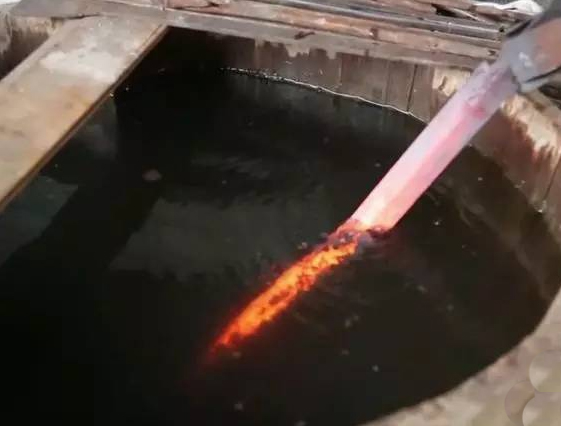
After the blade has been forged and shaped, the swordsmith heats it to the proper temperature for hardening. In traditional Japanese swordmaking, a layer of clay mixture is applied to different parts of the blade.
The clay is usually applied in different thicknesses:
The cutting edge receives a thinner coating.
The spine receives a thicker coating.
This causes different parts of the blade to cool at different rates when the hot blade is quenched.
The result is differential hardening.
During this process, the steel undergoes structural changes. The edge cools and hardens differently from the thicker, more insulated spine. These differences in cooling and transformation create internal stresses within the blade.
As those stresses develop, the blade can take on its characteristic curvature.
This is one of the reasons a traditionally hardened katana may appear to curve during or immediately after the quenching process.
The Role of Martensite in Katana Curvature
The cutting edge of a traditionally hardened Japanese sword is designed to become much harder than the spine.
When the edge cools rapidly, part of the steel transforms into a hard structure known as martensite.
The spine cools more slowly and generally remains tougher and more flexible.
This difference between the hardened edge and the softer spine is one of the defining characteristics of traditional differential hardening.
The transformation of the steel, combined with differences in cooling rates and thermal contraction, contributes to the development of the blade's curvature.
The exact amount of sori can vary depending on several factors, including:
Blade geometry
Steel composition
Thickness of the blade
Clay application
Heating temperature
Quenching medium
Quenching technique
For this reason, creating the desired curvature requires experience and careful control from the swordsmith.
Why Are Japanese Swords Curved?
The curved shape of many Japanese swords is closely associated with their historical development and intended use.
A curved blade can provide advantages for cutting and drawing motions. The geometry of the blade also affects how the sword moves through a target and how it feels in the hands.
However, there is no single "perfect" amount of curvature.
Different Japanese sword designs developed for different purposes.
For example, some earlier mounted swords such as the tachi often feature more pronounced curvature, while many katana designs have a more moderate curve.
The shape of the blade evolved over centuries alongside changes in warfare, armor, fighting styles, and swordmaking techniques.
Is the Curve of a Katana Only Created by Clay Tempering?
No.
Clay tempering is an important part of traditional differential hardening, but the final curvature of a Japanese sword is influenced by several factors.
The swordsmith may establish part of the blade's shape during forging. The blade can also change shape during heating, quenching, and later finishing work.
The amount of curvature is therefore the result of the entire swordmaking process rather than a single step.
In traditional Japanese swordmaking, however, quenching is often one of the most dramatic moments because the blade can visibly change shape as the steel cools.
Does Every Katana Have the Same Amount of Curvature?
No. Katana curvature can vary significantly.
Some blades have a shallow sori, while others have a deeper curve. The position of the curve can also vary along the blade.
Factors that influence katana curvature include:
Blade Length
Longer blades may have different curvature characteristics from shorter blades.
Blade Geometry
The thickness and shape of the blade affect how it responds during heat treatment.
Historical Style
Japanese sword shapes changed throughout different historical periods.
Forging and Heat Treatment
The swordsmith's forging method, clay application, and quenching technique can all influence the final sori.
Because of these differences, two handmade swords can have noticeably different curves even when they are based on a similar design.
What Happens If a Japanese Sword Is Not Differentially Hardened?
Modern Japanese-style swords can be made using different heat-treatment methods.
Some blades are through hardened, meaning the blade is hardened more uniformly. Others use differential hardening to create a harder edge and a tougher spine.
A through-hardened blade does not rely on the same traditional differential hardening process that produces the classic clay-tempered structure of many Japanese swords.
As a result, the relationship between quenching and blade curvature may be different.
Modern swordmakers can also create curvature primarily through forging and shaping rather than relying on the traditional quenching process.
The Japanese Sword Curve: A Balance of Art and Metallurgy
The curve of a Japanese sword is more than a decorative feature.
It is the result of blade design, forging skill, heat treatment, and the behavior of steel at high temperatures.
In a traditionally differentially hardened katana, the quenching process can dramatically influence the final shape of the blade. The different cooling behavior of the edge and spine creates internal changes that contribute to the formation of the sword's characteristic sori.
This combination of craftsmanship and metallurgy is one of the reasons Japanese swords continue to fascinate collectors and sword enthusiasts around the world.
FAQ: Japanese Sword and Katana Curvature
Why are Japanese swords curved?
Japanese swords are curved for a combination of historical, functional, and manufacturing reasons. The curved blade can support effective cutting motions, while the characteristic curvature, known as sori, is also closely connected to traditional forging and differential hardening methods.
What is the curve of a katana called?
The curve of a Japanese sword or katana is called sori (反り).
Does a katana become curved during forging?
Part of the blade's shape can be created during forging, but a traditionally hardened Japanese sword can develop additional curvature during the quenching process.
How does a katana curve during quenching?
Different parts of the blade cool and transform at different rates during differential hardening. The resulting differences in steel structure, thermal contraction, and internal stress can cause the blade to develop curvature.
Is every Japanese sword curved?
No. Japanese swords come in many shapes and styles. While many traditional Japanese swords have noticeable curvature, some Japanese blades are nearly straight or have only a slight curve.
Does clay tempering create the hamon?
Clay tempering helps control the differential hardening of the blade. This process can produce the visible transition between the hardened edge and the softer body of the blade, known as the hamon.
Can a swordsmith control how much a katana curves?
An experienced swordsmith can influence the final curvature through blade geometry, forging, clay application, heating, and quenching technique. However, traditional heat treatment involves complex changes in the steel, so precise results require skill and experience.
Are modern katana swords curved in the same way as traditional Japanese swords?
Not always. Some modern katana-style swords are differentially hardened, while others are through hardened or shaped primarily through mechanical forging. The method used depends on the steel and manufacturing process.