
Differential Heat Treatment of Japanese Swords: Clay Tempered Katana Guide
Differential Heat Treatment of Japanese Swords: Why Clay Tempered Katana Are Special
A traditional Japanese sword is not only defined by its shape, steel type, or polishing.
One of the most important steps in Japanese sword making is differential heat treatment, a technique that creates different hardness levels between the cutting edge and the spine of the blade.
This process is one of the reasons why the Japanese katana became famous for combining sharpness, durability, and flexibility.
Through traditional methods such as clay tempering, Japanese swordsmiths were able to create a blade with:
A hard cutting edge for excellent sharpness and edge retention
A softer spine for improved flexibility and shock resistance
A visible hamon (temper line) that reveals the heat treatment process
Understanding differential heat treatment helps collectors and sword enthusiasts appreciate the craftsmanship behind a handmade Japanese sword.
What Is Differential Heat Treatment?
Differential heat treatment is a blade-making technique where different areas of the sword are hardened differently during the heating and cooling process.
Unlike a blade that has the same hardness throughout, a differentially hardened Japanese sword has:
A harder edge
A softer and tougher spine
This balance is created by carefully controlling how different parts of the blade cool during quenching.
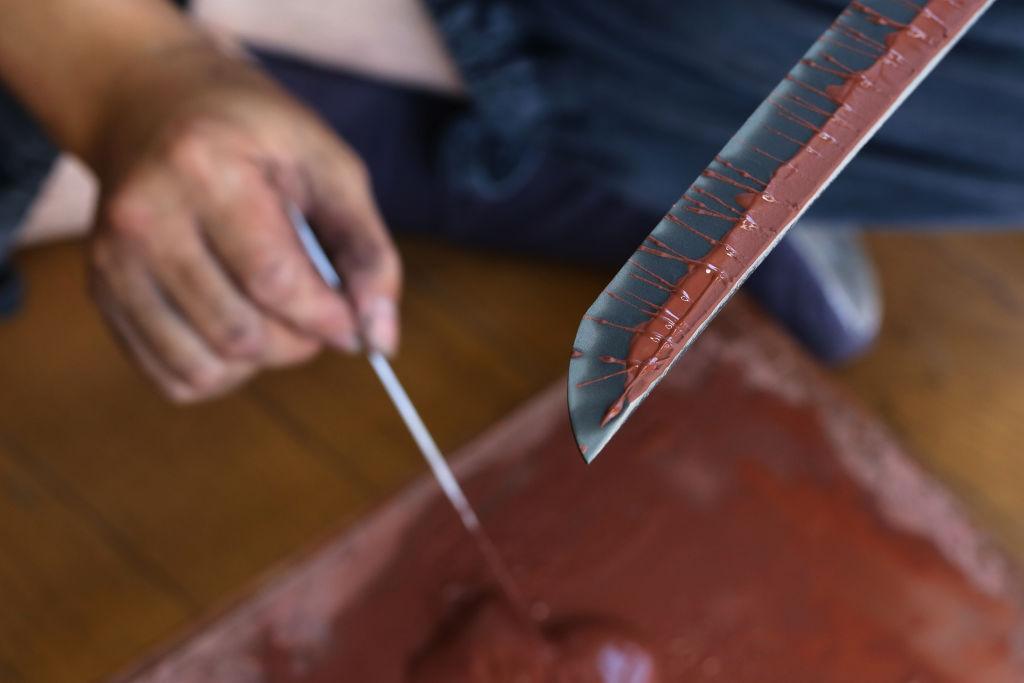
In traditional Japanese sword making, swordsmiths apply clay to specific areas of the blade before heating and quenching. The clay slows down cooling in certain areas, creating different steel structures inside the blade.
This traditional process is often called clay tempering or clay hardening.
Why Do Japanese Swords Use Differential Heat Treatment?
The main reason is balance.
A sword blade must handle several competing requirements:
The edge needs to be hard enough to stay sharp.
The body of the blade needs to absorb impact.
The sword must resist breaking during use.
A blade that is extremely hard everywhere may hold an edge well but can become more brittle.
A blade that is very soft everywhere may be durable but may not maintain a sharp cutting edge.
Differential heat treatment creates a compromise between hardness and toughness.
How Does Clay Tempering Create a Differentially Hardened Katana?
The traditional Japanese clay tempering process involves several important steps.
1. Preparing the Blade
Before heat treatment, the swordsmith forges and shapes the blade.
The blade geometry must already be correct because heat treatment will affect the final performance of the sword.
2. Applying Clay to the Blade
A special clay mixture is applied to different areas of the blade.
Typically:
A thinner clay layer or exposed area is left near the cutting edge.
A thicker clay layer is applied to the spine and body of the blade.
The clay acts as an insulator during quenching.
The thickness and pattern of the clay influence the final hamon pattern.
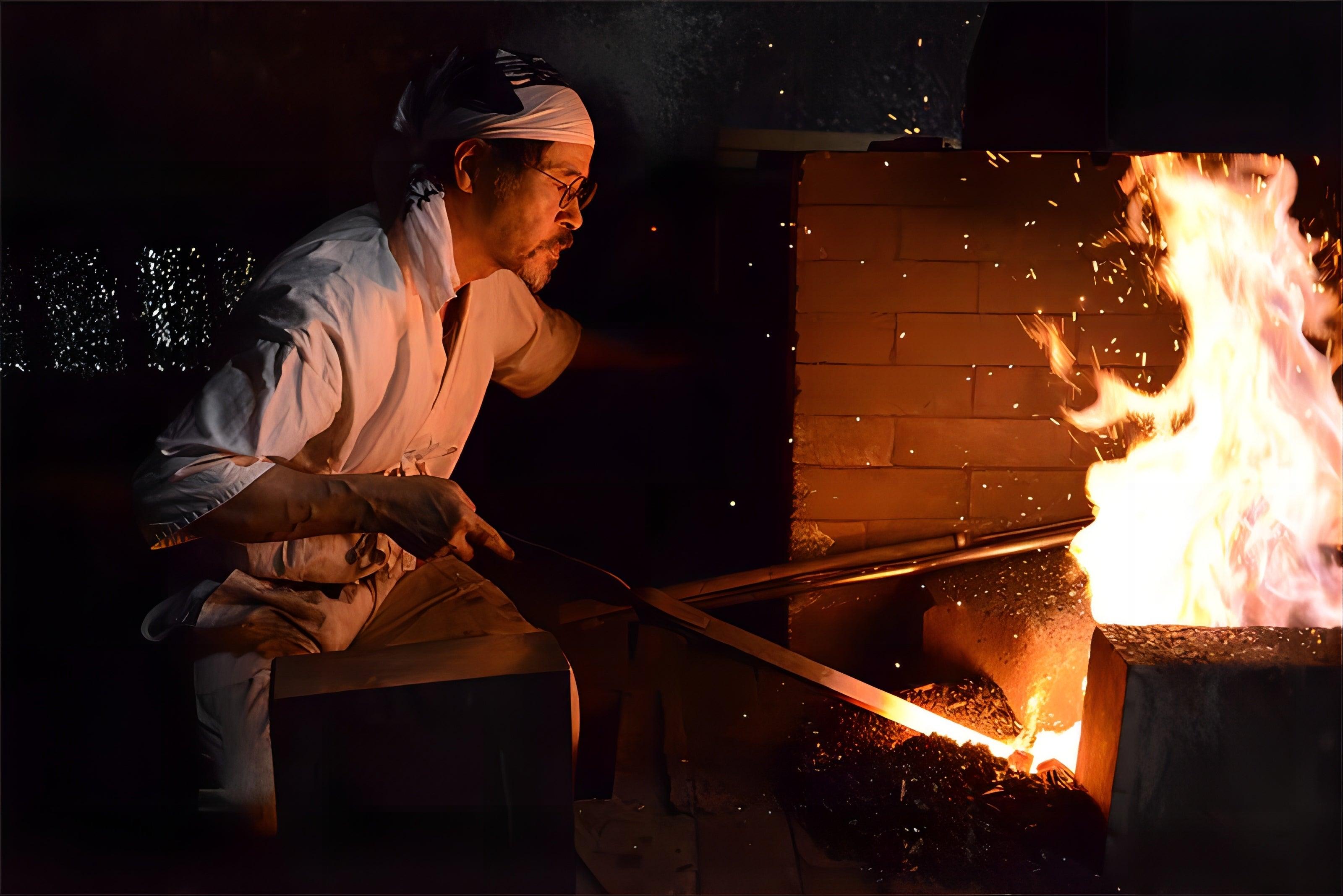
3. Heating the Blade
The clay-coated blade is heated to a temperature where the steel structure changes.
The swordsmith must carefully control:
Heating temperature
Timing
Blade condition
Too much heat can damage the steel structure, while insufficient heat may prevent proper hardening.
4. Quenching the Blade
The heated blade is rapidly cooled in the quenching process known as yaki-ire.

During this stage:
The exposed cutting edge cools faster and becomes harder.
The clay-covered spine cools more slowly and remains tougher.
This creates the different hardness zones that define a traditionally heat-treated Japanese sword.
What Is the Benefit of Differential Heat Treatment?
1. Creates a Hard Cutting Edge
The most important advantage is the creation of a hardened cutting edge.
The edge of a Japanese sword needs to maintain:
Sharpness
Edge retention
Cutting ability
The harder edge helps the blade perform effectively when properly used and maintained.
2. Improves Flexibility and Durability
A completely hardened blade can become too brittle.
By keeping the spine softer, the sword gains additional toughness.
The softer back section helps absorb stress and reduces the risk of catastrophic failure.
This combination of:
Hard edge
Flexible spine
is one of the defining characteristics of traditional Japanese sword construction.
3. Creates the Famous Hamon
One of the most recognizable features of a Japanese sword is the hamon.
The hamon is the visible boundary between the hardened edge and the softer body of the blade.
It is created during the differential hardening process and becomes visible after polishing.
Different clay application methods can create different hamon patterns, including:
Suguha (straight hamon)
Midare (irregular/wavy hamon)
Notare (gentle waves)
Choji (clove-shaped patterns)
The hamon is not simply decoration.
It represents the actual heat treatment history of the blade.
Differential Heat Treatment vs Through Hardening
Many modern blades are produced using through hardening, where the entire blade reaches a similar hardness level.
Both methods have advantages.
Differentially Hardened Katana
Advantages:
✔ Hard cutting edge
✔ Flexible spine
✔ Traditional Japanese craftsmanship
✔ Real hamon appearance
✔ Unique blade character
Considerations:
More difficult to produce
Higher risk during quenching
Requires skilled craftsmanship
Through Hardened Katana
Advantages:
✔ More uniform hardness
✔ Easier production
✔ Good durability for some applications
Considerations:
Usually does not have a traditional hamon
Less historically connected to Japanese sword-making methods
Why Are Clay Tempered Katana More Valuable?
A clay tempered katana requires more skill and carries additional production challenges.
The swordsmith must control:
Clay application
Heating temperature
Quenching speed
Blade distortion
Final polishing
Because the process is more complex, clay tempered swords are often valued by collectors who appreciate traditional craftsmanship.
However, a higher price does not automatically mean a better sword.
The final quality depends on:
Steel quality
Forging skill
Heat treatment accuracy
Blade geometry
Polishing quality
Does Differential Heat Treatment Make a Katana Stronger?
It makes the blade better balanced.
The goal is not simply maximum hardness.
A sword that is too hard may become fragile, while a sword that is too soft may lose cutting performance.
Differential heat treatment allows sword makers to combine:
Hardness where cutting happens
Toughness where impact resistance is needed
This balance is one of the reasons the katana remains one of the most famous sword designs in history.
Why Does Differential Heat Treatment Create a Curved Katana?
Another interesting effect of differential hardening is that it contributes to the characteristic curve of a Japanese sword.
During quenching, the hardened edge and softer spine contract differently.
This difference in contraction can naturally create curvature in the blade.
The final shape is also influenced by forging and later adjustment by the swordsmith.
How Can You Tell If a Katana Has Real Differential Hardening?
A genuine clay tempered katana usually shows characteristics such as:
A natural hamon pattern
Variation under different lighting angles
Visible activity within the hardened area
A clear transition between hardened and softer sections
However, appearance alone is not always enough.
Some decorative swords use artificial methods to imitate a hamon.
When buying a katana, it is important to understand:
Steel type
Heat treatment method
Manufacturer reputation
Construction details
Common Misconceptions About Differential Heat Treatment
Myth 1: Harder steel always means a better sword
Not necessarily.
A sword needs the right balance between hardness and toughness.
Myth 2: The hamon is only decoration
False.
A real hamon is created by the actual heat treatment process.
Myth 3: Every katana must have a hamon
Not every Japanese-style sword has a traditional hamon.
Some modern blades use different heat treatment methods.
Frequently Asked Questions About Differential Heat Treatment
What is differential heat treatment on a Japanese sword?
Differential heat treatment is a process that creates different hardness levels in different parts of a blade, producing a hard edge and tougher spine.
What is clay tempering on a katana?
Clay tempering is a traditional Japanese sword-making technique where clay is applied to parts of the blade before heating and quenching to control hardness differences.
Why does a katana have a hamon?
A katana has a hamon because differential hardening creates a visible boundary between the hardened cutting edge and softer blade body.
Is a clay tempered katana better than a normal katana?
A clay tempered katana offers traditional craftsmanship and a unique hamon, but overall quality depends on steel, forging, geometry, and workmanship.
Does differential hardening make a sword sharper?
It helps create a harder cutting edge, but sharpness also depends on blade geometry and polishing.
Can a katana break if it is too hard?
Yes. Excessive hardness can make steel more brittle. A good sword requires a balance between hardness and toughness.
What is the difference between differential hardening and tempering?
Differential hardening creates different hardness zones by controlling cooling rates. Tempering is a later process used to reduce brittleness and adjust steel properties.
Why are clay tempered katana more expensive?
Because the process requires more skill, careful control, and carries a higher risk of failure during heat treatment.
Final Thoughts
Differential heat treatment is one of the most important innovations in traditional Japanese sword making.
It allows a katana to achieve a unique balance:
A hard cutting edge
A durable blade body
A flexible spine
A beautiful hamon pattern
The process shows that Japanese sword craftsmanship is not about making steel simply harder.
It is about carefully controlling the properties of the blade to create harmony between performance, durability, and beauty.
A handmade clay tempered katana represents centuries of knowledge passed down through generations of sword makers.
Explore HanBon Forge handmade katana collections to discover blades created with traditional-inspired craftsmanship and modern quality standards.