
About polishing the Japanese samurai sword
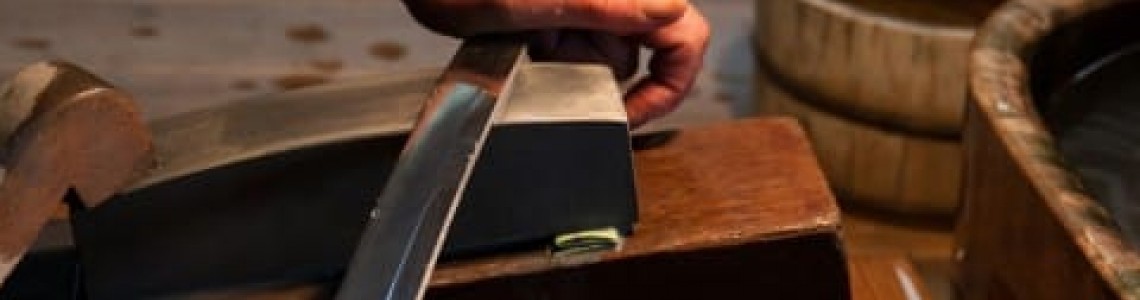
Japanese Sword Polishing: How a Katana Is Polished and Why It Matters
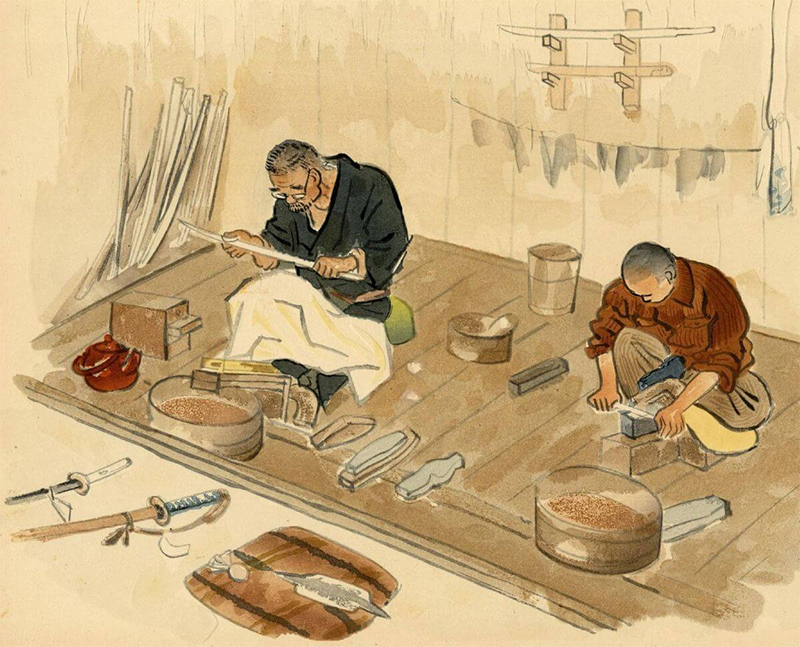
A Japanese sword is not finished when the blade comes out of the forge.
After forging, heat treatment, shaping, and hardening, the blade still needs to be carefully polished. Japanese sword polishing is an important part of the traditional sword-making process because it does much more than make the blade look shiny. A proper polish reveals the hamon, hada, blade geometry, and other details that are difficult or impossible to see on an unfinished blade.
Traditional Japanese sword polishing is performed by a specialist known as a togishi. It requires patience, experience, specialized stones, and a good understanding of Japanese sword construction.
For collectors and sword enthusiasts, understanding how katana polishing works is also important because an incorrect polishing job can permanently damage a blade.
What Is Japanese Sword Polishing?
Japanese sword polishing, known in Japanese as togi (研ぎ), is the traditional process used to refine and finish a Japanese sword blade.
It is sometimes described simply as sharpening, but that description is incomplete.
A professional sword polish has several purposes:
Refine and preserve the geometry of the blade
Remove surface imperfections and oxidation when appropriate
Reveal the hamon or temper pattern
Bring out the hada or grain structure of the steel
Improve the appearance of the blade
Prepare the surface for long-term preservation
Make important characteristics of the blade easier to examine
The goal is not simply to make a katana shine like a mirror.
Different areas of the blade can have different finishes. A skilled togishi works carefully to create the appropriate contrast between the ji, ha, shinogi, and other surfaces of the blade.
This is one reason why traditional Japanese sword polishing is considered a specialized craft rather than ordinary knife sharpening.
Who Polishes a Japanese Sword?
The specialist responsible for polishing a Japanese sword is called a togishi (研師).
A togishi is trained to understand the shape, structure, and characteristics of Japanese sword blades. The work requires considerably more than simply moving a blade across a sharpening stone.
The polisher needs to preserve the original geometry of the blade while gradually refining its surface.
A good togishi also needs to understand how different steels, hardening patterns, and forging structures respond to polishing.
For a traditional Japanese sword, the quality of the polish can have a major effect on how the blade is viewed and appreciated.
A poorly executed polish may hide important details or permanently alter the shape of the blade.
Why Does a Katana Need to Be Polished?
There are several reasons why Japanese sword polishing is so important.
1. It Reveals the Hamon
One of the most recognizable features of a Japanese sword is the hamon, the visible pattern created by the differential hardening of the blade.
Depending on the sword, the hamon may appear as a straight line, a wave, a series of rounded shapes, or a more complex pattern.
A proper polish helps reveal this feature.
The hamon can contain additional details that become visible under the right lighting and polishing technique. Without an appropriate surface finish, these characteristics may be difficult to see.
2. It Reveals the Hada
The hada refers to the visible grain pattern of the steel created during the forging process.
Traditional Japanese swordsmiths used different forging and folding methods, which could produce patterns such as:
Itame
Masame
Mokume
Ayasugi
The appearance of the hada can provide information about the blade's construction and craftsmanship.
A carefully polished Japanese sword allows these details to become much easier to appreciate.
3. It Preserves Blade Geometry
Polishing is not simply about removing material.
The shape of a Japanese sword is extremely important. The shinogi, ridgelines, curvature, thickness, point, and other parts of the blade all contribute to its appearance and structure.
A skilled togishi removes material carefully and consistently.
Too much material removal can change the original geometry of the blade. Once steel has been removed, it cannot simply be put back.
This is why inexperienced polishing can permanently damage a Japanese sword.
How Is a Japanese Sword Polished?
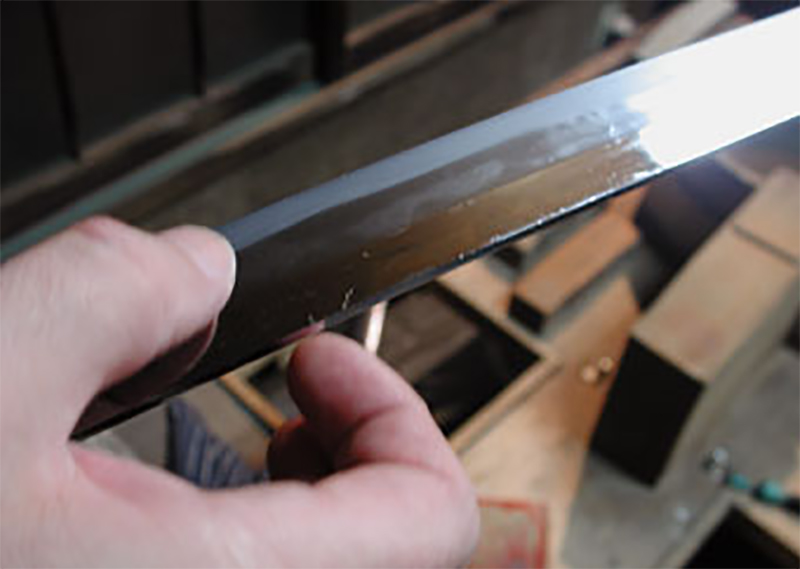
Traditional Japanese sword polishing is performed through a series of stages rather than one simple operation.
The exact process can vary depending on the blade, its condition, the desired finish, and the experience of the polisher.
In general, the work can be divided into two broad stages:
Foundation Polishing
The foundation stage is sometimes referred to as shitaji-togi.
During this stage, the togishi works with progressively finer stones to establish and refine the blade's geometry and surface.
This stage may address:
Surface scratches
Oxidation and rust where appropriate
Uneven surfaces
Blade geometry
Shinogi lines
Point geometry
Existing polishing damage
The polisher must constantly evaluate how much material can safely be removed.
This is particularly important with older blades because a historical Japanese sword may already have been polished several times during its lifetime.
Finishing Polishing
The second major stage is shiage-togi, or finishing polish.
At this stage, the focus moves toward revealing the blade's visual characteristics.
Fine polishing stones and specialized techniques are used to bring out:
Hamon
Hada
Nie and nioi
Hataraki
Surface contrast
The overall appearance of the blade
Techniques such as hazuya, jizuya, and other finishing methods may be used depending on the sword and the desired result.
The final appearance is the result of many carefully controlled polishing steps rather than one aggressive polishing pass.
Does Japanese Sword Polishing Make a Katana Sharp?
Not necessarily in the way people usually think of sharpening.
A katana blade can have a sharp cutting edge, but traditional Japanese sword polishing is much broader than simply sharpening the edge.
The togishi works on the entire blade surface and must preserve the geometry of the sword while revealing its characteristics.
This distinction is important.
A person who knows how to sharpen kitchen knives does not automatically have the skills required for Japanese sword polishing.
Traditional sword polishing is a specialized craft with its own tools, techniques, and standards.
Why Does a Japanese Sword Sometimes Have a Matte Finish?
A common misconception is that a properly polished katana should have a completely mirror-like blade from tip to base.
That is not necessarily the case.
Different sections of a Japanese sword can have different levels of reflectivity.
The finishing technique is selected to create the appropriate contrast and make features such as the hamon and hada easier to see.
Depending on the type of polish, some areas may appear highly reflective while others have a softer or more mist-like appearance.
This contrast is part of what makes a professionally polished Japanese sword visually distinctive.
How Long Does Katana Polishing Take?
Japanese sword polishing is a slow and highly methodical process.
The time required depends on several factors, including:
Blade length
Blade condition
Existing scratches or rust
Previous polishing
Blade geometry
Desired finish
Experience of the togishi
Type of sword
A complete polish can take weeks or considerably longer depending on the circumstances.
The important point is that professional katana polishing is not a quick process.
Trying to rush the work can result in excessive steel removal, uneven geometry, or a poor surface finish.
Can Bad Polishing Damage a Japanese Sword?
Yes.
This is one of the most important things to understand about Japanese sword polishing.
A poor polishing job can permanently alter the blade.
Common problems include:
Removing too much steel
Changing the blade's geometry
Weakening important ridgelines
Scratching the surface
Reducing the visibility of the hamon
Hiding or damaging the hada
Creating an unnatural surface finish
Once steel has been removed from a blade, the damage cannot simply be reversed.
For this reason, antique or historically significant Japanese swords should never be polished with sandpaper, power tools, buffing wheels, or other improvised methods.
If a valuable Japanese sword needs restoration or professional polishing, it should be evaluated by someone with appropriate Japanese sword polishing experience.
Japanese Sword Polishing and Sword Value
The condition of a blade's polish can have a significant influence on how the sword is viewed by collectors.
A well-executed polish can reveal characteristics that were previously difficult to see.
However, polishing is not automatically beneficial simply because the blade becomes brighter.
Over-polishing can remove too much original material and alter the blade's shape.
For an older or collectible Japanese sword, unnecessary polishing can therefore be counterproductive.
The decision to polish should consider the blade's age, condition, construction, historical importance, existing polish, and long-term preservation.
What Is the Difference Between a Professional Polish and a Mirror Polish?
A mirror polish generally aims for a highly reflective surface.
Traditional Japanese sword polishing has a different objective.
The purpose of a traditional polish is not simply to make the entire blade reflective. Instead, the polisher aims to reveal the structure and characteristics of the steel while maintaining the correct geometry and appropriate surface contrast.
For this reason, a traditional Japanese sword may not look like a modern stainless-steel knife or a highly buffed decorative sword.
A professional Japanese sword polish should be judged by how well it reveals and preserves the blade, not simply by how much it reflects light.
How Should You Maintain a Polished Katana?
Once a sword has been professionally polished, proper maintenance becomes important.
The blade should be kept clean, dry, and lightly protected against corrosion.
For a functional sword or modern katana, maintenance requirements can vary depending on the blade material, finish, and storage environment.
General care includes:
Keep the blade away from moisture.
Avoid touching the polished steel with bare fingers.
Do not use abrasive household cleaners.
Do not use sandpaper or metal polish.
Keep the blade properly stored when it is not being handled.
Inspect the blade periodically for signs of moisture or corrosion.
Use an appropriate protective oil when required.
For valuable or antique Japanese swords, avoid experimenting with cleaning products or polishing methods. Professional advice is preferable when the blade has rust, stains, scratches, or other damage.
Can You Polish a Katana Yourself?
For a valuable Japanese sword, the answer is no.
Japanese sword polishing requires specialized knowledge and experience. Even a small mistake can permanently change the blade.
Using sandpaper, a sharpening machine, a polishing wheel, or ordinary metal polish may produce a shiny surface, but it can also destroy the features that make a Japanese sword interesting and valuable.
This is especially important for antique nihonto.
If you own an antique Japanese sword and believe it needs polishing, have the blade assessed before doing anything to the surface.
What Can You See After a Japanese Sword Is Properly Polished?
A professional polish can make many details of a Japanese sword easier to see.
Depending on the blade, you may be able to observe:
Hamon
The hardened edge pattern created during heat treatment.
Hada
The visible grain structure of the forged steel.
Nie and Nioi
Fine structures associated with the hardened portion of the blade.
Hataraki
Additional activities or patterns that can appear within the hamon and surrounding steel.
Sugata
The overall shape, proportions, curvature, and geometry of the blade.
These characteristics are part of what makes Japanese swords different from ordinary modern blades.
Japanese Sword Polishing Is Part of the Craft
Forging a Japanese sword is only one part of creating the finished blade.
The swordsmith establishes the blade's fundamental structure through forging and heat treatment. The togishi then carefully works the surface to reveal what is already present in the steel.
In this sense, polishing does not simply add beauty to the sword.
It allows the characteristics of the blade to be seen.
The hamon, hada, geometry, and surface activities become much easier to appreciate after proper polishing.
That is why the togishi plays such an important role in Japanese sword craftsmanship.
Frequently Asked Questions About Japanese Sword Polishing
What is Japanese sword polishing called?
Traditional Japanese sword polishing is called togi (研ぎ), and the specialist who performs it is known as a togishi (研師).
Is polishing a katana the same as sharpening it?
No. Katana polishing includes much more than sharpening the cutting edge. It involves refining the blade surface, preserving its geometry, and revealing features such as the hamon and hada.
How long does it take to polish a Japanese sword?
The time varies depending on the blade's condition, size, previous polishing, and the desired finish. A complete professional polish can take weeks or longer.
Can I polish my katana with sandpaper?
It is not recommended, particularly for valuable or traditionally made Japanese swords. Sandpaper can change the geometry of the blade and permanently damage the surface.
Why is the hamon difficult to see on some swords?
The hamon may be difficult to see because of the blade's condition, lighting, surface finish, or previous polishing. A properly executed polish can make the hamon much easier to observe.
What is a togishi?
A togishi is a specialist Japanese sword polisher trained to refine the blade and reveal its characteristics through traditional polishing techniques.
Does polishing increase the value of a Japanese sword?
A professional polish can improve the presentation and visibility of a blade's characteristics, but polishing does not automatically increase value. Excessive or incorrect polishing can reduce a sword's condition and historical integrity.
How often should a katana be polished?
There is no simple fixed schedule. A Japanese sword should not be polished unnecessarily because every polishing removes some amount of steel. The condition and type of blade should be evaluated before deciding whether polishing is needed.
What is the difference between hamon and hada?
The hamon is the visible tempering pattern along the hardened edge, while the hada is the grain pattern of the steel created during forging.
Can polishing remove rust from a Japanese sword?
Professional polishing can address certain types of surface rust, but rust should not be aggressively removed at home. Improper cleaning can cause permanent damage to the blade.
Final Thoughts
Japanese sword polishing is one of the most important and misunderstood parts of traditional Japanese sword craftsmanship.
A katana is not simply polished to make it look shiny. A proper polish helps preserve the blade's geometry and reveals details such as the hamon, hada, and other characteristics of the steel.
The work requires patience, specialized tools, and considerable experience. Most importantly, polishing is not easily reversible. Removing too much steel or changing the original geometry can permanently affect the blade.
Whether you are interested in Japanese swords as a collector, martial arts practitioner, or enthusiast, understanding the basics of Japanese sword polishing will help you better appreciate the craftsmanship behind a finished katana.
If you are looking for a handcrafted katana, you can explore HanBon Forge's collection of Japanese swords and custom sword options.
Related Japanese Sword Guides
Japanese Sword Maintenance Guide
What Is a Clay Tempered Katana?
What Is the Hamon on a Japanese Sword?
What Is Hada on a Japanese Sword?
Carbon Steel vs. Damascus Steel Katana
How to Choose a Katana
Katana Blade Types and Steel Options
Japanese Sword Maintenance Guide
What Is a Clay Tempered Katana?
What Is the Hamon on a Japanese Sword?
What Is Hada on a Japanese Sword?
Carbon Steel vs. Damascus Steel Katana
How to Choose a Katana
Katana Blade Types and Steel Options
Tags: Japanese sword polishing, katana polishing, Japanese sword polish, samurai sword polishing, togishi, katana care, Japanese sword maintenance, hamon, hada, Japanese katana, samurai sword, katana guide