

Akane Ume Katana – Hand-Forged T10 Japanese Sword with Genuine Choji Hamon
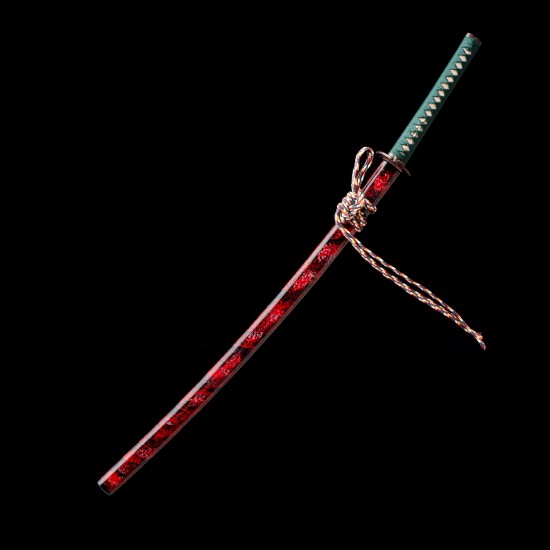
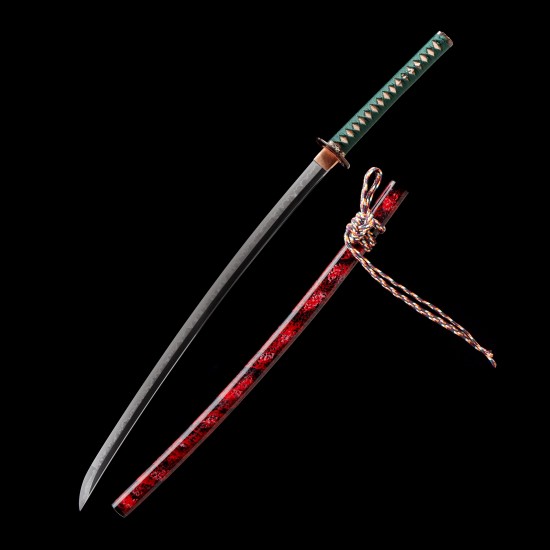
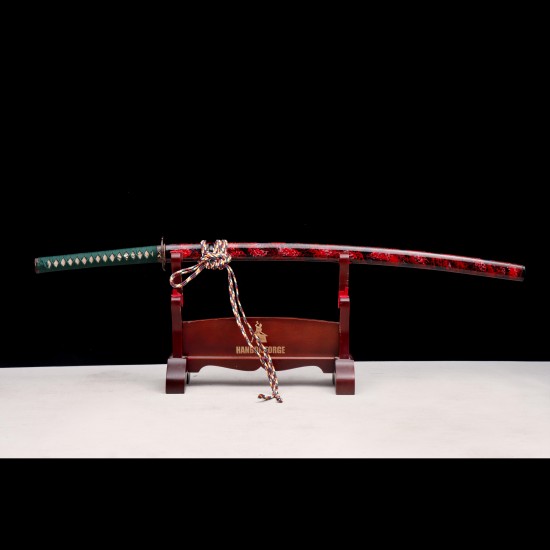
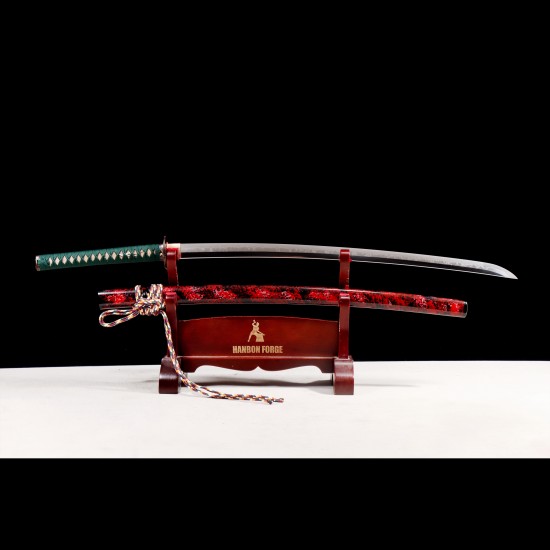
The Akane Ume Katana (茜梅), meaning "Crimson Plum," is an exquisitely detailed, handcrafted Japanese-style sword by HanBon Forge. Inspired by the timeless beauty of Japanese plum blossoms, this distinctive katana combines a hand-forged T10 high-carbon steel blade, genuine clay-tempered Choji hamon, Hazuya polishing, and an O-Kissaki with elaborate plum blossom sword fittings.
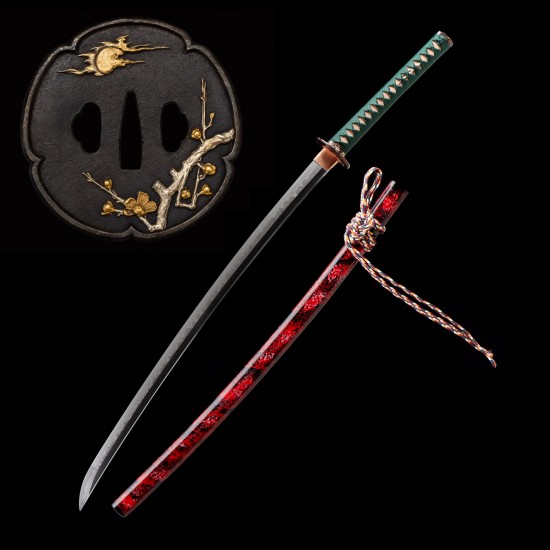
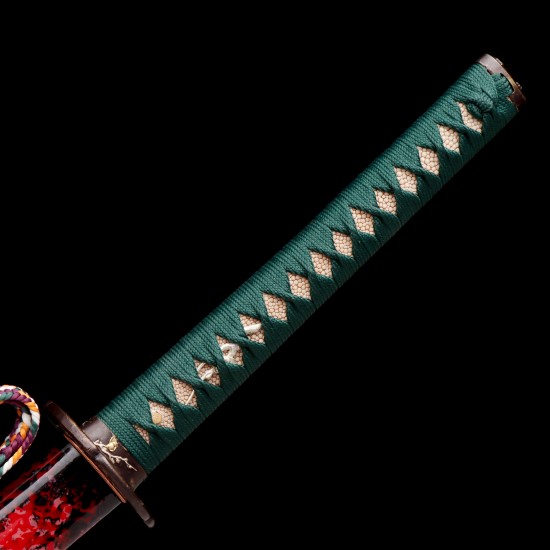
Its deep forest green tsuka wrapping, antiqued metal fittings, and richly patterned red-and-black lacquered saya create a striking contrast between traditional elegance and expressive decorative craftsmanship. The ornate Mokkō-shaped iron tsuba, embellished with gold and silver plum blossom motifs, serves as the visual centerpiece of this distinctive sword.
Designed for collectors, Japanese sword enthusiasts, and experienced practitioners, the Akane Ume combines traditional Japanese-inspired aesthetics with carefully executed modern hand-forged sword construction.
The Meaning Behind Akane Ume (茜梅)
Akane (茜) refers to a rich madder-red hue, while Ume (梅) means Japanese plum or plum blossom. Together, Akane Ume – Crimson Plum evokes the image of delicate plum blossoms against a vivid red landscape.
In Japanese artistic traditions, plum blossoms are often associated with perseverance, renewal, and the arrival of spring, as they can bloom in the colder months.
The name reflects the sword's red-and-black lacquered saya, floral metalwork, and the contrast of its dark green handle wrapping.
Akane Ume is a contemporary HanBon Forge product name inspired by Japanese aesthetics, not a claim of historical provenance or antique origin.
Key Features of the Akane Ume Katana
T10 Steel Blade – Hand Forging and Differential Hardening
At the heart of the Akane Ume Katana is a hand-forged blade crafted from T10 high-carbon tool steel, a material commonly used for modern Japanese-style swords.
T10 steel is valued for its ability to develop a hardened cutting edge when appropriately heat treated. Blade geometry, forging practices, heat treatment, and finishing all contribute to the finished sword's characteristics.
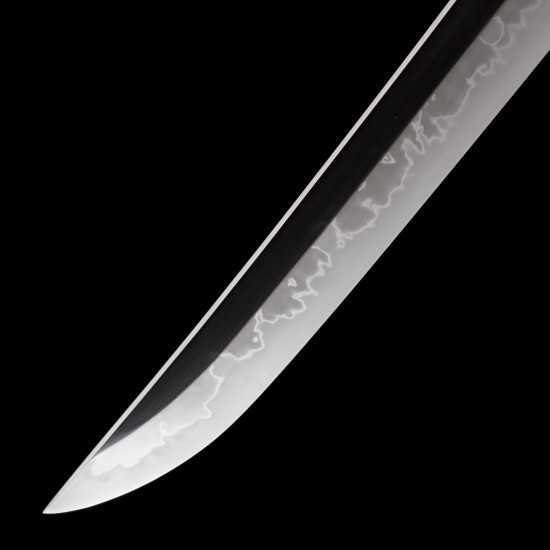
The Akane Ume blade is shaped in the traditional shinogi-zukuri form, differentially hardened, oil quenched, and polished to reveal its genuine Choji hamon.
Traditional-Inspired Clay Hardening
The Akane Ume uses differential clay hardening, a method inspired by traditional Japanese swordmaking.
During production, clay is applied to selected areas of the blade before quenching. Differences in cooling behavior produce distinct microstructural regions within the steel.
The resulting boundary between the hardened edge region and the surrounding blade material creates the natural hamon.
Unlike a decorative pattern applied solely by etching, this genuine temper line is associated with the actual heat-treatment process.
Craftsmanship Note: Each blade is individually forged and heat treated. Subtle variations in hamon pattern, polish, and overall appearance are normal. A genuine hamon does not, by itself, guarantee a particular hardness or cutting-performance rating.
Genuine Choji Hamon – The Distinctive Clove-Shaped Temper Pattern
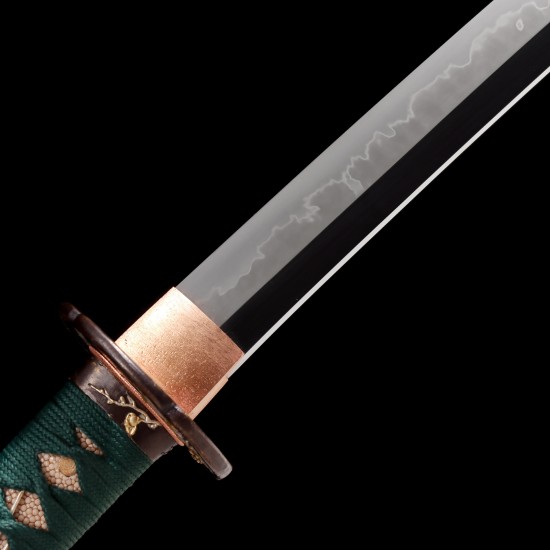
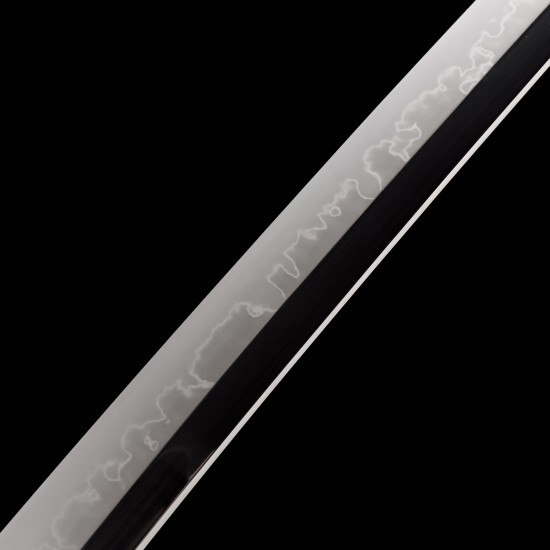
One of the most important features of the Akane Ume is its genuine Choji hamon.
Choji, meaning "clove," describes a hamon pattern characterized by rounded, irregular formations that can resemble clove buds.
Compared with relatively straight suguha patterns, Choji creates a more complex and expressive visual rhythm along the cutting edge.
The hamon on this sword is produced by differential clay hardening rather than a purely cosmetic surface treatment.
The naturally formed pattern complements the ornamental plum blossoms featured on the sword fittings, bringing together metallurgy and visual design.
Hazuya Polishing
The Akane Ume features Hazuya polishing, a finishing technique associated with traditional Japanese sword-polishing methods.
Hazuya work helps refine the appearance of the hardened blade surface, enhancing the visual contrast and complexity of the Choji hamon.
Under changing lighting, the polished blade may reveal subtle variations in the visibility and texture of the temper line.
Shinogi-Zukuri Geometry with O-Kissaki
The blade follows the traditional shinogi-zukuri profile, with a raised shinogi ridge separating the different planes of the blade.
This design gives the katana its recognizable ridged cross-section and traditional silhouette.
Extended O-Kissaki
The Akane Ume features an O-Kissaki, a longer-than-standard Japanese-style sword tip.
This extended tip gives the blade a distinctive profile and visually emphasizes its curvature and proportions.
A clearly defined yokote separates the blade body from the kissaki, creating a geometric transition rather than a merely decorative polishing line.
Clean Blade Profile Without Bo-Hi
The blade is manufactured without bo-hi, allowing the continuous blade surfaces, ridgeline, and Choji hamon to remain visually prominent.
The absence of a groove affects the blade's mass distribution compared with an otherwise similar grooved design, while overall balance depends on the complete mounting.
Antique Plum Blossom Tsuba – The Artistic Centerpiece
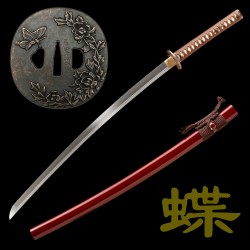
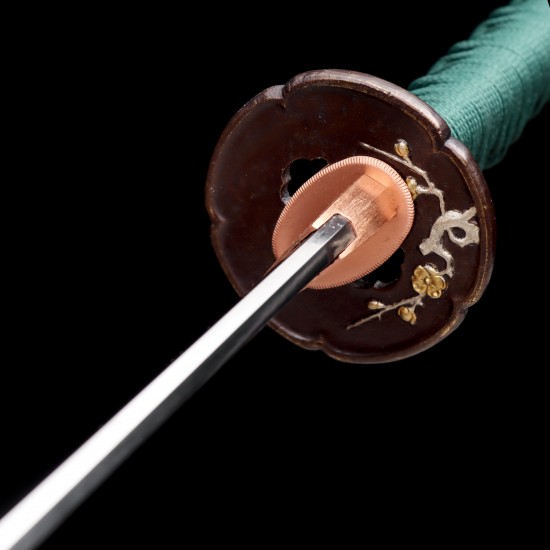
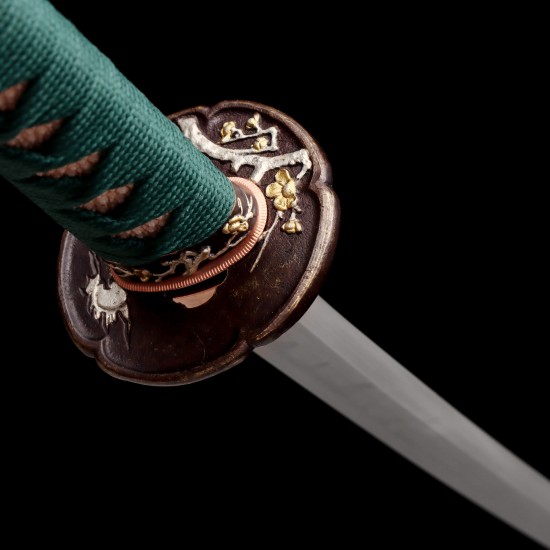
The most visually distinctive fitting on the Akane Ume is its antique dark iron Mokkō-shaped tsuba.
The guard features a carefully arranged plum blossom branch motif with contrasting gold and silver accents.
Its lobed Mokkō outline creates an elegant profile, while the detailed floral design offers a strong contrast against the dark iron background.
The combination of aged metal tones and decorative plum blossoms creates a traditional Japanese-inspired appearance without relying on an overly bright or modern-looking finish.
The Symbolism of Plum Blossoms
Known as Ume (梅) in Japanese, plum blossoms appear frequently in Japanese painting, textiles, decorative metalwork, and other arts.
Their association with late winter and early spring makes them a symbol of resilience and renewal.
For the Akane Ume, this floral motif connects the tsuba, the sword's name, and its distinctive red-and-black saya into a cohesive design.
Matching Fuchi, Kashira and Menuki
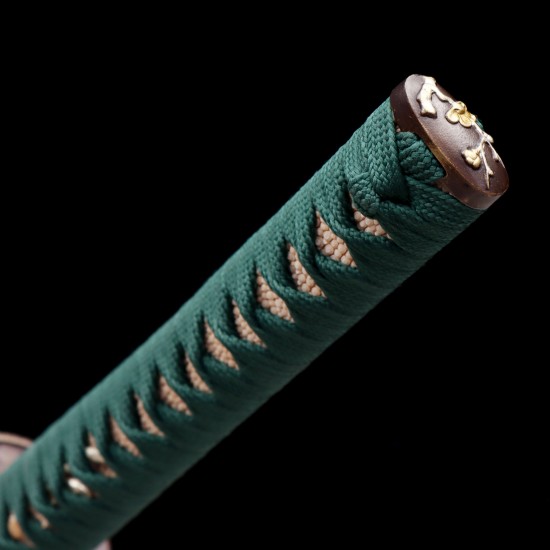
The fuchi and kashira feature an antiqued dark brass finish with engraved plum branch decoration.
Silver-toned ornamental menuki are positioned beneath the forest green handle wrapping, adding subtle metallic highlights to the tsuka.
The coordinated fittings provide visual continuity from the hand guard through the handle.
Forest Green Tsuka and Genuine Rayskin
The Akane Ume features a 27 cm hardwood tsuka covered with antiqued genuine samegawa (rayskin).
Its forest green wrapping provides a refined, restrained contrast to the expressive red-and-black saya.
Traditional Hineri-Maki Wrapping
The handle uses a hineri-maki wrapping pattern, with alternating diamond-shaped openings that reveal the antiqued rayskin below.
The texture of the green wrapping and darker samegawa creates a distinctive appearance suited to the overall plum blossom theme.
Full Tang and Two Bamboo Mekugi
The sword's full-length nakago extends into the hardwood handle core and is secured by two bamboo mekugi.
Copper habaki and seppa complete the blade-to-guard fitting assembly.
Proper assembly and component fit are important aspects of the construction of a functional modern Japanese-style sword.
Wakasa-Style Red and Black Lacquer Saya
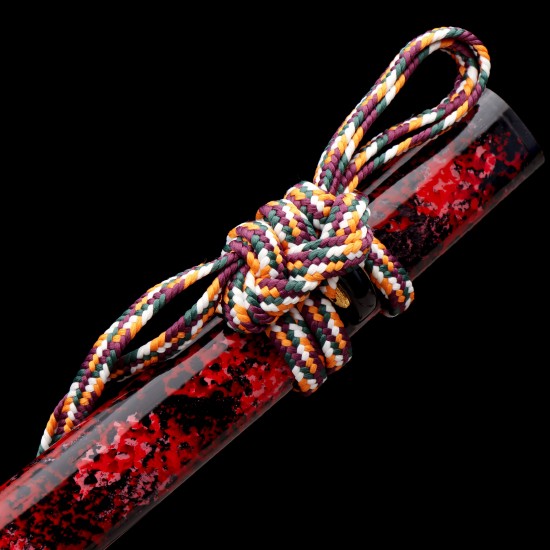
The Akane Ume's red-and-black lacquered wooden saya is among its most recognizable features.
The high-gloss finish has a mottled, marbled appearance inspired by Wakasa-style decorative lacquerwork.
Irregular black markings flow across the rich red background, creating a distinctive visual texture that pairs with the dark metal fittings and green tsuka.
The design is described as Wakasa-style inspired; it should not be interpreted as a claim that the scabbard is an antique or was made using certified traditional Wakasa lacquerware methods.
Horn Reinforcements
The wooden saya is fitted with horn components at the koiguchi, kojiri, and kurikata.
These details contribute to the traditional-style construction and finished appearance of the saya.
Multicolored Braided Sageo
A decorative multicolored sageo adds a final visual accent.
Its woven colors and traditional-style knot contrast with the red-and-black lacquer while complementing the handmade character of the complete mounting.
Akane Ume Katana – Full Specifications
| Specification | Details |
|---|---|
| Product Name | Akane Ume Katana (Crimson Plum) |
| Brand | HanBon Forge |
| Model | HBF1086 |
| Sword Type | Japanese-Style Katana |
| Blade Steel | T10 High-Carbon Steel |
| Production | Hand Forged, Hand Polished, Hand Assembled |
| Heat Treatment | Differential Clay Hardening |
| Quenching | Oil Quenched |
| Hamon | Genuine Choji Hamon |
| Blade Polish | Hazuya Polishing |
| Blade Geometry | Shinogi-Zukuri |
| Kissaki | O-Kissaki |
| Yokote | Defined Yokote |
| Bo-Hi | Without Bo-Hi |
| Cutting Edge | Very Sharp; Unsharpened Option Available |
| Tang | Full Tang |
| Tsuka Core | Hardwood |
| Samegawa | Antiqued Genuine Rayskin |
| Tsuka-Ito | Premium Forest Green Wrapping |
| Tsuka-Maki | Hineri-Maki |
| Mekugi | Two Bamboo Pegs |
| Tsuba | Antique Dark Iron Mokkō Shape, Plum Blossom Motif with Gold and Silver Accents |
| Fuchi / Kashira | Antique Dark Brass with Plum Branch Decoration |
| Menuki | Silver-Toned Ornamental Accents |
| Habaki | Copper |
| Seppa | Copper |
| Saya | High-Gloss Red and Black Wakasa-Style Lacquer Finish |
| Saya Fittings | Horn Koiguchi, Kojiri and Kurikata |
| Sageo | Multicolored Braided Cord |
| Standard Mei | Without Mei |
| Country of Origin | China |
Dimensions, Weight and Balance
The following specifications describe the standard Akane Ume Katana. Measurements are approximate and may vary slightly between individually handcrafted swords.
| Measurement | Approximate Value |
|---|---|
| Blade Length (Nagasa) | 70.5 cm / 27.76 in |
| Handle Length (Tsuka) | 27 cm / 10.63 in |
| Overall Length Without Saya | 100 cm / 39.37 in |
| Saya Length | 76 cm / 29.92 in |
| Motohaba (Width at Base) | 3.2 cm / 1.26 in |
| Sakihaba (Width Near Tip) | 2.4 cm / 0.94 in |
| Motokasane (Thickness at Base) | 7.5 mm / 0.30 in |
| Sakikasane (Thickness at Yokote) | 4.8 mm / 0.19 in |
| Blade Curvature (Sori) | 2 cm / 0.79 in |
| Point of Balance | 14.7 cm / 5.79 in |
| Weight Without Saya | 1.06 kg / 2.34 lb |
| Weight With Saya | 1.26 kg / 2.78 lb |
Dimensions and weight are approximate. Handmade production and approved custom changes may result in minor variations.
Handling Characteristics and Intended Use
The Akane Ume combines a 70.5 cm blade with a 27 cm tsuka, creating proportions associated with a traditional Japanese-style two-handed katana.
Its blade geometry, 2 cm curvature, and approximately 1.06 kg unsheathed weight contribute to the physical characteristics of the complete sword.
The point of balance is approximately 14.7 cm from the measurement reference used for the standard configuration.
Actual handling characteristics depend on the user's experience, grip, technique, and the finished mounting.
The Akane Ume is suited to private collections, Japanese sword appreciation, display, and appropriate supervised sword practice.
Any cutting activity should be undertaken only by trained adults in suitable controlled conditions and with appropriate targets.
Safety Information: A sharp katana requires careful handling. Full tang construction and differential hardening do not make the blade indestructible. Inspect fittings and the handle assembly before any supervised practice. Avoid hard targets and uncontrolled use.
Customization Options
HanBon Forge offers personalization options for customers who want to create a more individual version of the Akane Ume Katana.
Depending on production feasibility, available changes may include:
- Blade engraving: Personal names, text, symbols, or artwork.
- Tang inscription: A custom mei may be added upon request.
- Handle wrapping: Alternative tsuka-ito colors or materials.
- Sword fittings: Selected alternative tsuba and mounting options.
- Saya customization: Different compatible colors or finishes.
- Blade edge: An unsharpened version may be requested.
Explore our Japanese Sword Fittings Collection for additional customization options and available components.
For a more extensive custom project, visit our Custom Katana Builder .
Engraving and changes to the standard configuration may involve additional charges or production time. Please contact HanBon Forge to confirm compatibility and pricing before ordering.
HanBon Forge Craftsmanship and Quality Control
HanBon Forge is based in Longquan, a region with a longstanding swordmaking tradition.
Our workshop specializes in handcrafted Japanese-style swords, combining hand forging, blade shaping, heat treatment, polishing, fittings, and final assembly.
The Akane Ume reflects this approach through its individually produced T10 blade, genuine hamon, detailed floral koshirae, and coordinated lacquered saya.
Pre-Shipment Inspection
Before shipment, completed swords undergo workshop inspection that includes relevant checks of:
- Blade appearance and polish.
- Handle and fittings assembly.
- Tsuba, fuchi, kashira and menuki placement.
- Saya fit and seating.
- Requested finishing and customization details.
HanBon Forge provides photographs of the completed sword for customer confirmation before shipment.
This allows buyers to review visible craftsmanship details and the completed configuration before the sword is dispatched.
What's Included with Your Akane Ume Katana?
- 1 × Akane Ume Hand-Forged T10 Katana with Lacquered Wooden Saya
- 1 × Complimentary Sword Bag
- 1 × Sword Certificate
Accessory appearance may vary. The supplied sword certificate is not an independent antique authentication or third-party appraisal.
Frequently Asked Questions
What does Akane Ume mean?
Akane Ume (茜梅) is a Japanese-inspired name meaning "Crimson Plum." It combines the image of red coloring with the traditional symbolism of Japanese plum blossoms, reflecting the red-and-black saya and floral sword fittings.
Is the Choji hamon genuine?
Yes. The Akane Ume features a genuine Choji hamon produced through differential clay hardening and oil quenching. It is not simply a decorative etched imitation.
What steel is used for the blade?
The blade is hand forged from T10 high-carbon steel and features differential clay hardening followed by Hazuya polishing.
What is the difference between Choji and Notare hamon?
Choji hamon is characterized by rounded, clove-like formations. Notare generally features broader, flowing waves. Both can be produced through differential hardening, but they have different visual patterns.
Does this katana have an O-Kissaki?
Yes. The Akane Ume features an extended O-Kissaki tip and a defined yokote within its traditional shinogi-zukuri blade geometry.
Does the blade have a bo-hi?
No. The standard Akane Ume blade is made without a bo-hi, providing uninterrupted blade surfaces.
Is the Akane Ume a full tang katana?
Yes. The blade has a full tang (nakago) fitted into a hardwood handle core, secured with two bamboo mekugi.
What material is the plum blossom tsuba?
The tsuba is made from antique-finished dark iron in a Mokkō-shaped design, decorated with a plum blossom branch and contrasting gold and silver accents.
Is the rayskin genuine?
Yes. The handle features genuine antiqued samegawa beneath forest green hineri-maki wrapping.
Is the red and black saya made using Wakasa lacquer techniques?
The saya features a high-gloss red-and-black finish inspired by Wakasa-style marbled lacquer aesthetics. It is described as Wakasa-style inspired, not as certified traditional Wakasa lacquerware.
Are the saya fittings made from real horn?
The standard product specification includes horn fittings at the koiguchi, kojiri, and kurikata.
Is the Akane Ume Katana sharp?
The standard specification lists a very sharp cutting edge. An unsharpened configuration may also be requested when ordering.
Can I customize the sword?
Yes. Depending on availability and compatibility, HanBon Forge can offer alternative fittings, handle wrapping, saya options, and personalized engraving. Additional charges may apply.
Does HanBon Forge provide photos before shipping?
Yes. Photographs of the completed sword are provided for customer confirmation before shipment.
Will every Akane Ume Katana look exactly the same?
As each blade is individually crafted, minor variations in the hamon, polish, dimensions, and finishing details can occur naturally.
Akane Ume – The Beauty of the Crimson Plum
The Akane Ume Katana brings together the delicate symbolism of Japanese plum blossoms and the expressive character of a genuine Choji hamon.
Its hand-forged T10 steel blade, extended O-Kissaki, Hazuya polishing, antique Mokkō-shaped iron tsuba, and elaborate red-and-black lacquered saya create a distinctive sword with strong visual identity.
From the gold and silver floral details to the forest green tsuka and multicolored sageo, each element contributes to the sword's elegant overall composition.
The Akane Ume offers collectors and enthusiasts a distinctive combination of Japanese-inspired design, traditional-style construction, and modern handcrafted swordmaking.
Akane Ume Katana (茜梅) – Crimson Plum
Model HBF1086 | Handcrafted by HanBon Forge
Explore more handcrafted Japanese swords or contact HanBon Forge for customization information.