
How to Choose a Katana Blade: Steel, Geometry, Hamon & Expert Buying Guide
Choosing the right katana blade is about much more than appearance. The steel, heat treatment, blade geometry, length, and construction all influence how a Japanese sword looks, feels, and performs.
Whether you are purchasing your first handmade katana, selecting a sword for martial arts training, or designing a custom piece for your collection, understanding these features will help you make a more informed decision.
At HanBon Forge, our Longquan-based sword-making team works with different blade steels, forging techniques, heat treatments, and custom configurations. This guide draws on our practical experience manufacturing and assembling Japanese-style swords.
For most beginners, a properly heat-treated 1060 carbon steel katana with shinogi-zukuri geometry is a practical starting point. A 9260 spring steel blade is another option for buyers prioritizing toughness. For collectors interested in a natural hamon, a clay-tempered 1095 or T10 blade is worth considering.
However, no steel or blade design is automatically superior. Heat treatment quality, blade geometry, correct assembly, and intended use matter more than a steel name alone.
1. Choose a Katana Blade Based on Its Purpose
Before comparing steel types, decide what you want your sword to do. A collector, an iaido practitioner, and a cutting enthusiast may need very different blade characteristics.
For Display and Collection
If appearance is your primary concern, consider a well-polished blade, a natural hamon, folded steel patterns, or traditional blade shapes.
Clay-tempered T10 or 1095 steel can be appealing for collectors interested in visible temper lines and Japanese sword aesthetics.
For Iaido and Martial Arts Training
For iaido and other forms of controlled sword handling, the weight, balance, blade length, and suitability of the sword for your school are particularly important.
Many practitioners use unsharpened training swords known as iaito. A sharp sword should not be substituted for a training sword without the instructor's approval.
For Cutting Practice (Tameshigiri)
A sword intended for supervised cutting practice requires appropriate blade geometry, reliable heat treatment, secure construction, and a suitable edge profile.
1060, 9260, 1095, and T10 can all be used in functional swords when the blade is correctly designed and manufactured.
2. Compare Katana Blade Steel Types
Steel is one of the most discussed aspects of Japanese sword selection. However, there is no universally best katana steel.
Different steels offer different potential characteristics, and their real-world performance depends heavily on forging, heat treatment, blade geometry, and quality control.
| Steel Type | Key Characteristics | Common Applications |
|---|---|---|
| 1060 Carbon Steel | Medium-carbon steel with a practical balance of toughness and potential edge hardness. | Beginner swords, general-purpose katana, controlled cutting practice. |
| 1095 Carbon Steel | Higher carbon content allows high edge hardness, but proper heat treatment is essential. | Clay-tempered blades, traditional-style collectors' swords, cutting swords. |
| T10 Tool Steel | High-carbon tool steel commonly used for blades with visible hamon. | Clay-tempered katana, custom swords, collectors. |
| 9260 Spring Steel | Silicon-alloy spring steel known for its potential toughness and elastic behavior when correctly treated. | Durability-focused functional swords. |
| Folded Steel | Patterned layers produced through repeated folding and forging; properties depend on the underlying steel. | Traditional-inspired aesthetics and patterned blades. |
| Kobuse Construction | Composite construction combining different steel layers or sections. | Specialized custom swords and traditional-inspired craftsmanship. |
1060 Carbon Steel: A Practical Starting Point
1060 steel contains approximately 0.60% carbon, although actual composition varies by specification and production batch.
It is frequently selected for functional Japanese-style swords because it can provide a useful balance of hardness and toughness.
For customers who want an affordable, versatile sword without a strong preference for a natural hamon, 1060 steel is worth considering.
1095 Carbon Steel: High-Carbon Performance
1095 steel has a higher nominal carbon content than 1060 steel. With appropriate heat treatment, it can achieve high cutting-edge hardness.
However, hardness is not the same as toughness. Excessive hardness or unsuitable edge geometry can increase the risk of chipping under inappropriate cutting conditions.
At HanBon Forge, 1095 steel is available in different blade configurations, including clay-tempered options.
T10 Tool Steel: A Popular Clay-Tempered Choice
T10 is a high-carbon tool steel frequently used in modern handmade Japanese-style swords.
It is especially popular with buyers who want a natural hamon created through differential hardening.
T10 is not automatically better than 1095. The actual quality of the heat treatment, blade geometry, and finishing processes is more important than the steel designation alone.
9260 Spring Steel: A Toughness-Focused Option
9260 steel contains silicon as an important alloying element and is commonly associated with spring applications.
When properly heat-treated, 9260 can offer good toughness and resilience, making it an option for customers who prioritize practical durability.
However, spring steel should not be described as unbreakable or permanently bend-resistant. Every sword has mechanical limits.
Folded Steel and Damascus-Style Patterns
Folded steel describes a forging process rather than a specific steel grade.
Repeated folding and forging can create visible surface patterns. Modern folded blades are often chosen for their visual character and traditional-inspired appearance.
Because modern homogeneous steels are already manufactured with controlled composition, folding does not automatically make a sword stronger than a properly made monosteel blade.
Kobuse: Composite Blade Construction
Kobuse is a Japanese composite construction method that uses a core and an outer layer or jacket of steel.
HanBon Forge offers kobuse-style custom blades using a 1095 steel core and folded steel outer construction.
The purpose is to combine distinct materials and traditional-inspired craftsmanship. Actual performance still depends on material selection, forge welding, heat treatment, and geometry.
3. Clay Tempering vs. Through Hardening
Heat treatment has a major influence on katana performance. Two common approaches are differential hardening and through hardening.
Clay-Tempered (Differentially Hardened) Katana
In traditional-inspired differential hardening, an insulating clay mixture is applied selectively before quenching.
When the process succeeds, different regions of the blade cool and transform differently, typically producing a harder martensitic edge and a comparatively softer body or spine.
The transition between these hardened regions can become visible as a natural hamon after appropriate polishing.
Key characteristics include:
- A genuine metallurgical hamon.
- Distinct hardness characteristics between blade regions.
- Traditional Japanese-style visual appeal.
- Potential for high edge hardness.
Because the hard edge can be vulnerable to chipping or damage under excessive loading, a clay-tempered blade should not be assumed to tolerate poor cutting alignment or hard targets.
Through-Hardened Katana
A through-hardened blade is heat-treated to produce a more consistent hardening response across its cross-section, although hardness may still vary.
Many through-hardened swords are tempered to balance edge hardness and toughness rather than maximize hardness alone.
This approach is commonly used for practical Japanese-style swords, particularly where toughness and predictable performance are important.
| Feature | Clay-Tempered Blade | Through-Hardened Blade |
|---|---|---|
| Hardness distribution | Different hardness between edge and body | More consistent hardness profile |
| Natural hamon | Typically present | Generally absent |
| Appearance | Traditional temper-line aesthetics | Clean, uniform appearance |
| Maintenance | Requires normal carbon-steel care | Requires normal carbon-steel care |
| Recommended for | Collectors and users specifically seeking a natural hamon | Buyers seeking a practical and often more affordable configuration |
4. Understanding Katana Blade Geometry
The shape and cross-section of a blade influence weight distribution, cutting characteristics, structural behavior, and appearance.
Shinogi-Zukuri
Shinogi-zukuri is one of the most recognizable Japanese sword blade constructions. It features a distinct shinogi ridge separating the main blade surfaces.
It is a versatile choice for traditional-style katana and is generally our recommended starting point for customers uncertain about blade geometry.
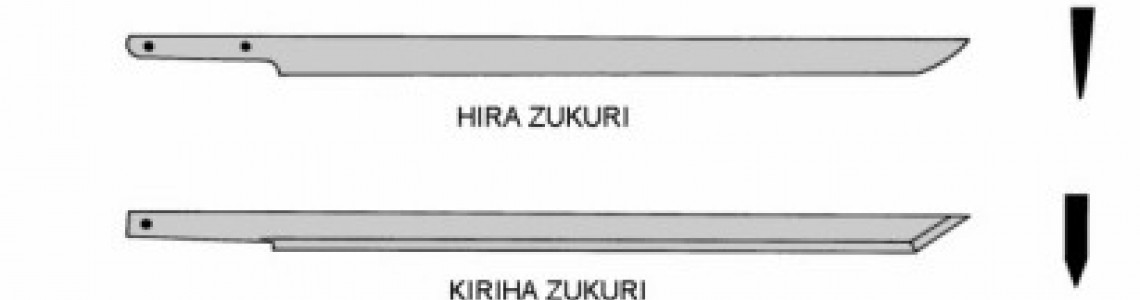
Hira-Zukuri
Hira-zukuri lacks the prominent shinogi ridge found on shinogi-zukuri blades.
This geometry is commonly associated with tanto and some shorter Japanese swords, although longer examples also exist.
Shobu-Zukuri
Shobu-zukuri has a flowing profile near the point without a sharply defined yokote separating the main blade from the kissaki.
It is popular with customers who prefer a continuous, leaf-like tip profile.
Unokubi-Zukuri
Unokubi-zukuri incorporates a distinctive reduced spine section, creating an unusual and recognizable blade profile.
It is often chosen for custom Japanese-style swords where visual character and blade weight distribution are important.
Other Custom Blade Shapes
HanBon Forge also offers selected configurations such as kiriha-zukuri, o-kissaki, and other custom-inspired forms, depending on blade length, steel, and manufacturing feasibility.
For a deeper explanation, see our Japanese Sword Blade Shape Guide.
5. Bo-Hi vs. No Bo-Hi: Which Should You Choose?
A bo-hi is a groove formed along the blade. It changes the blade's mass distribution and appearance.
Katana With Bo-Hi
Adding a bo-hi removes material from the blade. Depending on its dimensions and placement, this can reduce overall mass and change rotational handling characteristics.
Possible benefits include:
- Reduced blade weight compared with an otherwise similar solid blade.
- A different balance and handling feel.
- Distinctive traditional-inspired appearance.
- An audible sound, often called tachikaze, during suitable controlled swings.
The presence or volume of tachikaze is not a reliable stand-alone measure of cutting technique or sword quality.
Katana Without Bo-Hi
A blade without a groove retains more material when the other dimensions remain the same.
Some practitioners prefer this additional mass, while others find a grooved blade more comfortable.
| Feature | With Bo-Hi | Without Bo-Hi |
|---|---|---|
| Blade mass | Usually lower | Usually higher |
| Handling | May feel more agile | May feel more substantial |
| Appearance | Visible groove | Uninterrupted blade surface |
| Tachikaze | Often more noticeable | May be less noticeable |
| Best choice | Weight-conscious buyers | Buyers preferring more blade mass |
Neither design is universally superior. Actual stiffness and durability depend on the complete blade geometry, not simply the presence or absence of a groove.
6. Blade Length, Weight, and Balance
Blade length influences reach, weight, handling, and compatibility with a particular training style.
Common HanBon Forge custom sword configurations include:
| Sword Type | Typical Blade Length | Typical Handle Length |
|---|---|---|
| Katana | 28 inches | 11 inches |
| Ko-Katana | 24 inches | 6 inches |
| Wakizashi | 20 inches | Varies by configuration |
| Custom Long Katana | 30–31 inches or other approved dimensions | Custom |
These are common modern configurations, not universal historical standards. Measurements may vary between manufacturers and individual swords.
When choosing length, consider your height, arm length, intended practice, experience, and instructor's requirements.
Also consider balance. Two swords of the same length can feel substantially different due to blade thickness, distal taper, fittings, and weight distribution.
For additional advice, read our Sword Size Selection Guide.
7. Hamon Styles and Blade Polishing
A hamon is the visible boundary associated with the hardened structure of a differentially hardened Japanese sword blade.
Its appearance varies according to the steel, heating, clay application, quenching conditions, and polishing technique.
Common Hamon Styles
- Suguha: A comparatively straight temper-line pattern.
- Notare: A gently flowing, wave-like pattern.
- Gunome: A repeated rounded or wave-like pattern.
- Choji: A distinctive pattern resembling clove shapes.
The visual appearance of a hamon does not, by itself, establish the hardness, durability, or quality of the finished sword.
Mirror Polish vs. Hazuya Polish
A mirror polish emphasizes a reflective surface, while hazuya-style finishing is used to enhance the visibility and contrast of selected metallurgical features on suitable differentially hardened blades.
HanBon Forge offers hazuya polishing on eligible clay-tempered blades. Actual results depend on the blade's structure and finish.
A more elaborate polish can improve the appearance of the blade, but polishing alone does not change an incorrectly heat-treated blade into a properly hardened one.
8. Sharpness, Niku, and Cutting Geometry
Many first-time buyers focus heavily on whether a katana is sharp. However, edge geometry is just as important as sharpness.
What Is Niku?
Niku refers to the fullness or convexity of the blade's cutting geometry, particularly in the region behind the cutting edge.
A blade with more niku retains additional material behind the edge, which may help support the cutting edge under suitable conditions.
A thinner edge geometry can sometimes cut certain soft materials with less resistance, but it may be less tolerant of inappropriate impacts.
Choosing the Right Edge
- Unsharpened: For appropriate non-cutting applications, subject to instructor or school requirements.
- Very Sharp: A fine cutting edge intended for suitable light cutting targets.
- Sharp With Niku: A fuller cutting profile for customers seeking additional edge support.
No edge design makes a sword safe for cutting hard objects or compensates for poor technique.
9. Tang Construction and Sword Safety
Even a well-made blade cannot perform reliably if it is poorly fitted to the handle.
The nakago, or tang, is the portion of the blade that extends into the handle. A functional Japanese-style sword should have a tang appropriate to its intended use and a properly fitted tsuka assembly.
Important construction details include:
- A correctly formed nakago.
- Secure mekugi retention.
- A well-fitted handle and hilt assembly.
- Appropriate contact between the habaki, fittings, and blade.
- A secure saya fit without excessive binding.
Full-length tang construction is an important consideration, but the phrase "full tang" alone does not guarantee manufacturing quality or safety.
At HanBon Forge, our quality-control process includes inspection of component fit and assembly before shipment. Customers are provided finished sword photographs for review before dispatch.
If a sword develops movement, clicking, or looseness at the handle, discontinue handling and contact the seller for assessment. Do not attempt cutting with a sword that has a suspected assembly problem.
10. Recommended Katana Blade Configurations
For buyers who want a practical starting point, the following examples may help narrow the options.
| Buyer / Purpose | Suggested Starting Configuration | Reason |
|---|---|---|
| First-time buyer | 1060 steel, shinogi-zukuri, through hardened | Practical, versatile starting point. |
| Martial arts student | Instructor-approved iaito or other training sword | Prioritizes the requirements of the school and practice. |
| Durability-focused buyer | 9260 spring steel, suitable geometry | Potential for good toughness when correctly heat-treated. |
| Traditional aesthetics enthusiast | Clay-tempered 1095 or T10 | Natural hamon and traditional-inspired visual appeal. |
| Patterned blade collector | Folded steel | Distinctive layered surface patterns. |
| Premium custom collector | Kobuse construction with suitable polish | Composite craftsmanship and specialized appearance. |
These recommendations are starting points rather than universal rankings. A specific blade's quality cannot be determined solely from its listed steel type or construction category.
Build a Katana That Matches Your Preferences
Choose your blade steel, shape, heat treatment, fittings, handle wrapping, saya, and selected finishing options using the HanBon Forge custom sword configurator.
Customize Your Katana11. Common Mistakes When Choosing a Katana Blade
Choosing Only by Steel Name
A 1095 or T10 label does not guarantee a better blade than 1060 steel. Quality depends on the complete manufacturing process.
Assuming More Hardness Means More Durability
A harder edge can offer benefits, but excessively hard or unsupported cutting edges may chip under inappropriate loading.
Assuming Folded Steel Is Automatically Stronger
Modern folded steel is often appreciated for aesthetics and craftsmanship rather than a guaranteed improvement in cutting performance.
Ignoring Length and Balance
A sword that is too long, heavy, or poorly balanced for the user can be difficult to control.
Using a Sharp Sword for Unsuitable Training
Training equipment should meet the requirements of the instructor, school, and applicable safety rules.
Confusing Decorative Hamon With Real Hardening
A decorative or etched hamon-like pattern should not be confused with the metallurgical effects of differential hardening.
Overlooking Maintenance
Carbon-steel blades generally need regular inspection, careful cleaning, and appropriate corrosion protection. Proper storage also matters.
12. About This Guide & Our Craftsmanship Experience
This guide was prepared by the HanBon Forge team in Longquan, Zhejiang, drawing on our experience with custom Japanese-style sword production, blade specification, fitting selection, assembly, and quality inspection.
Our workshop offers various steel types, blade geometries, hardening methods, polishing options, and custom fittings. Working with these configurations allows our team to explain practical differences and help customers select blades suited to their preferences.
Our recommendations distinguish between materials, construction methods, aesthetics, and actual performance. We do not consider a particular steel grade, visible hamon, or price point to be sufficient evidence of superior performance on its own.
Editorial approach: The information in this article is intended to explain sword specifications and purchasing considerations. Historical terminology is used for educational purposes, and modern handmade swords should not automatically be considered equivalent to antique traditionally licensed Japanese swords.
Individual specifications, available customization options, and production methods may change. Please contact HanBon Forge to confirm the details of a particular sword before ordering.
Prepared by: HanBon Forge Sword-Making Team
Workshop: Longquan, Zhejiang
Subject: Japanese Sword Blade Selection, Construction & Materials
Last reviewed: October 2026
Contact: HanBon Forge Customer Support
About our workshop: Meet HanBon Forge
13. Frequently Asked Questions About Katana Blades
What is the best steel for a katana?
There is no universally best steel. 1060 offers a practical balance of properties, 9260 is often selected for toughness, and 1095 or T10 are popular choices for clay-tempered blades. Heat treatment and construction quality matter more than steel grade alone.
Is T10 steel better than 1095 steel?
Not necessarily. Both can be suitable for high-carbon katana blades. The better choice depends on the manufacturer's heat treatment, blade geometry, quality control, and the intended application.
Is 1060 steel good for beginners?
Yes. A properly made 1060 carbon steel katana can be a practical option for first-time buyers seeking a functional Japanese-style sword at a reasonable cost.
Is 9260 spring steel better for cutting?
9260 can offer good toughness when correctly heat-treated, but it is not automatically better for cutting. Edge geometry, blade construction, appropriate targets, and technique also influence performance.
Should I choose a katana with bo-hi?
Choose bo-hi if you prefer reduced blade mass and its distinctive appearance. Choose no bo-hi if you prefer retaining more material in an otherwise similar blade. Handling differences depend on the complete sword design.
Is clay-tempered steel stronger than through-hardened steel?
Neither method is universally stronger. Differential hardening produces distinct hardness regions and may create a natural hamon. Through hardening can provide a more consistent hardness profile. Performance depends on execution and intended use.
Does a real hamon mean a better katana?
No. A real hamon is associated with differential hardening and is valued for its appearance and craftsmanship, but it does not independently prove the overall quality, strength, or safety of a sword.
Is folded steel better than regular carbon steel?
Not automatically. Folded steel is often selected for visible grain patterns and traditional-inspired craftsmanship. A properly heat-treated monosteel blade can perform as well as or better than a folded blade, depending on their specific manufacture.
What is the difference between sharp and sharp with niku?
A fine cutting edge may offer lower resistance when cutting suitable soft materials. An edge with more niku has a fuller geometry behind the edge, providing additional material support. Neither option is appropriate for cutting hard or unsafe targets.
What blade length should I choose?
A 28-inch blade is a common modern katana configuration, but the appropriate length depends on your height, reach, training style, and personal preference. Martial arts students should consult their instructors.
Can I customize my katana blade at HanBon Forge?
Yes. HanBon Forge offers custom options for steel, blade geometry, length, bo-hi, selected hardening methods, sharpness, polishing, and other features. Availability depends on the requested combination and manufacturing feasibility.
How should I maintain a carbon steel katana?
Keep the blade dry, handle it carefully, remove fingerprints and moisture after handling, and apply a suitable thin protective oil layer when appropriate. Inspect the blade and fittings regularly, and store the sword in a dry environment.
14. Final Recommendations: How to Choose the Right Katana Blade
The best katana blade is not necessarily the hardest, most expensive, or most elaborately decorated option.
A good choice begins with understanding your intended use, then evaluating the blade's steel, heat treatment, geometry, size, construction, and finish.
For many first-time buyers, a properly manufactured 1060 steel katana with conventional shinogi-zukuri geometry is a practical starting point. Collectors may prefer the appearance of clay-tempered T10 or 1095, folded steel, or a specialized kobuse construction.
Most importantly, choose a sword based on the complete design and manufacturing quality rather than marketing claims about a single material.
Explore the HanBon Forge Custom Katana Collection to compare available configurations and create a sword that fits your requirements.
Related reading: