
Japanese Sword Terminology: A Complete Guide to Katana Parts and Terms
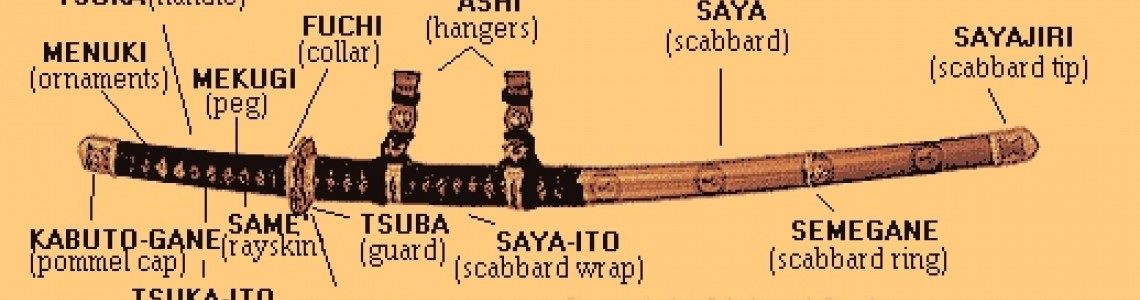
Japanese sword terminology includes hundreds of specialized words describing katana anatomy, blade shapes, forging techniques, hamon patterns, sword fittings, and traditional craftsmanship. This comprehensive Japanese sword glossary explains essential terms in English alongside Japanese kanji, helping beginners, collectors, martial artists, and custom katana buyers understand the parts and construction of Japanese swords.
Japanese Sword Terminology: Complete Katana Parts & Glossary Guide
Japanese swords are recognized for their distinctive construction, detailed craftsmanship, and specialized vocabulary. From the cutting edge of the blade to the smallest metal fitting on the handle, each component has a traditional Japanese name.
Understanding these terms makes it easier to read sword descriptions, recognize different styles of craftsmanship, discuss specifications with sword makers, and appreciate historical Japanese swords.
At HanBon Forge, our team works with Japanese-style swords including katana, wakizashi, tanto, tachi, and custom designs. Terms such as shinogi-zukuri, hamon, hada, nakago, tsuka, tsuba, habaki, and saya are regularly used when discussing blade and mounting specifications.
This guide organizes Japanese sword terminology by topic, explains common variations, and includes an extensive alphabetical glossary for quick reference.
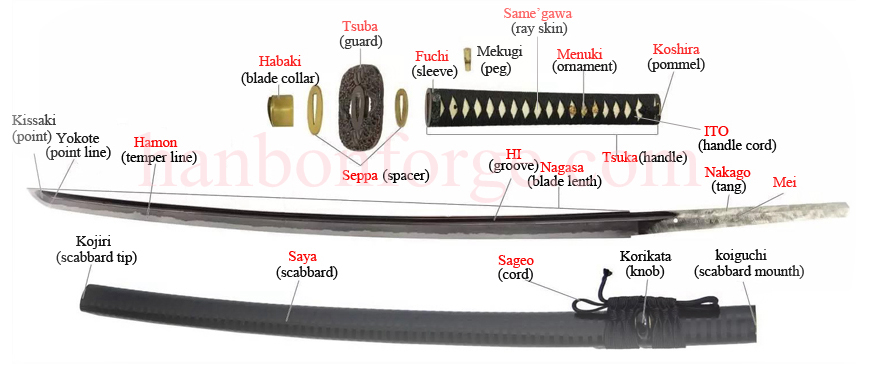
The essential parts of a katana include kissaki (tip), ha (cutting edge), mune (blade spine), shinogi (ridge line), hamon (hardened-edge pattern), nakago (tang), tsuka (handle), tsuba (guard), and saya (scabbard).
Other important terms include hada (steel grain), habaki (blade collar), mekugi (handle retaining peg), koshirae (complete sword mounting), and nagasa (blade length).
1. Types of Japanese Swords
Japanese swords differ in length, blade geometry, mounting style, and historical use. Terms such as katana and tachi refer to more than simple blade-length categories.
| Term | Japanese | Meaning |
|---|---|---|
| Nihontō | 日本刀 | Japanese sword; commonly used in traditional sword study. |
| Katana | 刀 | A curved, single-edged Japanese sword commonly associated with edge-up wear through the obi. |
| Tachi | 太刀 | A sword traditionally suspended from the belt with its cutting edge facing downward. |
| Wakizashi | 脇差 | A shorter Japanese sword, commonly carried with a katana. |
| Tantō | 短刀 | A Japanese dagger or short blade, typically under one shaku in blade length. |
| Daishō | 大小 | A paired long and short sword, most famously katana and wakizashi. |
| Ōdachi | 大太刀 | A particularly long tachi-style Japanese sword. |
| Nodachi | 野太刀 | A large field sword; modern usage often overlaps with ōdachi. |
| Kodachi | 小太刀 | A small or short tachi-style sword. |
| Chokutō | 直刀 | A straight Japanese sword form associated with earlier periods. |
| Ken / Tsurugi | 剣 | A straight, double-edged sword. |
| Iaitō | 居合刀 | A practice sword used for iaido; often unsharpened. |
| Bokken / Bokutō | 木剣 / 木刀 | A wooden practice sword. |
| Shinai | 竹刀 | A bamboo practice sword commonly used in kendo. |
Katana vs Tachi vs Wakizashi
A katana and tachi may have similar curved blade forms, but they are historically distinguished by mounting and wearing conventions, among other factors. A wakizashi is a shorter Japanese sword that can be paired with a katana to form a daishō.
Modern sellers often use these terms more broadly than traditional sword historians, so historical classification and modern product terminology should not always be treated as identical.
Explore our Katana Collection, Wakizashi Collection, and Tanto Collection.
2. Japanese Sword Blade Anatomy: Parts of a Katana
The blade itself is referred to as the tōshin. Japanese sword experts examine its profile, cross-sectional structure, tip, surface activity, and tang when describing and evaluating a sword.
Essential Katana Blade Parts
| Japanese Term | Kanji | English Definition |
|---|---|---|
| Tōshin | 刀身 | The sword blade. |
| Ha | 刃 | The cutting edge. |
| Mune | 棟 | The back or spine of the blade. |
| Kissaki | 切先 | The tip region of the sword. |
| Yokote | 横手 | The transverse ridge separating the kissaki from the main blade on applicable geometries. |
| Shinogi | 鎬 | The longitudinal ridge line of a ridged Japanese blade. |
| Shinogi-ji | 鎬地 | The blade surface between the shinogi and mune. |
| Ji | 地 | The main blade surface below the shinogi, excluding the hardened cutting-edge region. |
| Hamon | 刃文 | The visible hardened-edge pattern associated with differential hardening. |
| Yakiba | 焼刃 | The hardened cutting-edge region. |
| Bōshi | 帽子 | The hardened pattern in the kissaki. |
| Fukura | ふくら | The curvature of the cutting-edge outline in the tip. |
| Sori | 反り | The blade's curvature. |
| Hi | 樋 | A groove or fuller in the blade. |
| Bō-hi | 棒樋 | A wide longitudinal groove in the blade. |
| Horimono | 彫物 | A carved decorative or symbolic design on the blade. |
What Is a Kissaki?
The kissaki is the tip region of a Japanese sword. Its proportions can vary, producing categories such as ko-kissaki (small), chū-kissaki (medium), and ō-kissaki (large).
On a conventional shinogi-zukuri blade, the yokote marks the transition between the main blade and the kissaki. Other blade geometries, such as shōbu-zukuri, do not have a conventional yokote.
What Is the Difference Between Ha and Mune?
The ha is the cutting edge, while the mune is the blade's back or spine. These are fundamental reference points when discussing katana geometry, hardening, and sword measurements.
What Is a Bō-hi?
A bō-hi is a longitudinal groove formed in the blade. It removes material and can change blade mass and balance. Some grooved swords also produce an audible sound during a swing, commonly called tachikaze.
The popular expression "blood groove" is misleading. A bō-hi is not a channel designed to drain blood, nor does adding one automatically make a blade stronger.
3. Nakago: Japanese Sword Tang Terminology
The nakago is the tang of a Japanese sword, extending into the handle. On historical swords, its shape, patina, file marks, holes, and inscriptions can provide important evidence about the blade's origin and alterations.
| Term | Kanji | Definition |
|---|---|---|
| Nakago | 茎 | The tang of the blade. |
| Nakago-jiri | 茎尻 | The end shape of the tang. |
| Mekugi-ana | 目釘穴 | A hole in the tang for a retaining peg. |
| Mei | 銘 | An inscription or signature, often on the tang. |
| Mumei | 無銘 | An unsigned blade. |
| Gimei | 偽銘 | A false or forged signature. |
| Yasurime | 鑢目 | File marks on the tang. |
| Ubu | 生ぶ | An original, unshortened tang. |
| Suriage | 磨上げ | A shortened tang. |
| Ō-suriage | 大磨上げ | Extensive shortening, often removing the original tang end. |
| Ha-machi | 刃区 | The notch at the beginning of the cutting edge. |
| Mune-machi | 棟区 | The notch at the beginning of the spine. |
| Kurijiri | 栗尻 | A rounded, chestnut-shaped tang end. |
| Kengyō | 剣形 | A pointed, sword-shaped tang end. |
4. Japanese Sword Blade Shapes and Geometry
The Japanese term zukuri is commonly used in the names of blade construction styles. Blade geometry influences appearance, mass distribution, and functional characteristics.
| Blade Shape | Definition |
|---|---|
| Shinogi-zukuri | The familiar ridged Japanese sword geometry, generally featuring a shinogi ridge and a defined kissaki with yokote. |
| Hira-zukuri | A blade without the conventional shinogi ridge, with relatively flat side surfaces. |
| Shōbu-zukuri | A blade form in which the ridge continues toward the point without a conventional yokote. |
| Unokubi-zukuri | A blade geometry characterized by a distinctive reduced or relieved spine section. |
| Kanmuri-otoshi-zukuri | A geometry featuring a reduced or beveled upper portion of the blade. |
| Kiriha-zukuri | An early sword geometry with the shinogi positioned relatively close to the cutting edge. |
| Osoraku-zukuri | A short-blade geometry distinguished by an exceptionally long kissaki. |
| Naginata-naoshi-zukuri | A geometry associated with blades reshaped from naginata or inspired by that form. |
A buyer should distinguish between a traditional historical blade form and a modern sword made in a similar style. Modern custom katana may combine historically inspired profiles with contemporary steels and fittings.
Read more in our Japanese Sword Blade Shapes Guide.
5. Hamon, Differential Hardening and Heat-Treatment Terms
The hamon is one of the most recognizable characteristics of a traditionally differentially hardened Japanese sword blade.
During hardening, the steel is heated and quenched under controlled conditions. A refractory coating may be used to influence cooling across different blade regions. The resulting microstructures can create a visible hardened-edge pattern after appropriate polishing.
| Term | Meaning |
|---|---|
| Yaki-ire | Hardening by heating and quenching the blade. |
| Yakiba | The hardened cutting-edge region. |
| Hamon | The visible pattern associated with differential hardening. |
| Habuchi | The boundary region of the hardened edge. |
| Bōshi | The hardening pattern in the kissaki. |
| Kaeri | The return or turn-back of the bōshi. |
| Nie | Relatively coarse, individually visible martensitic crystalline activity. |
| Nioi | Very fine, mist-like crystalline activity along the hamon. |
| Ashi | Leg-like hardening features extending into the hardened region. |
| Sunagashi | Sand-swept-looking activity within the hardened region. |
| Kinsuji | Bright, thread-like hardening activity. |
| Hataraki | The activities or internal visual features of the blade's hardened regions. |
| Utsuri | A subtle shadow-like metallurgical feature appearing in the ji above the hamon on some blades. |
Common Hamon Patterns
| Style | English Description |
|---|---|
| Suguha | A relatively straight hamon. |
| Notare | A broad, gently undulating wave pattern. |
| Gunome | A repeating pattern with rounded or semicircular formations. |
| Choji | Clove-shaped formations in the hamon. |
| Midare | An irregular or varied pattern. |
| Gunome-midare | An irregular gunome pattern. |
| Choji-midare | An irregular clove-shaped pattern. |
| Hitatsura | A distinctive style featuring extensive hardening activity beyond the main edge region. |
| Toran-ba | A dramatic rolling-wave type of hamon. |
Is a Genuine Hamon Better Than a Fake Hamon?
A genuine hamon results from the blade's differential-hardening structure. An artificial or cosmetic hamon is a surface effect created to resemble one.
A genuine hamon is particularly relevant to collectors interested in heat-treatment methods and traditional blade aesthetics. However, the presence of a genuine hamon alone does not guarantee superior strength, toughness, or cutting performance.
For more information, read Real vs Fake Hamon and Japanese Katana Clay-Tempering Process.
6. Japanese Sword Steel, Forging and Hada Terminology
Japanese swords are also described by the characteristics of their steel and forging methods. These terms are especially useful when studying traditional blades and comparing different modern handmade sword constructions.
What Is Hada?
Hada (肌) refers to visible forging grain in the steel. It is associated with the structure and processing of the blade material.
Hada is different from hamon. Hada describes steel grain; hamon describes the visible hardened-edge pattern.
| Term | Meaning |
|---|---|
| Hagane | Steel. |
| Tamahagane | Traditional Japanese sword steel produced from iron sand using a tatara smelting process. |
| Tatara | The traditional Japanese furnace and smelting process associated with producing tamahagane. |
| Kitae | Forging and working the steel. |
| Hada | Visible grain or texture in the forged blade steel. |
| Itame-hada | Wood-grain-like forging texture. |
| Masame-hada | Relatively straight, parallel grain. |
| Mokume-hada | Wood-burl-like or concentric grain patterns. |
| Ayasugi-hada | A distinctive regular, undulating grain pattern. |
| Kawagane | Outer or jacket steel in certain laminated constructions. |
| Shingane | Core steel in certain laminated constructions. |
| Kobuse | A composite forging method involving an outer jacket and internal core, with construction details varying by interpretation and production method. |
| Sanmai | A three-layer or three-part laminated construction, with exact arrangements varying. |
| Togi | Sword polishing, or a term associated with the polishing craft. |
| Togishi | A specialist sword polisher. |
Kobuse vs Folded Steel
These terms describe different aspects of blade construction.
Folded steel refers to steel worked through repeated folding and forge-welding. Kobuse refers to a laminated arrangement involving more than one steel component.
A Kobuse blade may incorporate folded steel in one of its components, but folding alone does not make a blade Kobuse. Specific steel placement and construction should be confirmed with the maker.
7. Japanese Sword Mountings and Fittings: Koshirae
Koshirae (拵え) refers to the complete mounting arrangement of a Japanese sword, including its handle, guard, fittings, and scabbard.
These components combine functional construction with decorative craftsmanship.
Tsuka: Handle Components
| Term | Kanji | Definition |
|---|---|---|
| Tsuka | 柄 | The sword handle or hilt. |
| Tsuka-ito | 柄糸 | The cord or material used to wrap the handle. |
| Tsuka-maki | 柄巻 | The craft or arrangement of wrapping a sword handle. |
| Samegawa | 鮫皮 | The traditional textured skin covering under the handle wrap, commonly ray skin. |
| Menuki | 目貫 | Small ornaments generally placed beneath the handle wrapping. |
| Mekugi | 目釘 | A retaining peg securing the handle to the tang. |
| Fuchi | 縁 | A metal collar at the front of the handle. |
| Kashira | 頭 | A fitting at the end of the handle. |
| Fuchi-kashira | 縁頭 | A matching collar and end-cap set. |
| Hishigami | 菱紙 | Small paper supports used in certain traditional handle-wrapping methods. |
Tsuba, Habaki and Other Metal Fittings
| Term | Definition |
|---|---|
| Tsuba | The handguard of the sword. |
| Habaki | A blade collar that helps seat the blade in the saya and contributes to the mounting fit. |
| Seppa | Metal spacers used around the tsuba in the mounting assembly. |
| Kōgai | A traditional accessory sometimes carried in a scabbard fitting. |
| Kozuka | The handle of a small utility knife traditionally associated with some sword mountings. |
| Kōzukahitsu-ana | An opening in a tsuba associated with a kozuka. |
| Kōgai-hitsu-ana | An opening in a tsuba associated with a kōgai. |
| Shakudō | A copper-based alloy, traditionally incorporating gold, used in decorative metalwork. |
| Shibuichi | A copper-silver alloy used in Japanese decorative fittings. |
| Sukashi | Openwork or cut-out decoration, particularly in tsuba. |
| Zōgan | Decorative metal inlay. |
Saya: Scabbard Components
| Term | Kanji | Definition |
|---|---|---|
| Saya | 鞘 | The sword scabbard. |
| Koiguchi | 鯉口 | The mouth or opening of the saya. |
| Kojiri | 鐺 | The end or protective tip fitting of the saya. |
| Kurikata | 栗形 | A scabbard fitting through which the sageo is threaded. |
| Sageo | 下緒 | The cord attached to the saya. |
| Shitodome | 鵐目 | Small protective or decorative metal eyelets used in certain fittings. |
| Shirasaya | 白鞘 | Plain wooden storage mounting used for a blade. |
| Sayagaki | 鞘書 | Writing on a plain storage scabbard, often describing or attributing a blade. |
Shirasaya vs Koshirae
A shirasaya is a simple wooden storage mounting designed primarily for protecting and storing a blade. Koshirae refers to a complete sword mounting, typically intended for carrying or handling the sword according to its design.
A traditional shirasaya should not automatically be considered suitable for cutting practice, since it lacks the full construction and fittings of a functional sword mounting.
Explore our Japanese Sword Fittings Guide and Genuine Samegawa Guide.
8. Japanese Sword Measurements and Dimensions
Sword dimensions are an important part of Japanese sword classification and custom specifications. Traditional terminology and modern retail measurements are not always used in exactly the same way.
| Term | Meaning |
|---|---|
| Nagasa | Blade length, conventionally measured in a straight line from the kissaki to the mune-machi, not along the curve. |
| Sori | Maximum blade curvature according to the relevant measurement convention. |
| Motohaba | Blade width near the base. |
| Sakihaba | Blade width toward the tip. |
| Motokasane | Blade thickness near the base. |
| Sakikasane | Blade thickness toward the tip. |
| Kasane | Blade thickness. |
| Funbari | Noticeable taper in blade width, particularly toward the base. |
| Shaku | A traditional Japanese length unit of approximately 30.3 cm. |
| Sun | One-tenth of a shaku, approximately 3.03 cm. |
| Bu | One-tenth of a sun, approximately 3.03 mm. |
How Is Katana Blade Length Measured?
In traditional Japanese sword terminology, nagasa is typically measured in a straight line from the blade tip to the mune-machi. It is not the same as the total sword length or the length measured along the blade's curved cutting edge.
When ordering a custom Japanese-style sword, it is important to specify whether a dimension refers to the nagasa, handle, overall length, or another measurement.
9. Historical Periods and Japanese Sword Appraisal Terms
Collectors studying historical Japanese swords often encounter terms describing their approximate period of manufacture, school, or appraisal status.
| Term | Meaning |
|---|---|
| Kotō | Old swords, generally referring to blades produced before the beginning of the Shintō period. |
| Shintō | New swords, broadly associated with production from the late 16th century through the 18th century. |
| Shinshintō | New-new swords, broadly referring to later premodern Japanese sword production. |
| Gendaitō | Modern Japanese swords, often referring to traditionally forged blades from the modern era. |
| Guntō | Military swords or military-style sword mountings. |
| Gokaden | The five major classical Japanese swordmaking traditions: Yamato, Yamashiro, Bizen, Sōshū, and Mino. |
| Kantei | The study and appraisal of Japanese swords. |
| Meibutsu | A celebrated or famous sword. |
| Kizu | A flaw or defect. |
| Hagire | A crack running from the cutting edge; a serious blade defect. |
| Kirikomi | A cut or contact mark resulting from contact with another blade or weapon. |
| Kokuhō | National Treasure, a Japanese cultural-property designation. |
These historical categories do not mean that a newly made modern katana is an antique Japanese sword. Modern custom swords can take inspiration from traditional Japanese forms without belonging to historical swordmaking periods or schools.
10. Japanese Sword Terminology: Extended A–Z Glossary
This alphabetical reference supplements the main sections with additional terms encountered in sword catalogs, collector descriptions, martial arts literature, and discussions of historical Japanese sword craftsmanship.
A–D
| Term | Meaning |
|---|---|
| Aikuchi | A dagger-style mounting without a conventional prominent tsuba. |
| Aoi | Hollyhock; a decorative family-crest motif. |
| Ara-nie | Relatively coarse or large nie activity. |
| Ashi | Leg-like activity in the hardened region. |
| Atobori | Blade carving added at a later time. |
| Ayasugi | A regular, undulating style of forging grain. |
| Bakufu | A shogunal military government. |
| Bonji | Sanskrit seed characters incorporated into blade carvings. |
| Bō-hi | A broad longitudinal blade groove. |
| Bōshi | The hardening pattern in the kissaki. |
| Bushi | A warrior; often associated with the samurai class. |
| Bushidō | The concept of a warrior's ethical code. |
| Chikei | Dark, line-like activity associated with steel grain. |
| Chisa-katana | A short katana-style sword. |
| Chōji | Clove-shaped hamon formations. |
| Chū-kissaki | A medium-sized sword point. |
| Daimyō | A major feudal lord in Japanese history. |
| Daishō | A matched long and short sword pair. |
| Daitō | A long sword category. |
F–K
| Term | Meaning |
|---|---|
| Fuchi-kashira | Matching handle collar and end-cap fittings. |
| Fukura | The curve of the tip's cutting-edge outline. |
| Fukure | A blister-like defect in blade steel. |
| Fukurīn | A protective or decorative rim fitted to certain tsuba. |
| Funagata | A boat-shaped nakago form. |
| Funbari | Noticeable taper in blade width toward the tip. |
| Furisode | A tang form resembling a long kimono sleeve. |
| Gimei | A false sword signature. |
| Gokaden | The five classical swordmaking traditions. |
| Gomabashi | Paired, narrow grooves resembling ritual chopsticks. |
| Gunome | A rounded repeating hamon pattern. |
| Guntō | A military sword or military sword mounting. |
| Habaki | The blade collar. |
| Hada | Visible forging grain in the steel. |
| Hagane | Steel. |
| Hagire | A serious cutting-edge crack. |
| Ha-machi | The notch at the base of the cutting edge. |
| Hamon | The hardened-edge pattern. |
| Hataraki | Visible activity associated with blade microstructures. |
| Hitatsura | Extensive hardening activity reaching beyond the ordinary edge region. |
| Horimono | Decorative or symbolic blade carving. |
| Iori-mune | A peaked or roof-shaped blade spine. |
| Itame | Wood-grain-like steel pattern. |
| Kaeri | The turn-back of the bōshi. |
| Kantei | Sword examination and appraisal. |
| Kasane | Blade thickness. |
| Katana-kake | A sword display stand. |
| Kawagane | Outer steel in a laminated blade. |
| Kengyō | A pointed tang-end shape. |
| Kinsuji | Bright line-like activity in a hardened region. |
| Kitae | The process of forging and working blade steel. |
| Kizu | A blade flaw. |
| Kobuse | A composite steel construction with an outer component and a core. |
| Kodōgu | Small sword-mounting fittings and accessories. |
| Koiguchi | The mouth of a saya. |
| Kojiri | The end fitting of a saya. |
| Ko-maru | A small rounded turn-back style of bōshi. |
| Koshirae | Complete sword mountings. |
| Kurikata | A saya fitting associated with the sageo. |
| Kurijiri | A rounded tang end. |
M–S
| Term | Meaning |
|---|---|
| Masame | Relatively straight steel grain. |
| Mei | Signature or inscription on a sword. |
| Meibutsu | A famous or celebrated sword. |
| Mekugi | Handle retaining peg. |
| Mekugi-ana | Hole for the retaining peg. |
| Menuki | Decorative handle ornaments. |
| Midare | An irregular hamon pattern. |
| Mokume | A circular or wood-burl-like forging grain. |
| Mon | A family or identifying emblem. |
| Motohaba | Blade width near the base. |
| Motokasane | Blade thickness near the base. |
| Mumei | Unsigned blade. |
| Mune | Back or spine of the blade. |
| Nagasa | Blade length. |
| Nakago | Blade tang. |
| Nakago-jiri | Tang end. |
| Nie | Relatively coarse hardening activity. |
| Nioi | Fine mist-like hardening activity. |
| Notare | A broad wavy hamon. |
| Ō-kissaki | A large, elongated blade tip. |
| Ō-suriage | Major shortening of a sword tang. |
| Omote | The designated front or outer-facing side in a particular sword context. |
| Sageo | Scabbard cord. |
| Sakihaba | Blade width toward the tip. |
| Sakikasane | Blade thickness toward the tip. |
| Samegawa | Traditional textured skin used in sword mountings. |
| Sanmai | A multi-part laminated blade structure. |
| Saya | Scabbard. |
| Sayagaki | Writing on a storage scabbard. |
| Seppa | Metal spacers around the guard. |
| Shakudō | Copper-based decorative alloy containing gold. |
| Shibuichi | Copper-silver alloy. |
| Shingane | Core steel used in certain laminated structures. |
| Shinogi | Longitudinal blade ridge. |
| Shinogi-ji | Blade area between shinogi and mune. |
| Shinogi-zukuri | Traditional ridged blade geometry. |
| Shirasaya | Plain wooden storage mountings. |
| Shōbu-zukuri | Blade geometry without a conventional yokote. |
| Sori | Blade curvature. |
| Suguha | Straight hamon style. |
| Sukashi | Openwork decoration. |
| Sunagashi | Sand-swept-looking hardening activity. |
| Suriage | Shortening of a sword tang. |
T–Z
| Term | Meaning |
|---|---|
| Tachi | Traditional Japanese sword associated with edge-down suspended wear. |
| Tachikaze | Sound created by air movement during a sword swing. |
| Tamahagane | Traditional Japanese sword steel. |
| Tameshigiri | Test cutting with a sword. |
| Tantō | Japanese dagger. |
| Tatara | Traditional Japanese steel-smelting process and furnace. |
| Tō | Sword or blade. |
| Togi | Sword polishing. |
| Togishi | Professional sword polisher. |
| Toran-ba | Large rolling-wave hamon style. |
| Tsuba | Sword handguard. |
| Tsuka | Sword handle. |
| Tsuka-ito | Handle-wrapping cord. |
| Tsuka-maki | Art or arrangement of handle wrapping. |
| Tsunagi | Wooden substitute blade used to hold sword fittings together. |
| Tsurugi | Double-edged straight sword. |
| Ubu | Original, unshortened tang condition. |
| Uchigatana | A sword form and historical mounting category associated with edge-up wear. |
| Uchiko | Fine powder traditionally used in certain sword-cleaning methods. |
| Unokubi-zukuri | Blade geometry featuring a relieved spine section. |
| Ura | The designated reverse side in a particular sword or inscription context. |
| Utsuri | A shadow-like activity in the blade surface above the hamon. |
| Wakizashi | Short Japanese sword. |
| Ware | An opening or separation in blade steel, often associated with forging structure. |
| Yaki-ire | Blade-hardening operation involving heating and quenching. |
| Yakiba | The hardened cutting-edge region. |
| Yakidashi | The starting portion of the hamon near the blade base. |
| Yakizume | A bōshi style without a conventional turn-back. |
| Yari | Japanese spear. |
| Yasurime | File marks on the tang. |
| Yokote | Transverse ridge associated with the kissaki. |
| Yoroi-dōshi | A thick, robust tantō type associated with armored combat contexts. |
| Zōgan | Decorative inlay. |
| Zukuri | A construction or form suffix used in blade geometry terminology. |
Terminology Note: Japanese terms may appear with different romanizations or spellings, including long-vowel marks. Some historical definitions also vary by sword period, school, and specialist reference. This glossary uses commonly recognizable English forms and provides context where modern retail usage differs from traditional terminology.
11. How Japanese Sword Terminology Helps When Buying a Katana
For modern buyers, learning these terms has a practical benefit: it makes custom sword specifications more precise and reduces misunderstandings between the customer and the maker.
Example 1: Describing the Blade
Instead of requesting "a long sword with a groove and a wavy line," a customer can specify:
Blade: Shinogi-zukuri katana, 28-inch nagasa, single bō-hi, T10 steel, clay-assisted differential hardening with a Notare hamon.
This describes the blade profile, length, groove, steel, heat-treatment method, and desired hamon appearance.
Example 2: Describing the Handle
Tsuka: 11-inch hardwood handle, genuine black samegawa, black cotton tsuka-ito, hineri-maki wrapping, and iron tsuba with matching fuchi-kashira.
This identifies the handle length, core covering, wrapping material, wrapping style, guard, and associated fittings.
Example 3: Describing the Scabbard
Saya: Matte-black hardwood saya with matching black sageo, a properly fitted koiguchi, and compatible kojiri details.
This communicates both the desired appearance and the need for a correctly fitted scabbard.
Common Terminology Mistakes
| Common Confusion | Correct Distinction |
|---|---|
| Hamon vs Hada | Hamon is associated with differential hardening; hada is forging grain. |
| Tsuka vs Nakago | Tsuka is the handle; nakago is the blade tang inside it. |
| Habaki vs Seppa | Habaki is the blade collar; seppa are mounting spacers. |
| Kissaki vs Yokote | Kissaki is the tip region; yokote is its transverse ridge on applicable blades. |
| Shirasaya vs Koshirae | Shirasaya is plain storage mounting; koshirae is a complete sword mounting. |
| Bo-hi vs Blood Groove | Bō-hi is a blade groove, not a blood-drainage channel. |
| Folded Steel vs Kobuse | Folding is a forging process; Kobuse describes a composite blade construction. |
12. Frequently Asked Questions About Japanese Sword Terminology
These answers address common questions about katana anatomy, swordmaking vocabulary, Japanese sword fittings, and traditional blade construction.
What is the Japanese word for sword?
Common Japanese terms include tō (刀), meaning sword or blade, and ken (剣), often associated with double-edged swords. Nihontō (日本刀) means Japanese sword.
What are the main parts of a katana called?
The main blade terms include kissaki (tip), ha (cutting edge), mune (spine), shinogi (ridge), hamon (hardened-edge pattern), and nakago (tang). The mounted sword also includes tsuka (handle), tsuba (guard), habaki (blade collar), and saya (scabbard).
What does hamon mean on a katana?
Hamon (刃文) refers to the visible pattern associated with differential hardening along the cutting-edge region of a Japanese sword. It may be straight, wavy, or irregular, depending on the manufacturing process and polishing.
What is the difference between hamon and hada?
Hamon describes the blade's visible hardened-edge pattern, while hada describes the grain or texture of forged steel. They originate from different aspects of swordmaking and should not be confused.
What is a nakago?
Nakago (茎) is the tang of a Japanese sword, extending into the handle. On historical swords, the tang can provide important information about the maker, blade history, and possible alterations.
What is the difference between tsuka and saya?
Tsuka (柄) refers to the sword handle, while saya (鞘) is the scabbard used to protect the blade when it is not drawn.
What is the purpose of a tsuba?
The tsuba is the sword guard. It contributes to hand protection and the mounting arrangement, while also providing an important surface for decorative craftsmanship.
What is a habaki on a Japanese sword?
Habaki is a metal collar fitted near the base of the blade. It helps the blade seat correctly in the saya and contributes to the fit of the sword's mounting.
What is a bo-hi on a katana?
A bō-hi is a longitudinal groove on the blade. It removes material and can change blade weight and balance. It is sometimes incorrectly called a blood groove.
What does shinogi-zukuri mean?
Shinogi-zukuri refers to a traditional Japanese blade geometry with a prominent longitudinal ridge. It is one of the most recognizable geometries used in katana and other Japanese sword forms.
What is the difference between a katana and a tachi?
Katana and tachi differ in historical mounting and wearing conventions, among other factors. Katana are commonly associated with cutting-edge-up wear, while tachi are traditionally suspended with the cutting edge down.
What is a daisho?
Daishō means a paired long and short sword, most famously a katana and wakizashi. The pairing is strongly associated with historical samurai sword wearing practices.
What is the difference between Kobuse and folded steel?
Kobuse refers to a composite blade arrangement incorporating core and outer steel components. Folded steel refers to repeated folding and forge-welding. A folded blade is not automatically Kobuse.
Does shirasaya mean an unsharpened sword?
No. Shirasaya refers to plain wooden storage mountings, not the sharpness of the blade. A sharpened blade can be stored in shirasaya, but traditional storage mountings are not automatically suitable for active sword use.
What does nagasa mean?
Nagasa is the conventional blade length measurement, typically taken in a straight line from the sword tip to the mune-machi. It does not include the handle or the total mounted length of the sword.
Can I use Japanese sword terminology when ordering a custom katana?
Yes. Terms such as shinogi-zukuri, bō-hi, nagasa, hamon, tsuka-ito, samegawa, tsuba, and saya can help communicate specifications accurately. HanBon Forge customers can use these terms when selecting options or submitting additional custom requests.
Final Thoughts: Understanding the Language of Japanese Swords
Japanese sword terminology offers a detailed way to describe and appreciate the craft of swordmaking.
Learning the difference between hamon and hada, recognizing the components of a koshirae, and understanding how nakago, tsuka, tsuba, and saya work together helps collectors and buyers evaluate a sword more carefully.
These terms also connect modern sword enthusiasts to the long history of Japanese blades, from traditional forging and polishing to the artistry of sword mountings.
At HanBon Forge, we encourage customers to learn the terminology behind the swords they collect or commission. Accurate vocabulary makes it easier to discuss craftsmanship, choose compatible components, and communicate design preferences.
Explore Japanese Sword Craftsmanship at HanBon Forge
Discover handmade Japanese-style swords or create your own katana with selected blade steel, hamon, sword geometry, handle materials, fittings, and saya.
Explore Handmade KatanaCustomize Your Katana13. References, Editorial Standards & HanBon Forge Experience
Reference Materials
Japanese sword terminology is a specialized subject. Historical usage, transcription, and the interpretation of certain features can vary by period and source.
The following materials provide useful foundations for continued study:
-
Leon Kapp, Hiroko Kapp & Yoshindo Yoshihara — The Craft of the Japanese Sword.
A detailed introduction to Japanese sword forging, hardening, polishing, and related craftsmanship.
-
Kokan Nagayama — The Connoisseur's Book of Japanese Swords.
A reference for traditional Japanese sword terminology, blade shapes, appraisal, and historical sword study.
-
Nobuo Nakahara — Facts and Fundamentals of Japanese Swords.
A specialist reference on Japanese sword characteristics, identification, and appraisal considerations.
-
The Metropolitan Museum of Art — The Japanese Blade: Technology and Manufacture.
A museum resource describing historical Japanese sword production.
Read the Museum Article. -
NihontoCraft — Japanese Sword Terms.
An additional glossary containing Japanese characters and terminology used by sword collectors.
Explore the Terminology Reference.
About This Guide & Editorial Experience
Prepared by: HanBon Forge Team
Topic: Japanese Sword Terminology, Katana Anatomy, Nihontō Glossary, Blade Geometry, Hamon, Hada, Koshirae, and Sword Fittings.
Experience and Perspective: HanBon Forge produces handmade and custom Japanese-style swords, including katana, wakizashi, tanto, tachi-inspired swords, and specialized custom designs.
Our team works with modern high-carbon steel blades, different heat-treatment options, blade geometries, handle construction, genuine rayskin, tsuka wrapping, saya fitting, and decorative sword fittings.
These practical manufacturing activities inform how we explain modern sword specifications and their relationship to historical Japanese sword terminology.
Editorial Approach: This guide combines practical manufacturing knowledge with established terminology from Japanese sword study. Historical classifications and traditional Japanese swordmaking practices are distinguished from modern commercial sword specifications where relevant.
Limitations: The glossary is intended for educational reference and is not an authentication certificate or appraisal of an individual historical Japanese sword. Terminology and romanization may vary between specialist sources.
Last Reviewed: October 2026.