
How to Choose the Right Katana Saya: Styles, Materials & Customization
Choosing the right katana saya involves more than selecting a color or decorative finish. A properly fitted Japanese sword scabbard protects the blade, supports safe retention, and completes the overall appearance of the sword. This guide compares traditional wooden saya, lacquered finishes, rayskin decoration, buffalo horn fittings, shirasaya, and custom options to help you choose the right scabbard for your katana.
How to Choose the Right Katana Saya: Styles, Materials & Customization
When choosing a Japanese katana, attention often goes first to the blade: its steel, curvature, hamon, and polishing. Yet the saya (鞘), or Japanese sword scabbard, deserves equal consideration.
A well-made katana saya protects the blade when stored, contributes to the overall appearance of the sword, and affects how securely the blade sits within its mounting.
A well-chosen saya should do more than match the color of the handle. Its internal shape must suit the blade, its opening must work correctly with the habaki, and its exterior should complement the sword's other fittings.
At HanBon Forge, we offer a range of saya finishes and customization options for handmade Japanese swords. Our experience coordinating custom sword components informs the practical guidance in this article, particularly the importance of blade compatibility, scabbard fit, and coordinated design.
This guide explains the main types of katana saya, traditional and modern materials, important scabbard components, customization possibilities, and what to check before choosing a saya for your sword.
For most buyers choosing a fully mounted katana, a properly fitted wooden saya with a durable exterior finish is a practical starting point. Black lacquer-style finishes provide a timeless appearance, while colored, textured, and rayskin-decorated designs offer greater personalization.
The most important factor is blade compatibility. A beautiful saya cannot compensate for poor internal fit, inadequate blade retention, or an improperly matched koiguchi and habaki.
1. What Is a Katana Saya?
A saya is the protective scabbard used with Japanese swords, including katana, wakizashi, and tanto. It forms an important part of the sword's complete mounting, known as the koshirae.
Traditional Japanese sword scabbards are generally made around a wooden core. The interior is carefully shaped to accommodate the sword blade, while the exterior may be lacquered or decorated with additional materials.
Unlike a generic protective sleeve, a functional saya must be fitted with consideration for the individual blade's length, width, thickness, curvature, and habaki dimensions.
What Are the Main Parts of a Katana Saya?
Several components contribute to the function, appearance, and construction of the saya.
- Koiguchi (鯉口): The opening or mouth of the scabbard, where the habaki is seated.
- Kurikata (栗形): A fitting attached to the saya through which the sageo cord passes.
- Sageo (下緒): The cord attached to the saya, commonly used when securing the sword at the waist.
- Kojiri (鐺): The end fitting or protective finish at the tip of the scabbard.
- Shitodome: Small metal fittings sometimes installed around the kurikata opening.
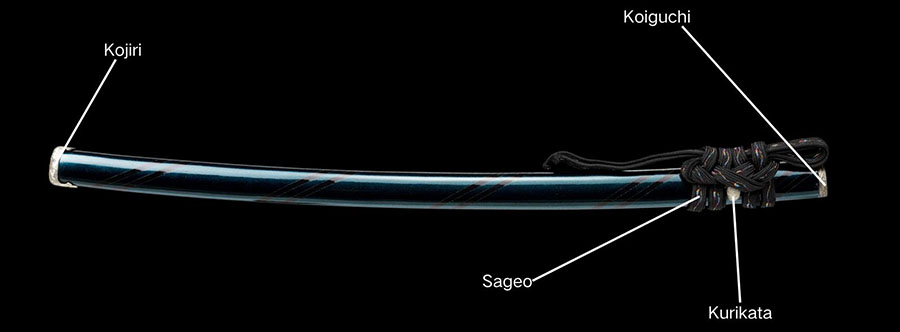
Although these components may appear decorative, several have important practical functions.
For example, the kurikata helps secure the sageo, while the koiguchi works with the habaki to retain the blade.
For a more detailed explanation, read our Complete Guide to Japanese Sword Saya Components.
2. Why Proper Saya Fit Matters More Than Appearance
A saya is one of the most visually prominent parts of a katana, but its most important qualities are functional.
The internal fit of the scabbard influences blade retention, protection, and the ease of controlled drawing and sheathing.
The Relationship Between the Koiguchi and Habaki
The habaki is the metal collar located at the base of the blade. When the sword is fully seated, the habaki interacts with the koiguchi to help hold the sword securely within the saya.
A properly matched opening should provide sufficient retention without requiring excessive force to release the sword.
If the fit is too loose, the sword may move or become unexpectedly unseated. If the fit is too tight, drawing may become difficult and create a safety concern.
Blade Curvature and Internal Clearance
Japanese swords do not all share the same curvature, known as sori. Even two katana with the same nominal blade length may have noticeably different shapes.
Other important dimensions include the blade width at the base and near the tip, blade thickness, and the geometry of the kissaki.
The saya must accommodate the actual blade geometry without excessive contact, particularly along the cutting edge.
Practical Advice: Never assume that an existing saya will fit another katana simply because both swords have 28-inch blades.
3. Common Katana Saya Styles
There is no single best appearance for every katana. A suitable saya should reflect the purpose of the sword and create a coherent design with the handle, tsuba, sageo, and other fittings.
Black Lacquer Saya: Traditional and Versatile
A black lacquer-style saya is among the most recognizable Japanese sword scabbard designs.
Its understated appearance works with a wide variety of sword fittings, making it suitable for both traditional-inspired swords and modern custom katana.
A glossy black saya can provide a refined appearance, while a matte black saya offers a more subdued visual style.
Best suited for: Classic Japanese-style katana, minimalist designs, formal displays, and buyers seeking versatility.
Colored Saya: Personalized and Distinctive
Red, blue, brown, green, and other colored finishes can create a distinctive sword without changing the blade itself.
A deep blue saya, for example, may pair well with dark blue or black tsuka-ito. A red saya can create a strong visual accent when combined with restrained metal fittings.
For a cohesive result, the colors of the saya, sageo, tsuka-ito, and fittings should complement one another rather than compete for attention.
Best suited for: Custom katana, themed collections, decorative displays, and buyers seeking a personalized color scheme.
Matte and Textured Saya: Understated Detail
Matte and textured finishes add visual character without requiring elaborate decoration.
These styles can be effective when paired with iron fittings, dark handle wraps, or simple geometric designs.
Textured surfaces should still be evaluated for finish quality, comfort during handling, and compatibility with the sword's intended use.
Best suited for: Minimalist custom designs and buyers who prefer a less reflective finish.
Rayskin-Wrapped Saya
Rayskin-decorated saya offer a distinctive textured appearance.
Depending on the design, genuine rayskin may be combined with lacquered sections, buffalo horn fittings, or additional decorative elements.
A rayskin-wrapped saya is especially appealing for collectors who appreciate unusual materials and carefully coordinated koshirae.
Best suited for: Collector swords, premium decorative mountings, and highly personalized custom designs.
Decorative and Specialty Saya Finishes
Other decorative styles may incorporate intricate motifs, contrasting colors, patterned coatings, or mother-of-pearl-inspired effects.
Historical Japanese sword mountings demonstrate the artistic possibilities of elaborate lacquer work. Surviving examples include gold lacquer, shell ornamentation, family crests, and detailed metal fittings.
Modern decorative finishes may reproduce aspects of these traditional designs or introduce contemporary visual styles.
Best suited for: Presentation swords, custom collections, and customers seeking a distinctive aesthetic.
| Saya Style | Main Appearance | Recommended For |
|---|---|---|
| Glossy Black | Polished, reflective black | Classic katana designs |
| Matte Black | Non-reflective dark finish | Minimalist designs |
| Colored Lacquer-Style | Red, blue, brown, or other colors | Personalized swords |
| Textured | Subtle or pronounced surface texture | Distinctive custom designs |
| Rayskin-Wrapped | Textured rayskin decoration | Collectors and display |
| Patterned or Specialty | Decorative designs and effects | Themed or presentation swords |
4. What Materials Are Used to Make a Katana Saya?
The materials beneath the exterior finish are just as important as the decorations visible on the outside.
Traditional Wooden Construction
Traditional Japanese sword saya commonly use honoki, or Japanese magnolia wood, valued for its suitability for carving and relatively gentle contact with polished steel.
The wooden body is typically constructed from carefully shaped sections forming the interior cavity around the blade.
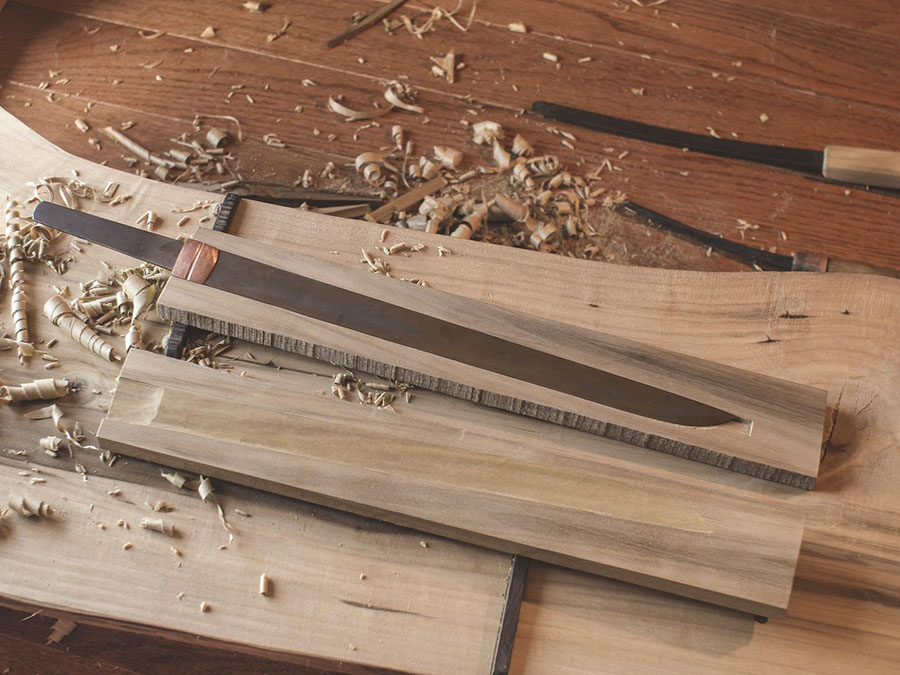
The exact timber used in contemporary production can vary. Buyers seeking a particular traditional wood species should confirm the material with the sword maker rather than assuming every wooden saya is made from honoki.
Lacquer and Modern Surface Finishes
The exterior coating determines the finished color and appearance of the saya and provides a degree of surface protection.
Historical Japanese examples frequently feature sophisticated urushi lacquer work.
Modern production swords may use different lacquer or painted coating systems. A glossy modern saya should not automatically be described as traditional natural urushi unless its materials are confirmed.
Buffalo Horn Fittings
Buffalo horn is commonly used for selected functional and decorative saya components, including the koiguchi, kojiri, and kurikata.
Horn can provide reinforcement in areas subject to repeated contact and handling while creating an elegant appearance.
However, horn fittings should be regarded as part of the complete construction rather than a replacement for accurate internal fitting.
Rayskin and Metal Decoration
Rayskin provides a distinctive textured appearance, while brass, copper, and other metal fittings can add ornamental contrast and localized protection.
Material selection should be appropriate for the sword's intended use and expected handling conditions.
| Material or Finish | Main Function | Buyer Consideration |
|---|---|---|
| Wooden Core | Forms the blade cavity | Accurate fit is essential |
| Lacquer or Paint | Exterior finish and surface protection | Check coating quality |
| Buffalo Horn | Local reinforcement and finishing | Consider workmanship and fit |
| Rayskin | Textured decorative covering | Consider durability and use |
| Metal Fittings | Decorative and protective details | Check secure attachment |
5. Shirasaya vs Koshirae Saya: What Is the Difference?
Two terms that buyers frequently encounter are shirasaya and koshirae.
These describe different approaches to Japanese sword mounting and should not be considered interchangeable.
What Is Shirasaya?
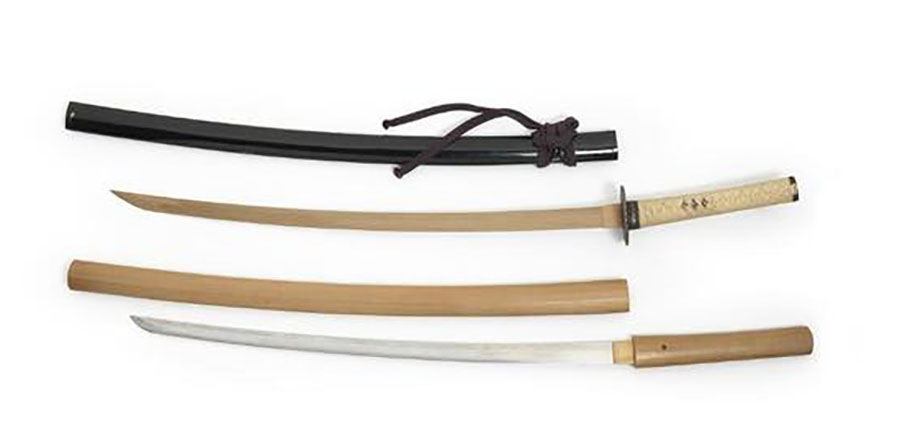
Shirasaya (白鞘) is a plain wooden storage mounting primarily intended for preserving a Japanese sword blade.
It generally consists of a plain wooden scabbard and handle arrangement without the normal guard and complete fittings associated with functional koshirae.
Shirasaya should not be treated as a substitute for a securely assembled mounted sword used for cutting or martial arts practice.
What Is Koshirae Saya?
Koshirae refers to the complete sword mounting, including the handle, guard, scabbard, and associated fittings.
The saya used with a fully mounted katana may include a lacquered finish, kurikata, sageo, decorative fittings, and additional reinforcement.
| Feature | Shirasaya | Koshirae Saya |
|---|---|---|
| Primary Purpose | Blade storage and preservation | Part of a mounted sword |
| Appearance | Plain wood | Lacquered or decorative |
| Fittings | Minimal storage components | May include kurikata, sageo, horn, and metal fittings |
| Normal Use | Storage | Display and suitable mounted-sword handling |
| Customization | Generally restrained | Wide variety of decorative options |
For collectors prioritizing blade storage, shirasaya may be appropriate. For buyers seeking a complete mounted katana, a properly constructed koshirae and saya are normally the relevant choice.
Explore our Shirasaya Collection and Katana Collection to compare the styles.
6. How to Match a Saya with Your Katana
When selecting a custom saya, consider the sword as a complete design rather than choosing each component independently.
Coordinate the Saya and Tsuka-Ito
The handle wrapping, known as tsuka-ito, provides a natural starting point for selecting a complementary saya color.
For example, black ito with a glossy black saya creates a restrained, unified appearance. Dark brown ito combined with a natural or wood-grain finish can produce a warmer visual character.
Balance Decorative Fittings
An ornate tsuba often pairs well with a simpler saya, allowing the guard to remain a focal point.
Conversely, a highly decorative scabbard may benefit from understated handle fittings.
Choose a Consistent Overall Theme
Before choosing individual components, decide whether the finished sword should have a traditional, minimalist, historically inspired, contemporary, or highly decorative appearance.
Keeping the overall theme consistent helps create a more cohesive design.
| Design Preference | Suggested Saya Direction |
|---|---|
| Classic Japanese Appearance | Glossy black or dark lacquer-style finish |
| Minimalist Design | Matte black or restrained textured finish |
| Elegant Decorative Sword | Deep color with coordinated fittings |
| Highly Personalized Display | Patterned, rayskin, or specialty decorative saya |
| Traditional Blade Storage | Properly fitted shirasaya |
7. Custom Katana Saya Options at HanBon Forge
One advantage of ordering a custom katana is the ability to coordinate the saya with the blade, handle, and fittings during the production process.
HanBon Forge offers a selection of standard saya styles and additional customization possibilities, subject to the chosen sword model and production availability.
Available Saya Style Examples
- Glossy Black Saya: A classic finish suitable for many katana designs.
- Matte Saya: A subdued alternative for customers who prefer less shine.
- Colored Saya: Red, blue, and other finishes to match a custom sword design.
- Hualee-Style Wooden Saya: A decorative wood-grain appearance for selected configurations.
- Rayskin-Wrapped Saya: A textured design for personalized sword mountings.
- Special Decorative Finishes: Additional patterns, contrasting colors, and visual effects available for selected custom orders.
Buffalo horn fittings and sageo color options may also be available depending on the specific configuration.
Examples from Our Saya Selection
Some of the styles available within HanBon Forge's customization range include:
| Saya Code | Style or Finish |
|---|---|
| S110 | Glossy finish |
| S107 | Matte finish |
| S105 | Deep blue finish |
| S220 | Hualee-style wooden finish |
| S225 | Black rayskin-wrapped saya |
| S224 | Red rayskin-wrapped saya |
| S301 | Mother-of-pearl-style spiral decoration |
These are examples rather than an exhaustive current inventory. Customers should confirm the availability, finish, compatibility, and price of their preferred saya before ordering.
Complex custom paintwork or unusual decorative finishes may require additional production time.
How to Order a Custom Saya with Your Katana
| Step | What to Do |
|---|---|
| 1. Choose Your Sword | Select the blade type, length, curvature, and other sword specifications. |
| 2. Select the Saya | Choose the desired finish, color, material, and decorative details. |
| 3. Match the Fittings | Coordinate the handle wrapping, tsuba, sageo, and compatible components. |
| 4. Confirm Special Requests | Contact HanBon Forge about unusual paintwork, horn fittings, custom dimensions, or other non-standard details. |
Our Custom Katana Builder allows you to choose compatible components and create a coordinated sword design.
8. How to Evaluate Saya Quality Before Buying
A beautiful exterior finish does not necessarily mean a saya is properly fitted. When evaluating a Japanese sword scabbard, consider both its appearance and functional construction.
Check the Koiguchi Fit
The habaki should seat securely within the saya opening.
Excessive looseness may reduce retention, while unusual resistance may indicate an overly tight or poorly matched opening.
Look for Unwanted Blade Movement
Some variation in wooden scabbard fit can occur as environmental conditions change.
However, significant rattling, unexpected blade movement, or insecure retention should be investigated before the sword is used.
Inspect the Exterior Finish
Look for visible cracks, poorly finished edges, damaged lacquer, loose metal fittings, or problems with decorative materials.
Check the Kurikata and Sageo
The kurikata should be securely attached, and the sageo should be properly installed for its intended purpose.
Consider the Intended Use
A sword intended for static display may place more emphasis on decoration. A sword intended for supervised martial arts practice requires careful attention to blade retention, internal clearance, secure fittings, and safe handling.
For a custom sword, blade-to-saya fit should be reviewed as part of final assembly rather than judged from the exterior appearance alone.
Important checks include the relationship between the habaki and koiguchi, secure blade seating, suitable internal clearance, exterior finish quality, and the attachment of saya fittings.
At HanBon Forge, completed custom swords are photographed for customer review before shipment. These photographs help customers confirm visible specifications and requested design details.
However, photographs alone cannot replace physical fitting and safety checks.
9. Common Mistakes When Choosing a Katana Saya
Choosing Appearance Before Compatibility
The most attractive saya is not necessarily suitable for a specific blade. Blade compatibility should always take priority over decorative appearance.
Assuming All Katana Have Identical Dimensions
Two katana with the same stated blade length may differ in curvature, width, thickness, kissaki geometry, and habaki dimensions.
This is why saya should not be assumed interchangeable.
Confusing a Decorative Saya with Shirasaya
Shirasaya is primarily intended for blade storage. It should not replace a correctly constructed functional mounting.
Using Too Many Competing Colors
Too many decorative elements may weaken the visual consistency of the finished sword.
A restrained combination of saya, tsuka-ito, sageo, and fittings often produces a more balanced result.
Overlooking Maintenance Requirements
Wooden scabbards can be affected by humidity and temperature changes. Buyers should consider storage conditions and finish care rather than focusing only on the initial appearance.
10. How to Maintain a Katana Saya
Proper care helps preserve the appearance and functionality of a Japanese sword scabbard.
- Keep It Dry: Avoid prolonged exposure to moisture and excessive humidity.
- Store It in Stable Conditions: Large changes in temperature or humidity can affect wooden components.
- Clean the Exterior Gently: Use a soft, dry cloth appropriate for the finish.
- Protect the Koiguchi: Avoid unnecessary impact or pressure near the saya opening.
- Inspect Fittings Periodically: Check for loose attachments, cracks, or visible damage.
- Never Force the Blade: If the sword becomes difficult to sheath, stop and investigate the cause.
Do not apply excess oil or liquid inside the saya. Moisture or oil trapped within the wooden interior can create problems for both the scabbard and blade.
If internal contamination or damage is suspected, consult a qualified sword-care professional rather than inserting abrasive tools or attempting an improvised repair.
For additional blade and storage care information, read our Japanese Sword Maintenance Guide.
11. Which Katana Saya Should You Choose?
The ideal saya depends on the sword's design, intended use, and your personal preferences.
| Your Priority | Recommended Direction |
|---|---|
| Traditional Appearance | Properly fitted black lacquer-style saya |
| Unique Custom Design | Coordinated colored or decorative finish |
| Minimalist Style | Matte or subtly textured finish |
| Display Collection | Rayskin or specialty decorative saya |
| Blade Storage | Purpose-fitted shirasaya |
| Martial Arts Practice | Secure retention, proper fit, and instructor guidance |
For First-Time Katana Buyers
A properly fitted glossy black or matte black wooden saya is a reliable starting point.
These finishes work with many traditional-inspired katana designs and are generally easy to coordinate with different handle and fitting colors.
For Collectors
Collectors seeking a distinctive visual style may appreciate textured, rayskin-wrapped, or elaborate decorative saya.
The scabbard's construction and fit should remain a priority regardless of the level of ornamentation.
For Custom Sword Buyers
Choosing the saya during the original sword-building process is generally preferable to attempting to fit a separately purchased scabbard later.
This allows the blade, habaki, saya cavity, and exterior components to be considered together during production.
Frequently Asked Questions About Katana Saya
These answers address common questions about katana scabbard materials, replacement saya, blade compatibility, and customization.
What is a katana saya?
A katana saya is the traditional Japanese scabbard that houses and protects the sword blade. It generally has a wooden core and may include lacquer, horn, rayskin, and decorative fittings.
What is the best material for a katana saya?
Traditional Japanese sword scabbards commonly use honoki wood. However, overall quality depends on construction, accurate internal fit, finish quality, and the intended use of the sword.
Is a black saya better than a colored saya?
Not necessarily. Color alone does not determine quality. Black is a versatile traditional-looking option, while colored saya provide greater personalization. Blade compatibility and workmanship are more important.
Can one saya fit different katana swords?
Not reliably. Blade length, curvature, width, thickness, and habaki geometry vary between swords. A saya should be fitted or verified for the specific blade rather than assumed to be interchangeable.
What is the difference between shirasaya and a regular katana saya?
Shirasaya is a plain wooden storage mounting primarily intended for preserving a blade. A regular koshirae saya forms part of a fully mounted sword and may include lacquer, kurikata, sageo, horn, and decorative fittings.
Do buffalo horn fittings make a saya better?
Buffalo horn can provide localized reinforcement and an attractive finish at selected areas, but it does not compensate for poor construction or incorrect blade fit.
Can HanBon Forge customize my katana saya?
Yes. HanBon Forge offers various colors, finishes, decorative options, and selected fittings for newly commissioned custom swords. Availability depends on the configuration, and unusual requests should be confirmed before ordering.
Can I buy a replacement saya for an existing katana?
A replacement saya must be accurately matched to the individual blade. HanBon Forge generally does not provide separately manufactured replacement saya when the original blade is unavailable for accurate fitting.
Why does my katana rattle inside the saya?
Rattling may result from excessive internal clearance or changes in the wooden scabbard. If the movement is substantial or retention is uncertain, stop using the sword and seek qualified inspection.
How should I clean the inside of a katana saya?
Avoid adding liquids or inserting abrasive objects into the saya. If debris, moisture, or contamination is suspected, seek advice from a qualified sword-care professional.
How should a katana fit inside its saya?
The sword should seat securely, with appropriate retention between the habaki and koiguchi. The interior should accommodate the blade without excessive contact or dangerous looseness. Drawing and sheathing should never require abnormal force.
Which saya is best for a custom katana?
For most custom katana, a properly fitted wooden saya with a durable finish is a good starting point. The exterior color, texture, horn fittings, and sageo can then be selected to complement the complete sword.
Final Thoughts: Choosing a Saya That Complements Your Katana
A katana saya is not simply an ornamental sheath. It is a carefully fitted component that helps protect the blade and complete the overall sword mounting.
Whether you prefer a glossy black finish, a matte surface, a traditional storage mounting, or an elaborate custom design, the most important consideration remains the relationship between the saya and the blade it is intended to hold.
For customers commissioning a custom Japanese sword, selecting the saya alongside the blade, habaki, handle, and fittings helps create a more coherent finished sword.
At HanBon Forge, we recommend balancing visual design with construction quality, accurate blade fit, and the intended purpose of the sword.
Design Your Own Katana at HanBon Forge
Choose your blade steel, handle wrapping, tsuba, saya finish, sageo, and other custom details to create a Japanese sword that reflects your preferences.
Our team can help review special saya requirements and confirm whether a requested finish or fitting combination is suitable for your custom sword.
Explore Custom Katana OptionsContact HanBon ForgeReferences & Further Reading
The following resources provide additional historical context and practical information about Japanese sword scabbards, materials, and traditional mountings.
-
The British Museum — Japanese Katana and Saya Collection.
Historical examples of Japanese sword mountings, lacquered scabbards, and associated fittings.
Explore the British Museum Collection. -
The British Museum — Japanese Lacquered Sword Mountings.
Historical collection materials illustrating decorative lacquer techniques, family crests, and metal fittings.
Explore Historical Sword Mountings. -
The Kagawa Museum — Historical Japanese Sword Mountings.
Japanese museum resources providing context for Edo-period lacquer decoration and coordinated sword fittings.
Visit the Kagawa Museum. -
HanBon Forge — Saya (Scabbard) for Katana: Parts, Materials and Complete Guide.
Further explanation of the koiguchi, kurikata, sageo, kojiri, and other traditional scabbard components.
Read the HanBon Forge Saya Guide. -
HanBon Forge — Japanese Sword Fittings.
Information about sword fittings, component selection, and customization options.
Explore Japanese Sword Fittings.
Editorial Note: External museum references are included for historical context and do not imply endorsement of HanBon Forge. Modern materials, production methods, and customization options should be confirmed for individual sword orders.
About This Guide & Editorial Experience
Prepared by: HanBon Forge Team
Practical Perspective: Custom Japanese sword production, component selection, saya fitting coordination, and pre-shipment quality inspection.
Editorial Approach: This article combines established information about historical Japanese sword mountings with practical considerations from modern custom sword production.
HanBon Forge specializes in handmade Japanese-style swords, including katana, wakizashi, tanto, and customized traditional-inspired designs.
Our team works with customers to coordinate blade dimensions, fittings, saya styles, and decorative details before production, with finished-sword photographs provided for customer review before shipment.
Last Reviewed: October 2026