
How to Measure Japanese Sword Size Properly: Katana Length Guide
How to Measure Japanese Sword Size Properly: A Complete Katana Measurement Guide
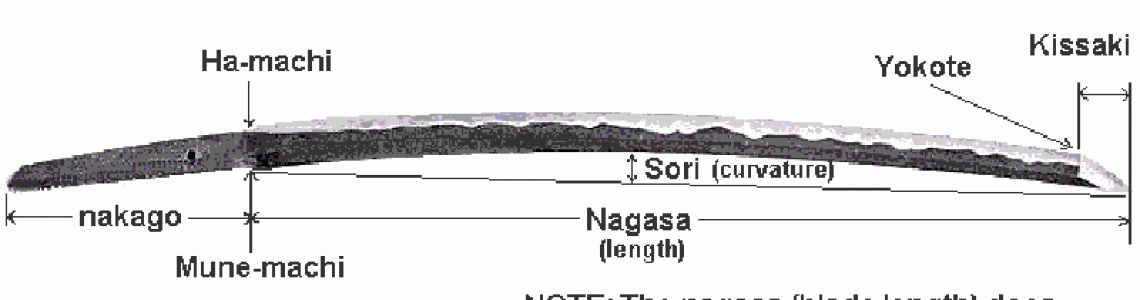
Japanese swords are measured differently from many modern swords. When people ask about the size of a katana, they often look only at the overall length. However, traditional Japanese sword measurements are based on several important dimensions, including the nagasa, sori, nakago, kissaki, blade width, and blade thickness.
Understanding these measurements is useful for collectors, martial arts practitioners, and anyone buying a Japanese sword. Knowing how to measure a katana correctly also makes it easier to compare different swords and understand product specifications.
In this guide, we will explain how to measure Japanese sword size properly and introduce the most important dimensions used when describing a katana or other traditional Japanese blades.
What Does Japanese Sword Size Mean?
The size of a Japanese sword is not determined by a single measurement. A complete description of a blade may include its blade length, curvature, tang length, blade width, thickness, and point length.
The most important measurement is usually the nagasa, which refers to the length of the blade itself. It is important to understand that the nagasa is not the same as the overall length of the sword.
For example, two katana may have the same overall length but different blade lengths because their handles, tangs, or mountings are different.
When comparing Japanese swords, collectors usually pay attention to several measurements rather than relying only on the total length.
The Most Important Japanese Sword Measurements
Before measuring a Japanese sword, it is helpful to understand the basic terminology.
- Nagasa: Blade length
- Sori: Blade curvature
- Nakago: Tang length
- Kissaki: Length of the sword point
- Motohaba: Blade width near the base
- Sakihaba: Blade width near the point
- Motokasane: Blade thickness near the base
- Sakikasane: Blade thickness near the point
Together, these measurements provide a much more complete description of a Japanese sword than overall length alone.
How to Measure Nagasa: Japanese Sword Blade Length
The nagasa is the most important measurement of a Japanese sword blade. It is generally used to describe the length of the blade and is one of the first specifications collectors look at when comparing Japanese swords.
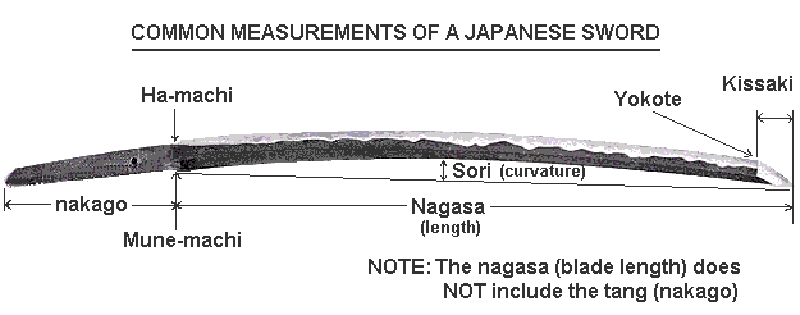
To measure the nagasa correctly, measure in a straight line from the mune-machi to the tip of the kissaki.
The mune-machi is located at the base of the blade where the blade transitions into the tang. The kissaki is the point of the sword.
One common mistake is measuring along the curved cutting edge. This does not provide the standard blade length measurement. The nagasa is measured as a straight line between the base measurement point and the tip.
In simple terms:
Nagasa = Straight-line distance from the mune-machi to the tip of the kissaki.
For most collectors and buyers, the nagasa is the most useful measurement when comparing the size of different katana blades.
How to Measure Sori: Japanese Sword Curvature
The sori is the curvature of a Japanese sword blade. The sori plays an important role in the overall appearance and character of a katana.
To measure sori, first imagine or establish a straight line between the mune-machi and the tip of the kissaki. Then measure the greatest distance between this straight line and the curved back of the blade, known as the mune.
That maximum distance represents the sori.
A Japanese sword with a deeper curve will have a larger sori measurement, while a straighter blade will have a smaller sori.
The amount and location of curvature can significantly affect the visual profile of a sword. Some blades have more curvature near the base, while others have curvature that is distributed more evenly across the blade.
How to Measure the Nakago
The nakago is the tang of the Japanese sword. It is the portion of the blade that extends inside the handle, or tsuka.
The nakago is measured separately from the nagasa.
To measure the nakago, measure from the mune-machi to the end of the tang, known as the nakago-jiri.
The tang is not normally included when determining the nagasa. This is why the blade length and the total length of a Japanese sword can be significantly different.
The nakago may also contain important information about a sword, including the maker's signature, called the mei, file marks, known as yasurime, and other historical characteristics.
How to Measure the Kissaki
The kissaki is the pointed section at the end of a Japanese sword blade.
The kissaki is generally measured from the yokote to the tip of the sword.
The yokote is the line or transition that separates the main portion of the blade from the point.
Kissaki size can vary considerably depending on the style and period of the Japanese sword. Some blades have relatively short points, while others have long and prominent kissaki.
Although the kissaki measurement is not usually the first specification considered when buying a katana, it is important when describing the overall geometry and appearance of the blade.
How to Measure Japanese Sword Blade Width
Blade width is another important measurement when describing a Japanese sword.
The width of the blade near the base is called motohaba. It is measured near the machi, where the blade begins.
The width closer to the point is called sakihaba.
Comparing motohaba and sakihaba can help describe how much the blade tapers from the base toward the point.
A blade with a wide motohaba and narrow sakihaba will have a stronger visible taper. A blade with less difference between these two measurements may appear wider and more uniform along its length.
Blade width can influence the visual balance and overall character of a katana, wakizashi, or other Japanese sword.
How to Measure Blade Thickness
The thickness of a Japanese sword blade is commonly described using the term kasane.
Blade thickness near the base is called motokasane, while thickness closer to the point is called sakikasane.
These measurements help describe the geometry of the blade and how the blade tapers from the base toward the kissaki.
Thickness measurements are especially useful when comparing blades with similar lengths and widths.
However, blade thickness alone does not determine the overall quality of a sword. The shape, construction, heat treatment, steel, and blade geometry should all be considered together.
Japanese Sword Size: Blade Length vs Overall Length
One of the most common sources of confusion when buying a katana is the difference between blade length and overall sword length.
The blade length usually refers to the nagasa. The overall length may include the blade, handle, and other mounted components.
Because Japanese swords can have different handle lengths and mountings, two swords with the same blade length may have different overall dimensions.
For this reason, buyers should always check the product specifications carefully.
When comparing Japanese swords, look at:
- Blade length (Nagasa)
- Overall length
- Handle length
- Blade curvature (Sori)
- Blade width
- Blade thickness
These measurements provide a much clearer picture of the actual size and proportions of the sword.
Traditional Japanese Sword Measurements: Shaku, Sun, and Bu
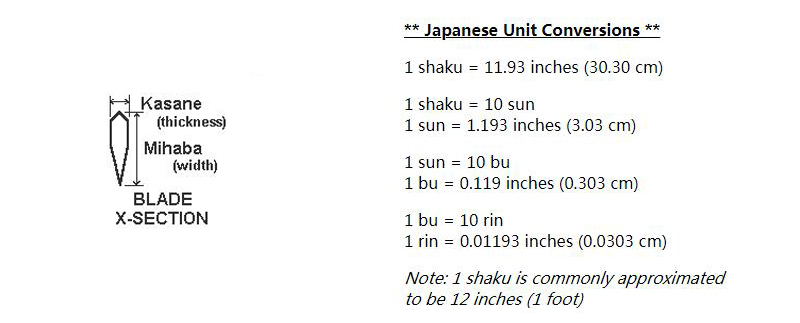
Traditional Japanese swords were commonly measured using Japanese units known as shaku, sun, and bu.
The basic relationship between these units is:
- 1 shaku = 10 sun
- 1 sun = 10 bu
One shaku is approximately 30.3 centimeters, or about 11.9 inches.
Although modern sword specifications are often listed in centimeters or inches, traditional Japanese measurements are still commonly used when discussing historical blades.
For example, a Japanese sword may be described by its length in shaku while modern product specifications provide the same measurement in centimeters.
Common Japanese Sword Length Categories
Japanese swords are often grouped according to blade length. Traditional classifications may vary depending on historical context, but the following categories provide a useful general reference.
- Tanto: Short Japanese blade, generally under 1 shaku.
- Wakizashi: Medium-length sword, generally between 1 and 2 shaku.
- Katana: Long sword, generally over 2 shaku.
These categories are primarily based on blade length rather than the total length of the mounted sword.
This is another reason why understanding the nagasa is important when identifying and comparing Japanese swords.
Typical Katana Length
There is no single standard size for every katana. Japanese swords were made for different periods, purposes, and individual preferences.
However, many modern katana replicas and traditionally styled swords have blade lengths in the range commonly associated with full-size Japanese swords.
When choosing a katana, it is usually better to consider more than just blade length.
A sword should also have balanced proportions between the blade, handle, and overall construction.
For example, a longer blade may look impressive, but the best size for a particular user depends on personal preference, intended use, storage space, and handling requirements.
How to Measure a Katana at Home
If you want to measure a katana yourself, use a straight ruler or measuring tape and follow a consistent method.
For accurate measurements, place the sword on a stable and protected surface. Avoid measuring while holding the sword in the air.
Measure the following:
- Nagasa: Straight line from the mune-machi to the kissaki.
- Sori: Maximum distance between the blade's back and the straight nagasa measurement line.
- Nakago: From the mune-machi to the end of the tang.
- Kissaki: From the yokote to the tip.
- Overall length: The total length of the complete sword.
When measuring a mounted sword, remember that the tang is inside the handle and cannot normally be measured without disassembling the sword. For ordinary product comparison, the blade length and overall length are usually sufficient.
Always handle a Japanese sword carefully. A sharp blade should not be disassembled or handled unnecessarily.
Why Accurate Japanese Sword Measurements Matter
Accurate measurements are important for collectors, buyers, sword enthusiasts, and anyone comparing different Japanese swords.
A product description that lists only the overall length does not provide the complete picture. Two swords with the same total length may have different blade lengths, handle lengths, and proportions.
Understanding Japanese sword measurements can help you:
- Compare different katana more accurately.
- Understand traditional Japanese sword terminology.
- Choose the right blade size.
- Evaluate sword proportions.
- Read historical sword specifications.
- Compare modern replicas with traditional measurements.
For collectors, measurements can also provide useful information about the style and proportions of a particular blade.
Which Japanese Sword Measurement Is the Most Important?
For most people, the most important measurement is the nagasa, or blade length.
The nagasa is commonly used to identify the size category of a Japanese sword and is one of the most useful measurements when comparing different blades.
However, the nagasa should not be considered alone.
A complete understanding of a Japanese sword also requires looking at its curvature, blade width, thickness, tang length, and overall proportions.
The combination of these measurements creates the unique shape and character of each sword.
Final Thoughts
Learning how to measure Japanese sword size properly is useful for anyone interested in katana, wakizashi, tanto, or traditional Japanese swords.
The most important measurement is the nagasa, which represents the blade length measured in a straight line from the mune-machi to the tip of the kissaki. Other important measurements include the sori, nakago, kissaki, blade width, and blade thickness.
When comparing Japanese swords, do not rely only on the overall length. Looking at the complete set of measurements will give you a much better understanding of the sword's size, proportions, and design.
Whether you are buying your first katana, comparing different Japanese swords, or studying traditional sword terminology, understanding these measurements will help you make more informed decisions.
Frequently Asked Questions About Japanese Sword Size
1. How is katana length measured?
Katana blade length is usually measured as the nagasa, using a straight line from the mune-machi to the tip of the kissaki. The measurement does not include the tang or handle.
2. What is nagasa on a Japanese sword?
Nagasa refers to the length of the Japanese sword blade. It is one of the most important measurements used when describing a katana, wakizashi, or other traditional Japanese sword.
3. Is katana blade length measured along the curve?
No. The standard nagasa measurement is taken in a straight line from the mune-machi to the tip of the kissaki. Measuring along the curved edge will produce a different result.
4. What is sori on a katana?
Sori is the curvature of a Japanese sword blade. It is measured as the greatest distance between the curved back of the blade and the straight line used to measure the nagasa.
5. What is the difference between blade length and overall sword length?
Blade length refers to the nagasa, while overall length includes the complete mounted sword. Overall length may include the blade, handle, and other components.
6. How long is a typical katana?
Katana sizes can vary. Traditional Japanese swords were made in different lengths depending on the period, style, and intended use. When comparing katana, the blade length, or nagasa, is generally more useful than overall length alone.
7. What is the nakago?
The nakago is the tang of a Japanese sword. It extends from the blade into the handle and is measured separately from the nagasa.
8. What units are traditionally used to measure Japanese swords?
Traditional Japanese sword measurements use units such as shaku, sun, and bu. Modern sword specifications may also use centimeters and inches.
9. What measurements should I check before buying a katana?
Before buying a katana, check the blade length, overall length, handle length, sori, blade width, blade thickness, weight, and other product specifications. These details provide a better understanding of the sword's size and proportions.
10. Can two katana have the same overall length but different blade lengths?
Yes. Two katana can have similar overall lengths while having different blade and handle lengths. This is why it is important to check the nagasa when comparing Japanese swords.