
Common Boshi Styles: A Guide to Japanese Sword Tip Hamon
Common Boshi Styles: A Guide to Japanese Sword Tip Hamon
The boshi is one of the most important features found near the tip of a traditionally made Japanese sword. It is the continuation of the hamon into the kissaki, or point of the blade.
Although the kissaki is relatively small compared with the rest of a katana blade, the boshi can reveal a great deal about the sword's heat treatment, overall craftsmanship and visual character. Japanese sword enthusiasts and collectors often examine the boshi carefully when studying a blade.
Like the hamon along the main edge of the sword, the boshi can appear in different patterns. Some form a small rounded turn-back, while others create a large curve, irregular waves, brush-like streaks or a pattern with no turn-back at all.
Understanding the most common boshi styles is useful for anyone interested in Japanese swords, katana craftsmanship and traditional sword terminology.
In this guide, we will explain the most common types of boshi, including Komaru, Ō-maru, Midare-komi, Hakikake, Yakizume, Jizō and Kaen.
What Is Boshi on a Japanese Sword?
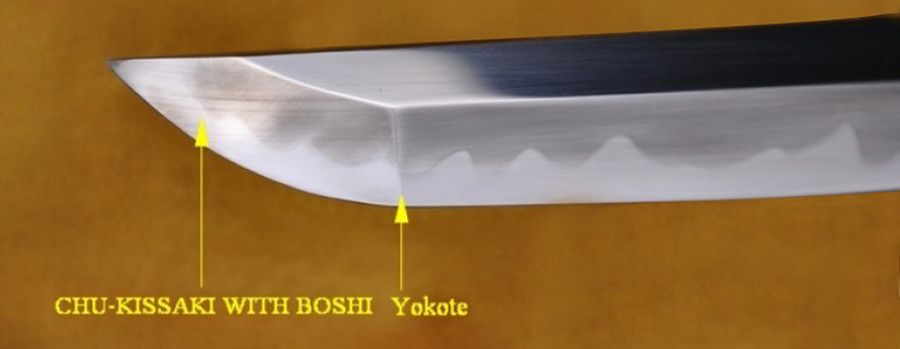
Boshi (帽子) refers to the hamon pattern in the kissaki, the pointed section of a Japanese sword blade.
The hamon is associated with differential hardening. During the traditional heat-treatment process, different areas of the blade can develop different structures and visual characteristics. After proper polishing, the hardened pattern becomes visible as the hamon.
When this pattern continues from the main body of the blade into the kissaki, it forms the boshi.
In many examples, the hamon enters the kissaki, approaches the point and then turns back toward the spine of the blade. This return is known as kaeri, meaning a turn-back or return.
However, not every boshi has the same form. The size, shape and direction of the kaeri can vary significantly. Some boshi have a small rounded return, while others have a large curve, a deep return or no kaeri at all.
For this reason, the boshi has developed its own vocabulary within Japanese sword study.
Boshi, Hamon and Kissaki: What Is the Difference?
These three terms are closely connected, but they describe different parts of a Japanese sword.
Hamon refers to the visible tempering pattern that runs along the hardened edge of a differentially hardened Japanese blade.
Kissaki refers to the pointed tip section of the sword.
Boshi refers specifically to the continuation of the hamon within the kissaki.
The yokote, when present and clearly defined in the blade geometry and polish, marks the transition between the main body of the blade and the kissaki.
A simple way to understand the relationship is:
Hamon = temper pattern along the blade
Kissaki = the tip section of the blade
Boshi = the hamon pattern within the kissaki
This distinction is important because the boshi is not simply another name for the tip of the sword. It is a specific feature of the hardened pattern visible in the tip area.
What Is Kaeri?
Kaeri (返り) refers to the turn-back of the boshi.
As the hamon enters the kissaki, it may curve around the point and return toward the back of the blade. The shape and length of this returning section are important characteristics when describing different boshi styles.
For example, a small rounded kaeri may be described as Komaru, while a larger rounded return may be called Ō-maru.
Some boshi have an especially deep or long return. Others, such as Yakizume, are characterized by the absence of a kaeri.
Understanding kaeri makes it much easier to recognize the differences between common types of boshi.
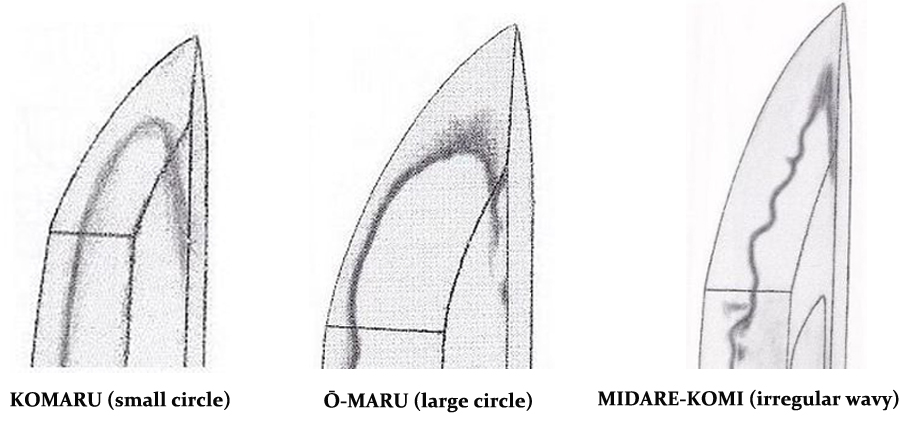
1. Komaru Boshi: The Small Rounded Turn-Back
Komaru (小丸) literally means "small round." It is one of the most common and easily recognized boshi styles.
A Komaru boshi features a relatively small, rounded turn-back near the point of the kissaki. The boshi follows the hamon into the tip, curves around the point and forms a compact rounded kaeri.
The appearance is generally controlled, balanced and elegant. Because the turn-back is relatively small, Komaru often creates a neat and refined visual effect.
Komaru can appear with different hamon patterns. The main characteristic is the small rounded form of the kaeri rather than the exact pattern of the hamon along the rest of the blade.
Characteristics of Komaru Boshi
- Small rounded turn-back
- Compact and controlled appearance
- One of the most recognizable boshi forms
- Defined by the shape of its kaeri
- Can accompany different hamon styles
For beginners learning Japanese sword terminology, Komaru is often one of the easiest boshi styles to identify.
2. Ō-maru Boshi: The Large Rounded Turn-Back
Ō-maru (大丸) means "large round."
As the name suggests, this style is characterized by a larger rounded turn-back than Komaru.
The hamon continues into the kissaki and forms a broader curve around the point before returning toward the back of the blade.
The result is a more prominent and expansive rounded pattern.
The difference between Komaru and Ō-maru is primarily the scale of the rounded turn-back. Komaru is smaller and tighter, while Ō-maru has a larger and more extensive curve.
Characteristics of Ō-maru Boshi
- Large rounded turn-back
- Broader curve around the kissaki
- More prominent than Komaru
- Creates a bold rounded appearance
- Defined primarily by the size of the kaeri
Both Komaru and Ō-maru are important examples of rounded boshi forms and are useful reference points when learning to identify Japanese sword tip hamon.
3. Midare-komi Boshi: An Irregular Pattern in the Kissaki
Midare-komi refers to a boshi in which an irregular or undulating hamon pattern continues into the kissaki.
The word midare is associated with an irregular or wavy pattern. Instead of becoming completely smooth and uniform at the tip, the hamon retains an active and uneven appearance.
Midare-komi can create a lively visual effect because the pattern flowing along the main blade continues naturally into the kissaki.
The exact appearance can vary greatly. Some examples have gentle waves, while others are more dramatic and complex.
Because Midare-komi describes the irregular character of the boshi, it may also appear in combination with other visible features near the point.
Characteristics of Midare-komi Boshi
- Irregular or wavy pattern
- Active appearance in the kissaki
- Continues an irregular hamon into the tip
- Can vary significantly from blade to blade
- May appear with other boshi characteristics
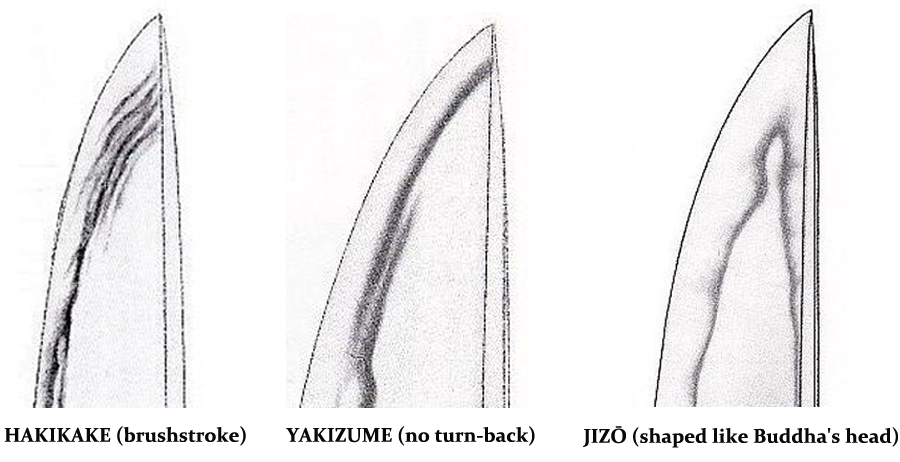
4. Hakikake Boshi: The Brushstroke Appearance
Hakikake (掃掛け) is commonly translated as a brushstroke or brushed appearance.
This style is characterized by streaked activity that can create the visual impression of brush marks extending across the boshi area.
Hakikake can give the kissaki a dynamic and energetic appearance. Instead of a smooth and clearly defined rounded pattern, the tempering activity appears more irregular and swept.
The amount of Hakikake can vary. In some cases, it is only one feature within the boshi. In others, the brush-like activity becomes more dominant.
When the brushstroke effect is especially pronounced, the boshi may be described using the term Kaen.
Characteristics of Hakikake Boshi
- Brushstroke-like appearance
- Streaked activity in the boshi
- Dynamic and energetic visual character
- Can accompany irregular hamon patterns
- Heavy Hakikake may be associated with Kaen boshi
5. Yakizume Boshi: A Boshi with No Turn-Back
Yakizume (焼詰) is one of the most distinctive boshi styles because it is characterized by the absence of a normal turn-back.
In a Yakizume boshi, the hamon continues into the kissaki but does not form a clear kaeri returning toward the back of the blade.
The hardened pattern appears to terminate without the familiar return seen in Komaru or Ō-maru.
Yakizume does not necessarily mean that the boshi has only one visual form. The pattern leading into the kissaki may still be straight, irregular or accompanied by other forms of activity.
The key identifying feature is the lack of a normal turn-back.
Characteristics of Yakizume Boshi
- No normal kaeri or turn-back
- The hamon terminates in the kissaki
- Clearly different from rounded boshi styles
- May appear with straight or irregular patterns
- Important traditional category of Japanese sword boshi
Yakizume is particularly useful for comparison because it demonstrates that not every boshi follows the same rounded return pattern.
6. Jizō Boshi: The Bodhisattva-Shaped Form
Jizō Boshi is named after its resemblance to the profile or head shape associated with Jizō, a well-known Buddhist bodhisattva in Japanese tradition.
This type of boshi can appear similar to Midare-komi, but it has a more distinctive constricted area that gives the overall pattern a recognizable silhouette.
The relationship between the irregular portion of the pattern and the narrowed area of the kaeri creates the characteristic visual form.
Jizō boshi is particularly important in traditional Japanese sword terminology because it demonstrates how boshi names can be based on visual resemblance rather than simply describing a geometric shape.
It is often discussed in connection with blades from particular sword-making traditions, including examples associated with Mino swordsmithing.
Characteristics of Jizō Boshi
- Distinctive silhouette resembling the head or profile of Jizō
- Often related to irregular Midare-komi patterns
- Features a constricted or narrowed return area
- Recognizable through its unusual overall outline
- Associated with traditional Japanese sword classification
7. Kaen Boshi: The Flame-Like Pattern
Kaen (火炎) means flame.
Kaen boshi is characterized by strong, dramatic activity that can create a flame-like appearance in the kissaki.
The pattern is often associated with pronounced Hakikake or other vigorous tempering activity.
Compared with a simple rounded Komaru boshi, Kaen has a much more energetic and irregular visual character.
The name reflects the impression created by the pattern rather than a perfectly standardized geometric outline.
Kaen is a useful example of how Japanese sword terminology often describes the visual qualities of the hamon through references to natural forms and familiar objects.
Characteristics of Kaen Boshi
- Flame-like appearance
- Strong and active tempering pattern
- Often associated with pronounced Hakikake
- Highly dynamic visual character
- One of the more dramatic boshi forms
8. Ichimai Boshi: When the Temper Pattern Fills the Kissaki
Ichimai (一枚) refers to a boshi in which the hardened pattern fills, or nearly fills, the kissaki area.
Rather than appearing as a narrow line that simply travels around the point, the visible hardened area occupies a much larger portion of the tip.
This creates a distinctive appearance and makes Ichimai easy to distinguish from many other boshi styles.
The exact visual result depends on the blade, polishing and underlying heat treatment, but the defining idea is the extensive coverage of the kissaki by the hardened pattern.
Ichimai demonstrates the wide range of forms that can occur in the boshi and helps explain why Japanese sword terminology contains many specialized categories for the tip area.
How Boshi Relates to the Overall Hamon
The boshi should not be studied completely separately from the rest of the blade.
In many Japanese swords, the pattern of the hamon along the main edge provides important context for understanding the appearance of the boshi.
A straight hamon may enter the kissaki differently from an irregular Midare hamon. A highly active pattern may continue into the tip with waves, streaks or brush-like activity.
However, the boshi can also develop characteristics that make it distinct from the hamon along the main body of the blade.
For this reason, Japanese sword students often examine both the overall hamon and the boshi when describing a blade.
The relationship between the two can contribute to the overall visual balance of the sword.
Why Is the Boshi Important?
The boshi is important for several reasons.
First, it is part of the overall heat-treatment pattern of a traditionally differentially hardened blade.
Second, the boshi is an important visual feature. The kissaki is a highly visible part of a Japanese sword, and the pattern within it contributes to the character of the entire blade.
Third, the boshi is relevant when studying Japanese sword craftsmanship and traditional terminology.
Collectors and students of Japanese swords often pay close attention to the boshi because different patterns can provide useful information when describing and comparing blades.
The boshi is also technically demanding to reveal clearly during polishing. The geometry and surface of the kissaki require careful work, and the visibility of the temper pattern depends on the condition of the blade and the quality of the polish.
Can Every Japanese Sword Have a Boshi?
The term boshi is generally used to describe the hamon pattern in the kissaki of a traditionally differentially hardened blade.
A sword that does not have a visible differential hardening pattern in the traditional sense will not display a boshi in the same way as a clay-tempered blade with a visible hamon.
Modern Japanese-style swords can be produced using different steels and heat-treatment methods. As a result, the appearance of the blade may vary significantly.
Some modern production swords may have a decorative or artificial hamon rather than a naturally formed temper line.
Therefore, when studying a boshi, it is important to understand how the blade was made and whether the visible pattern is the result of traditional differential hardening.
How to Identify Boshi on a Katana
To identify the boshi, begin by locating the kissaki.
The kissaki is the pointed section near the end of the blade. On many traditionally shaped Japanese swords, the transition between the main blade and the kissaki is visually associated with the yokote.
Next, follow the visible hamon toward the point of the blade.
Observe how the tempering pattern behaves as it enters the kissaki.
Ask the following questions:
- Does the pattern form a small rounded turn-back?
- Does it form a large rounded curve?
- Does the pattern remain irregular?
- Are brush-like streaks visible?
- Does the boshi have a clear kaeri?
- Does the pattern terminate without turning back?
These observations can help identify the general style of the boshi.
However, correctly identifying complex examples may require experience because Japanese sword terminology can describe combinations of features rather than completely separate categories.
Common Boshi Styles at a Glance
Komaru: A small rounded turn-back.
Ō-maru: A large rounded turn-back.
Midare-komi: An irregular or wavy pattern continuing into the kissaki.
Hakikake: A brushstroke-like or streaked appearance.
Yakizume: A boshi with no normal turn-back.
Jizō: A distinctive form resembling the profile or head shape associated with Jizō.
Kaen: A dramatic flame-like pattern, often with pronounced brush-like activity.
Ichimai: A pattern in which the hardened area fills or nearly fills the kissaki.
Conclusion: Understanding Common Boshi Styles
The boshi is a small but important part of a Japanese sword.
As the continuation of the hamon into the kissaki, it connects the heat-treatment pattern of the main blade with the distinctive geometry of the sword's tip.
Different boshi styles can create very different visual effects. Komaru and Ō-maru form rounded turn-backs, Midare-komi creates an irregular pattern, Hakikake produces a brushstroke-like appearance and Yakizume is recognized by the absence of a normal kaeri.
Jizō, Kaen and Ichimai demonstrate even greater variety in the way the hardened pattern can appear within the kissaki.
For collectors, sword enthusiasts and anyone learning Japanese sword terminology, understanding the boshi is an important step toward appreciating the craftsmanship of a traditionally made katana.
The next time you examine a Japanese sword, do not focus only on the hamon along the main edge. Follow the pattern all the way to the kissaki and observe how it forms the unique character of the boshi.
Frequently Asked Questions About Boshi
What is Boshi on a Japanese sword?
Boshi is the continuation of the hamon into the kissaki, or tip section, of a Japanese sword. It describes the visible tempering pattern within the point of the blade.
What is the difference between Boshi and Hamon?
Hamon refers to the visible tempering pattern along the blade, while Boshi specifically refers to the continuation of that pattern within the kissaki.
What is Kaeri on a katana?
Kaeri is the turn-back or returning section of the Boshi. After the hamon enters the kissaki, it may curve around the point and return toward the back of the blade.
What is Komaru Boshi?
Komaru Boshi is a Boshi with a small rounded turn-back. It is one of the most common and easily recognized Japanese sword tip hamon styles.
What is Ō-maru Boshi?
Ō-maru Boshi has a large rounded turn-back. It is similar to Komaru but features a broader and more prominent rounded curve.
What is Yakizume Boshi?
Yakizume is a Boshi style in which the hamon runs into the kissaki without forming a normal turn-back or kaeri.
What does Hakikake mean?
Hakikake refers to a brushstroke-like appearance in the Boshi. The tempering activity can create streaks that resemble marks made by a brush.
Does every katana have a Boshi?
Boshi is associated with the visible hamon in the kissaki of a differentially hardened blade. A sword without a traditional visible differential hardening pattern will not show Boshi in the same way.
Why is Boshi important?
Boshi is important because it is part of the blade's heat-treatment pattern and a significant feature when studying Japanese sword craftsmanship. Its form also contributes to the appearance and character of the kissaki.