
Ko-Katana Vs Katana
Ko-Katana vs Katana: What's the Difference?
A Complete Guide to Japanese Sword Length, Handling, and Choosing the Right Blade
When exploring traditional Japanese swords, you may encounter both the Ko-Katana and the Katana. Although they share a similar appearance, their differences in blade length, reach, balance, and handling can significantly influence the experience of owning and using them.
A Ko-Katana offers a more compact interpretation of the traditional Japanese katana, while a standard Katana provides greater reach and a longer blade. Neither is automatically better: the right choice depends on your preferences, intended purpose, and desired sword dimensions.
In this guide, HanBon Forge explains the key differences between Ko-Katana and Katana swords, including their dimensions, construction, historical context, practical characteristics, and customization options.
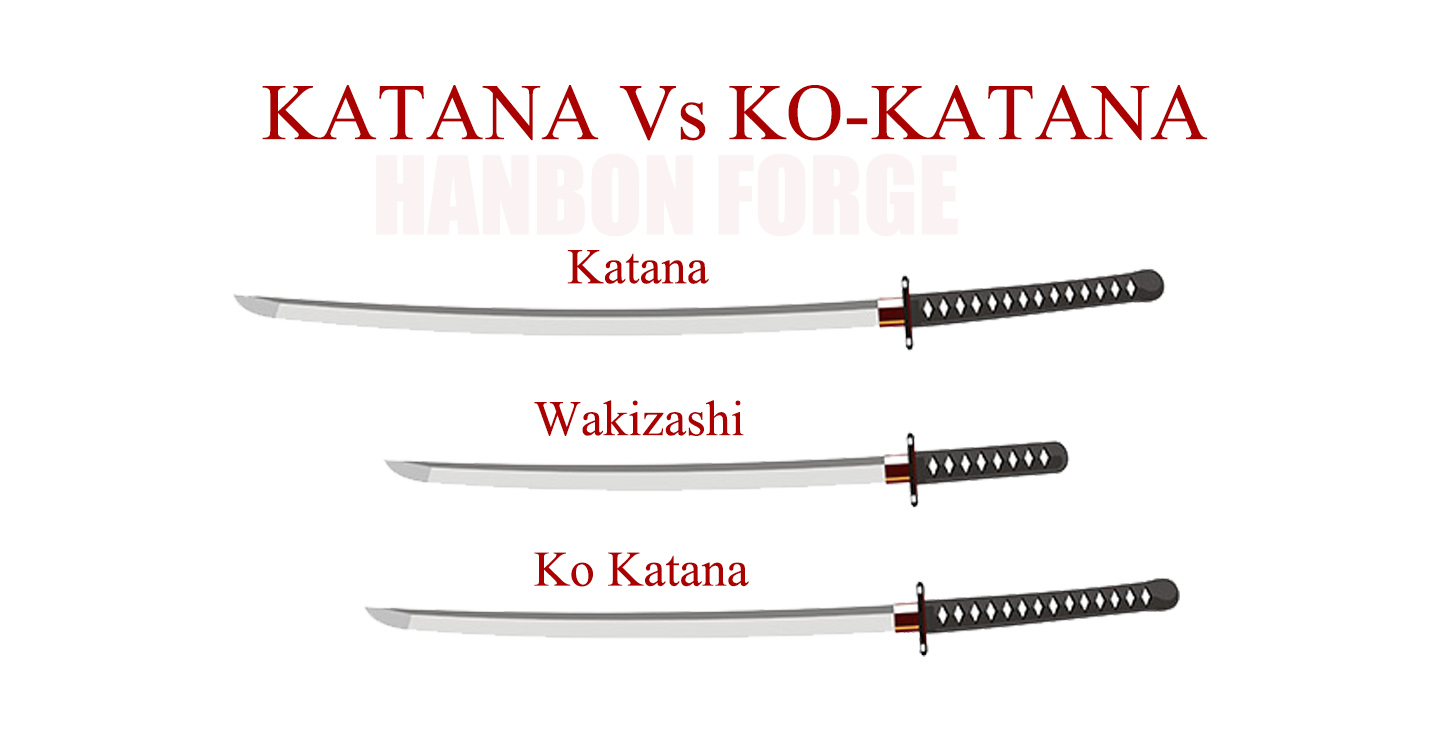
Visual comparison of Katana, Wakizashi, and Ko-Katana sword designs. Illustration for general reference.
The Main Difference at a Glance
Ko-Katana: A shorter, more compact katana-style sword that generally offers easier handling and reduced reach.
Katana: A traditional longer Japanese sword offering greater reach, a longer cutting edge, and familiar full-length katana proportions.
Ko-Katana vs Katana: Size Comparison
Blade length is the most obvious difference between these two Japanese swords. At HanBon Forge, a typical Ko-Katana configuration has a 24-inch blade, while a standard Katana configuration has a 28-inch blade.
| Feature | Ko-Katana | Standard Katana |
|---|---|---|
| Typical HanBon Forge Blade Length | 24 inches (61 cm) | 28 inches (71 cm) |
| Typical Handle Length | 6 inches (15 cm) | 11 inches (28 cm) |
| Overall Size | Compact | Full-length |
| Reach | Shorter | Longer |
| Handling | Generally easier to maneuver in limited space | Longer reach and broader movement requirements |
| Balance | Depends on blade and handle geometry | Depends on blade and handle geometry |
| Display | Suitable for compact displays | Classic full-size sword presentation |
| Customization | Available | Available |
Note: Dimensions shown are typical HanBon Forge configurations, not universal measurements for every Japanese sword. Custom blade lengths, handles, and fittings may vary.
For a more detailed explanation of how blade and handle dimensions are measured, read our Japanese Sword Size and Measurement Guide.
What Is a Ko-Katana?
The term Ko-Katana is commonly used in today's sword market to describe a shorter katana-style Japanese sword. The Japanese prefix "ko" means small, and in modern sword-making terminology, it generally indicates a compact version of a standard katana.
Unlike a traditional Wakizashi, which is a historically established Japanese short-sword category, the modern commercial term Ko-Katana does not refer to one universally standardized historical sword type.
A modern Ko-Katana typically retains familiar katana design elements, including:
- A curved, single-edged blade.
- A traditional Japanese-style handle (tsuka).
- A guard (tsuba) and matching metal fittings.
- A wooden scabbard (saya).
- Katana-style blade geometry and finishing options.
Its shorter proportions make the Ko-Katana attractive to enthusiasts who appreciate the traditional katana appearance but prefer a more compact sword.
Explore our collection of handmade Ko-Katana swords.
What Is a Traditional Katana?
The Katana is one of Japan's most recognizable swords. Characterized by its curved, single-edged blade, distinctive handle construction, and traditional mountings, it became closely associated with the samurai during Japan's feudal era.
A standard modern Katana often features a blade around 28 inches long, although historical and contemporary examples vary considerably.
Katana construction may include:
- A long curved blade with a defined cutting edge.
- A tsuka designed for secure grip and control.
- A tsuba positioned between the blade and handle.
- A fitted saya for storage and carrying.
- Traditional features such as hamon, bo-hi, and decorative koshirae, depending on the model.
The Katana is especially popular with collectors, Japanese sword enthusiasts, and practitioners of traditional sword arts.
Browse our hand-forged Katana collection to explore different steel types, finishes, and fittings.
Handling, Balance, and Maneuverability
1. Reach and Blade Length
A standard Katana's longer blade provides greater reach. This is one of the most noticeable differences when comparing a typical 28-inch Katana with a 24-inch Ko-Katana.
A Ko-Katana sacrifices some reach in exchange for more compact dimensions, which can make it easier to manage in environments where available space is limited.
2. Weight and Balance
A shorter blade often reduces overall sword weight, but blade length alone does not determine how a sword feels.
Blade thickness, width, distal taper, steel distribution, handle length, and fittings all influence the sword's balance and rotational inertia.
As a result, a well-balanced full-length Katana may feel more comfortable than a poorly balanced shorter sword. Sword selection should consider the entire construction rather than blade length alone.
3. Drawing and Movement
A shorter blade generally requires less space to draw from its scabbard, while a longer Katana requires more room and appropriate technique.
However, successful drawing and controlled handling depend on the practitioner's training, the sword's mounting, and the style of martial art being practiced.
Historical Context: Is a Ko-Katana Older Than a Katana?
Japanese sword development spans many centuries, with blade designs evolving in response to changes in warfare, armor, social customs, and sword-making techniques.
Historically recognized Japanese sword categories include the Tachi, Katana, Wakizashi, Kodachi, and Tanto. Their distinctions involve more than just overall length, including historical period, mounting style, and intended use.
The name Ko-Katana can be encountered in discussions of smaller katana-length swords, but its modern commercial use should not be confused with a single historical predecessor from which all later Katana developed.
It is also important not to confuse Ko-Katana with Kogatana, a term that can refer to a small utility blade associated with Japanese sword fittings.
For modern collectors, the key distinction is straightforward: a Ko-Katana usually describes a shorter katana-style sword, whereas Katana is a historically established sword category.
Ko-Katana vs Wakizashi: Are They the Same?
Although they can appear similar, a Ko-Katana and a Wakizashi are not necessarily the same type of sword.
A Wakizashi is a traditional Japanese short sword, historically associated with samurai sidearms and commonly worn together with a Katana as part of a paired set known as a daisho.
A modern Ko-Katana is generally marketed as a shorter katana-style sword. Some models feature a longer blade than a typical Wakizashi, and handle proportions may also differ.
| Characteristic | Ko-Katana | Wakizashi |
|---|---|---|
| Classification | Common modern commercial sword category | Traditional Japanese short-sword category |
| Typical HanBon Forge Blade | 24 inches | 20 inches |
| Handle | Varies by design | Typically shorter than a Katana handle |
| Style | Compact katana-style proportions | Traditional short-sword proportions |
If you are considering a shorter Japanese sword, we recommend comparing the Ko-Katana collection with our Wakizashi swords before deciding.
Which Should You Choose: Ko-Katana or Katana?
Your ideal sword depends on how you intend to use or display it, your preferred dimensions, and your appreciation of traditional Japanese craftsmanship.
Choose a Ko-Katana If...
- You prefer a shorter, more compact Japanese sword.
- You want a katana-style appearance with reduced overall dimensions.
- You have limited display space.
- You prefer a shorter blade and potentially lighter handling.
- You are interested in an alternative to a full-length Katana.
Choose a Katana If...
- You prefer traditional full-length katana proportions.
- You want greater blade reach.
- You appreciate the classic appearance of a long Japanese sword.
- You want a broader selection of standard configurations.
- You are building a traditional Japanese sword collection.
For collectors, either sword can make an excellent addition to a display. For martial arts applications, the most suitable length and configuration should be selected with consideration for the specific training discipline.
Can You Customize a Ko-Katana or Katana?
At HanBon Forge, we specialize in handcrafted and customized Japanese swords. Customers can select from a wide range of blade materials, traditional mountings, handle styles, and decorative details.
Depending on the design and production requirements, available customization options may include:
- Blade steel: 1060 carbon steel, 1095 carbon steel, T10 steel, folded steel, and other available options.
- Blade length: Standard or custom dimensions, subject to production feasibility.
- Blade finish: Traditional polishing, mirror polishing, and selected clay-tempered hamon finishes.
- Handle: Custom tsuka length, ito wrapping colors, and rayskin options.
- Fittings: Tsuba, fuchi, kashira, menuki, habaki, and seppa selections.
- Saya: Different colors, finishes, and decorative styles.
- Personalization: Selected engraving options and other custom details.
If your preferred sword dimensions fall between a Ko-Katana and a standard Katana, a custom configuration may be possible.
You can explore our Custom Katana Builder or contact HanBon Forge to discuss a specific design.
Frequently Asked Questions
Here are answers to some common questions about Ko-Katana and Katana swords.
1. What is the main difference between a Ko-Katana and a Katana?
The main difference is blade length and overall size. A Ko-Katana is generally a shorter, more compact katana-style sword, while a standard Katana has a longer blade and greater reach.
2. How long is a Ko-Katana?
Ko-Katana dimensions vary by manufacturer and design. A typical HanBon Forge Ko-Katana has a 24-inch (approximately 61 cm) blade, while our standard Katana configuration commonly uses a 28-inch (approximately 71 cm) blade.
3. Is a Ko-Katana the same as a Wakizashi?
No. Wakizashi is a historically recognized Japanese short-sword category. Ko-Katana is commonly used today as a commercial description for a shorter katana-style sword. Their dimensions and mountings may overlap, but the names are not interchangeable.
See our Wakizashi collection for examples.
4. Is a Ko-Katana easier to handle than a full-length Katana?
A shorter blade may be easier to maneuver in restricted spaces and can reduce overall weight. However, actual handling depends on the complete sword design, including balance, blade geometry, handle dimensions, and the experience of the user.
5. Can a Ko-Katana be used for cutting practice?
A properly constructed and sharpened Ko-Katana may be suitable for appropriate supervised cutting practice, depending on the specific model and its intended use. Not all swords are designed for cutting, and any training should follow appropriate safety procedures.
6. Can I order a custom Ko-Katana from HanBon Forge?
Yes. HanBon Forge offers customization options for Japanese swords, including selected blade lengths, handle designs, fittings, and finishes. Special requests are subject to production feasibility.
Visit our Custom Katana page to explore available options.
7. Which sword is better for a beginner?
For collecting and display, either style can be a good starting point. For martial arts training, the correct sword length and type depend on the discipline and instructor's requirements. Beginners should prioritize appropriate dimensions, safe construction, and suitable training equipment.
You may also find our First Katana Buying Guide helpful.
8. Does a shorter Ko-Katana always weigh less?
Not necessarily. Although a shorter blade often reduces weight, a sword with a thick blade, heavy fittings, or different construction may weigh more than expected. Overall weight and balance should be assessed together.
Final Thoughts: Ko-Katana vs Katana
Both the Ko-Katana and Katana reflect the distinctive design and craftsmanship of Japanese swords. The best choice depends on whether you prefer compact dimensions and shorter reach or the traditional proportions of a full-length Katana.
If you value a smaller, more maneuverable sword, a Ko-Katana may be the right fit. If you appreciate the reach, appearance, and classic proportions of a longer Japanese sword, a standard Katana is an excellent option.
At HanBon Forge, we believe the right sword should reflect your personal preferences, intended purpose, and appreciation of Japanese sword craftsmanship.
Find Your Perfect Japanese Sword at HanBon Forge
Explore our handcrafted Japanese swords or create a customized Katana with your preferred blade length, fittings, handle wrapping, and scabbard design.
Shop Ko-KatanaShop KatanaCustomize Your Sword