
KO-KATANA Vs WAKIZASHI
Ko-Katana vs Wakizashi: What's the Difference?
A Complete Guide to Size, History, Design, and Choosing the Right Japanese Sword
When exploring traditional Japanese swords, two shorter blade styles often attract attention: the Ko-Katana and the Wakizashi.
At first glance, they may look very similar. Both are shorter than a standard Katana, and both can feature curved blades, traditional Japanese fittings, wooden scabbards, and handcrafted steel construction.
However, their differences extend beyond appearance. The Wakizashi is an established historical Japanese sword type closely associated with samurai culture, while Ko-Katana is commonly used in the modern sword market to describe a compact katana-style design.
In this guide, HanBon Forge explains the differences between Ko-Katana and Wakizashi swords, including their dimensions, historical background, handle proportions, handling characteristics, and customization possibilities.
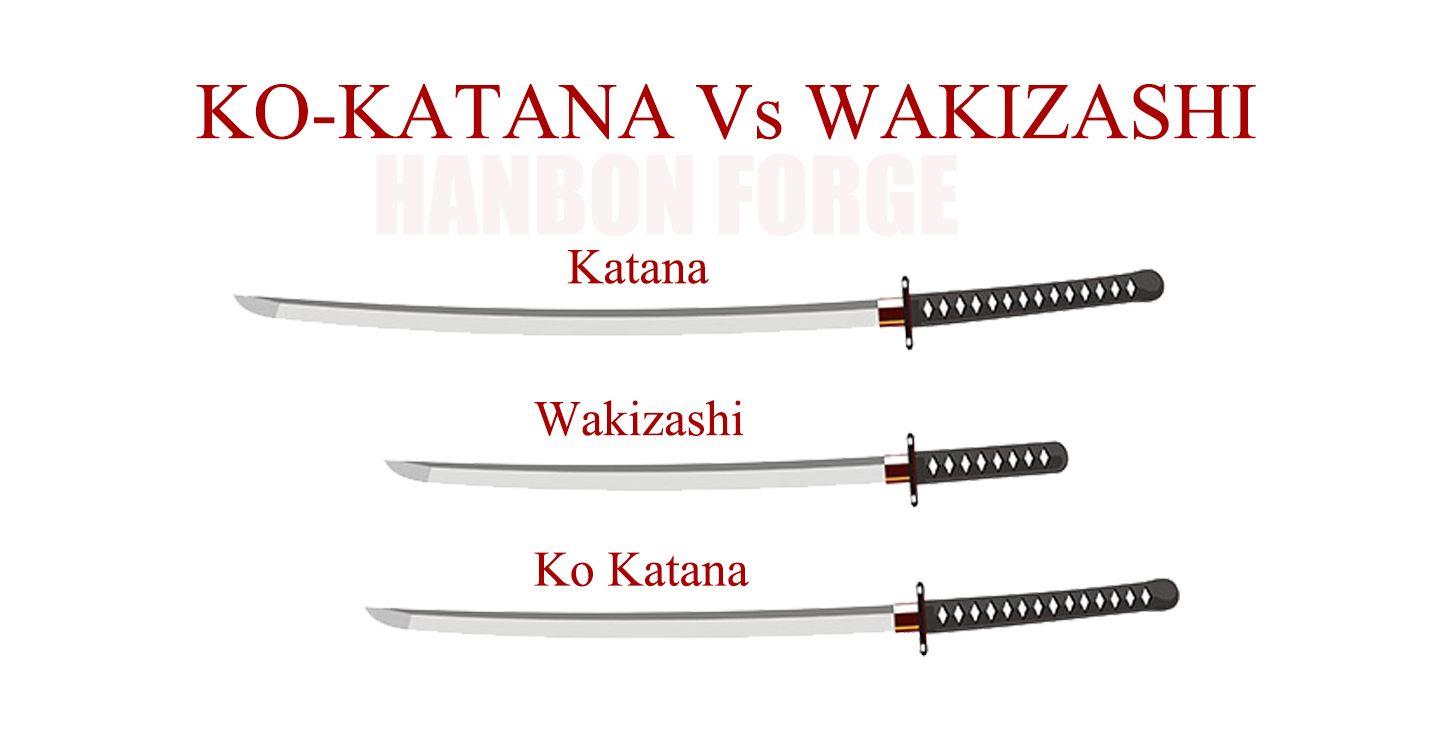
Katana, Wakizashi, and Ko-Katana designs compared. Illustration for general visual reference; actual blade and handle dimensions vary by model.
Ko-Katana vs Wakizashi: The Short Answer
Ko-Katana: A modern term commonly describing a shorter katana-style sword, often designed with compact blade dimensions and katana-inspired proportions.
Wakizashi: A historically recognized Japanese short sword that was traditionally carried alongside a Katana and played an important role in samurai culture.
Ko-Katana vs Wakizashi: Size Comparison
One of the most important differences between these two swords is their typical blade and handle configuration.
At HanBon Forge, a standard Ko-Katana configuration commonly features a 24-inch blade with a 6-inch handle, while a typical Wakizashi configuration uses a 20-inch blade with a shorter handle of approximately 6 to 8 inches, depending on the design.
| Feature | Ko-Katana | Wakizashi |
|---|---|---|
| Sword Classification | Modern compact katana-style category | Traditional Japanese short sword |
| Typical HanBon Forge Blade | 24 inches (61 cm) | 20 inches (51 cm) |
| Typical Handle | 6 inches (15 cm) | Approximately 6–8 inches (15–20 cm) |
| Historical Identity | Modern commercial designation | Established historical sword category |
| Reach | Generally longer in standard HanBon Forge configurations | Generally shorter |
| Appearance | Compact katana-inspired design | Traditional short-sword proportions |
| Traditional Samurai Pairing | Not a standardized historical daisho category | Historically paired with the Katana |
| Customization | Available | Available |
Important: These measurements describe typical HanBon Forge configurations rather than fixed universal standards. Actual blade lengths, handle lengths, and overall dimensions vary depending on the sword.
Learn more about Japanese sword dimensions in our Ko-Katana vs Katana comparison guide.
What Is a Ko-Katana?
The term Ko-Katana is widely used in the modern sword industry to describe a shorter version of a katana-style sword. The Japanese prefix "ko" means small, reflecting the sword's compact proportions.
Unlike a historically standardized category, modern Ko-Katana designs can vary between manufacturers. Some have blade lengths close to the upper range of a Wakizashi, while others approach the dimensions of a shorter Katana.
Typical Features of a Ko-Katana
- A shorter blade than a conventional full-length Katana.
- Traditional Japanese-style curved blade geometry.
- A compact handle selected to suit the intended design.
- Standard Japanese-style fittings, including tsuba, fuchi, kashira, and habaki.
- A fitted wooden saya for storage and display.
- Optional customization of blade steel, fittings, and finishes.
A Ko-Katana appeals to enthusiasts who prefer the overall appearance of a Katana but want a smaller sword.
Discover our handmade Ko-Katana sword collection for available designs.
What Is a Wakizashi?
The Wakizashi is a traditional Japanese short sword historically associated with the samurai class. It became especially well known as the companion sword worn together with a Katana.
During the Edo period, the combination of a Katana and Wakizashi became closely associated with the samurai's daisho, meaning a pair of long and short swords.
Wakizashi blade lengths historically varied, but they are generally associated with the Japanese short-sword range of approximately one to two shaku, or roughly 30 to 60 centimeters.
Typical Features of a Wakizashi
- A relatively short, single-edged Japanese blade.
- A handle proportioned to its shorter blade.
- Traditional Japanese fittings and mounting styles.
- Historical use as a companion sword to the Katana.
- Important cultural associations with samurai dress and sword traditions.
- Modern availability as a collectible, display piece, or appropriately configured training sword.
A Wakizashi is particularly attractive to collectors who value traditional Japanese sword history and the relationship between the long and short swords of the samurai.
View our hand-forged Wakizashi collection.
Historical Differences Between Ko-Katana and Wakizashi
Although both swords may share similar physical features, their historical backgrounds are different.
The Historical Role of the Wakizashi
The Wakizashi developed into a recognizable category within Japanese sword traditions and became an important part of the samurai's equipment.
When paired with a Katana, the Wakizashi formed the shorter component of the daisho. This pairing became especially associated with samurai identity and status during the Edo period.
Wakizashi swords could also be used independently, but their historical significance extends beyond practical function to the customs and symbolism of Japan's warrior class.
The Modern Meaning of Ko-Katana
Ko-Katana is most commonly encountered today as a descriptive commercial term for a shorter katana-style sword.
Although smaller Japanese swords have existed throughout history, modern Ko-Katana products should not automatically be treated as examples of one distinct historical sword category.
The term also should not be confused with Kogatana, which can refer to a small utility blade found with certain traditional Japanese sword mountings.
Blade Design and Handle Proportions
When choosing between a Ko-Katana and a Wakizashi, it is important to consider the relationship between blade length and handle length rather than comparing blade length alone.
1. Blade Length and Shape
Both sword types can feature curved, single-edged blades, traditional kissaki shapes, and recognizable Japanese blade geometry.
A Ko-Katana is generally designed to retain the appearance of a compact Katana. A Wakizashi typically follows traditional Japanese short-sword proportions.
However, these are design tendencies rather than absolute rules. Actual dimensions and blade geometry can overlap.
2. Handle Length and Grip
The handle, known as the tsuka, has an important influence on the overall proportions and handling of a Japanese sword.
Some Ko-Katana models use longer handles relative to blade length, while Wakizashi swords often use compact handles suited to their short blades.
Neither style has one universal modern handle length. The ideal configuration depends on the sword's geometry, balance, and intended purpose.
3. Fittings and Mountings
Both Ko-Katana and Wakizashi swords can use traditional Japanese-style mountings, including:
- Tsuba: The handguard.
- Fuchi and Kashira: The fittings at the ends of the handle.
- Menuki: Decorative ornaments beneath the handle wrapping.
- Tsuka-ito: The material wrapped around the handle.
- Habaki: The blade collar that helps secure the blade in the saya.
- Saya: The protective scabbard.
For customers interested in customizing these details, explore our Japanese Sword Fittings Guide.
Handling, Balance, and Practical Differences
The overall handling characteristics of a Japanese sword depend on more than its category name.
Reach and Movement
With HanBon Forge's typical 24-inch Ko-Katana and 20-inch Wakizashi configurations, the Ko-Katana provides a longer cutting edge and greater reach.
The shorter Wakizashi may be more convenient to maneuver in restricted spaces, although the difference depends on the specific sword and the user's technique.
Weight and Balance
A shorter blade does not necessarily mean a lighter or better-balanced sword.
Steel distribution, blade width, thickness, distal taper, fittings, and handle length all contribute to overall weight and handling characteristics.
Two swords of similar length may feel noticeably different because of their construction.
Training and Intended Use
Modern Ko-Katana and Wakizashi swords are available in different configurations for collecting, display, and certain forms of martial arts practice.
For formal Japanese sword training, blade length and sword type should follow the requirements of the martial arts discipline and the instructor.
Which Is Better: Ko-Katana or Wakizashi?
Neither sword is inherently superior. The better choice depends on whether you value compact katana styling, traditional historical identity, or a particular blade and handle configuration.
Choose a Ko-Katana If...
- You want a shorter alternative to a full-length Katana.
- You prefer a compact katana-style design.
- You want a typical blade length around 24 inches.
- You appreciate modern customized Japanese sword configurations.
- You prefer a blade that is generally longer than a standard HanBon Forge Wakizashi.
Choose a Wakizashi If...
- You value traditional Japanese sword history.
- You want a sword historically associated with the samurai.
- You prefer a shorter blade, commonly around 20 inches.
- You want a traditional companion sword for your Katana.
- You are interested in creating a matching daisho sword set.
If you are collecting Japanese swords for historical appreciation, a Wakizashi may be especially appealing. If you prefer a compact Katana-inspired design with a somewhat longer blade, a Ko-Katana may better suit your preferences.
Can a Ko-Katana and Wakizashi Be Part of a Sword Set?
A traditional daisho refers to the pairing of a long and short sword, most famously a Katana and Wakizashi.
Today, collectors often enjoy coordinating the fittings, handle wrapping, and saya designs of multiple Japanese swords to create a matching collection.
Although a Ko-Katana is not the standard historical long sword of the daisho pairing, a matching Ko-Katana and Wakizashi set can still be an attractive modern custom display.
For a more historically familiar combination, consider pairing a full-length Katana with a Wakizashi.
Custom Ko-Katana and Wakizashi Swords at HanBon Forge
At HanBon Forge, we specialize in handcrafted Japanese swords and offer a variety of customization options to help customers create swords that reflect their personal preferences.
Depending on the selected model and production requirements, available options may include:
- Blade Materials: 1060, 1095, T10, folded steel, and other available carbon steel options.
- Blade Length: Standard dimensions or custom measurements, subject to production feasibility.
- Blade Finish: Traditional polishing, mirror polishing, and selected genuine hamon designs.
- Handle Design: Different tsuka lengths, handle wrapping materials, and rayskin options.
- Fittings: Decorative and traditional tsuba, fuchi, kashira, menuki, habaki, and seppa options.
- Saya: Different colors, lacquer finishes, and decorative styles.
- Engraving: Selected text or personalized designs where available.
If you want a Ko-Katana with a particular blade length or a Wakizashi with a customized handle, you can discuss your requirements with our team before ordering.
Explore our Custom Japanese Sword Builder or contact HanBon Forge for assistance.
Frequently Asked Questions
Find answers to common questions about Ko-Katana and Wakizashi swords.
1. What is the difference between a Ko-Katana and a Wakizashi?
A Ko-Katana is generally a modern term for a shorter katana-style sword, while a Wakizashi is a historically recognized Japanese short sword traditionally associated with samurai culture. They may share similar designs, but their classifications and typical dimensions differ.
2. Is a Ko-Katana longer than a Wakizashi?
Often, but not always. A typical HanBon Forge Ko-Katana has a 24-inch blade, compared with approximately 20 inches for a standard Wakizashi. However, dimensions vary by model, and the blade lengths of these two categories may overlap.
3. Is a Ko-Katana historically the same as a Wakizashi?
No. Wakizashi is an established historical Japanese sword classification. Ko-Katana is generally used in the modern sword market to describe a shorter katana-style design, without one universal historical definition.
4. Did samurai carry Wakizashi swords?
Yes. The Wakizashi was commonly carried as a companion to the Katana. Together, these swords formed the daisho, a combination closely associated with samurai identity, especially during the Edo period.
5. Which is better for collecting, a Ko-Katana or Wakizashi?
Both are suitable for collectors. A Wakizashi may appeal more to those interested in traditional Japanese sword history and daisho sets, while a Ko-Katana may be preferred by collectors seeking compact katana-style proportions or a distinctive custom sword.
6. Can I customize the blade length of a Ko-Katana?
HanBon Forge offers selected custom blade lengths and handle configurations, subject to production feasibility. You can explore the available options on our Custom Sword page or contact us with your measurements.
7. Can I order a matching Katana and Wakizashi set?
Yes. Matching Katana and Wakizashi combinations are popular among collectors. You can select coordinated fittings, handle colors, saya styles, and other available customization options.
Explore our Japanese Sword collection for more options.
8. Is a Ko-Katana suitable for beginners?
A compact Ko-Katana can be appealing to new collectors, but suitability for martial arts training depends on the user's experience, the chosen sword, and the discipline being practiced. Beginners should consult a qualified instructor before selecting training equipment.
9. Can a Wakizashi be used for cutting practice?
Some properly constructed and sharpened Wakizashi swords may be suitable for appropriate supervised cutting practice. However, not every Wakizashi is designed for cutting. Always verify the intended use of a specific model and follow suitable safety procedures.
Final Thoughts: Ko-Katana vs Wakizashi
The Ko-Katana and Wakizashi offer two different approaches to shorter Japanese sword designs.
The Ko-Katana is commonly associated with modern compact katana configurations, making it attractive to customers who prefer a shorter version of the familiar Katana design.
The Wakizashi, meanwhile, carries a distinct historical identity as a Japanese short sword closely connected with samurai traditions and the daisho pairing.
At HanBon Forge, both styles can be appreciated for their craftsmanship, appearance, and customization possibilities. The right choice ultimately depends on your preferred dimensions, historical interests, and intended purpose.
For more information, read our Ko-Katana vs Katana Guide or explore our Ko-Katana and Wakizashi collections.
Discover Your Ideal Japanese Sword
Explore handcrafted Ko-Katana and Wakizashi swords at HanBon Forge, or customize your own Japanese sword with your preferred blade length, steel, fittings, and handle design.
Shop Ko-Katana Shop Wakizashi Customize Your Sword