
Shinogi-Zukuri: The Most Important Katana Blade Shape You Should Know
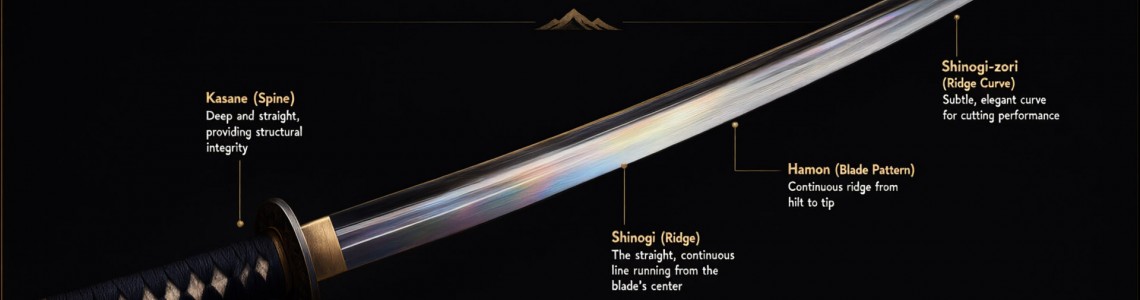
Shinogi-Zukuri (鎬造り) is one of the most recognizable and widely used blade shapes in traditional Japanese swordmaking. Its distinctive raised ridge, defined blade surfaces, and classic kissaki geometry are closely associated with the traditional katana.
Quick Answer: What Is Shinogi-Zukuri?
Shinogi-Zukuri is a traditional Japanese sword blade construction characterized by a raised longitudinal ridge called the shinogi. This ridge separates the main blade surface from the upper surface near the spine. A conventional Shinogi-Zukuri katana also features a defined yokote separating the main blade from the kissaki, or tip.
This guide explores the anatomy, historical development, geometry, and practical characteristics of Shinogi-Zukuri. We also explain how it differs from other Japanese blade shapes and share insights from HanBon Forge's experience producing modern handmade Japanese-style swords.
In This Guide
1. What Does Shinogi-Zukuri Mean?
Shinogi-Zukuri (鎬造り) is a traditional Japanese sword blade construction identified by a prominent raised ridge running lengthwise along the blade.
The name combines two Japanese terms:
- Shinogi (鎬): The raised ridge running along the blade.
- Zukuri (造り): A Japanese term referring to construction or form.
Together, Shinogi-Zukuri describes a ridged blade profile. The shinogi creates a distinct transition between the main blade face and the upper blade surface known as the shinogi-ji.
It is important to understand that Shinogi-Zukuri describes blade geometry, not steel type, heat treatment, or hardness. Two swords with the same Shinogi-Zukuri profile may have very different construction materials, dimensions, balance, and finishing methods.
Although strongly associated with the katana, Shinogi-Zukuri also appears on traditional tachi and wakizashi.
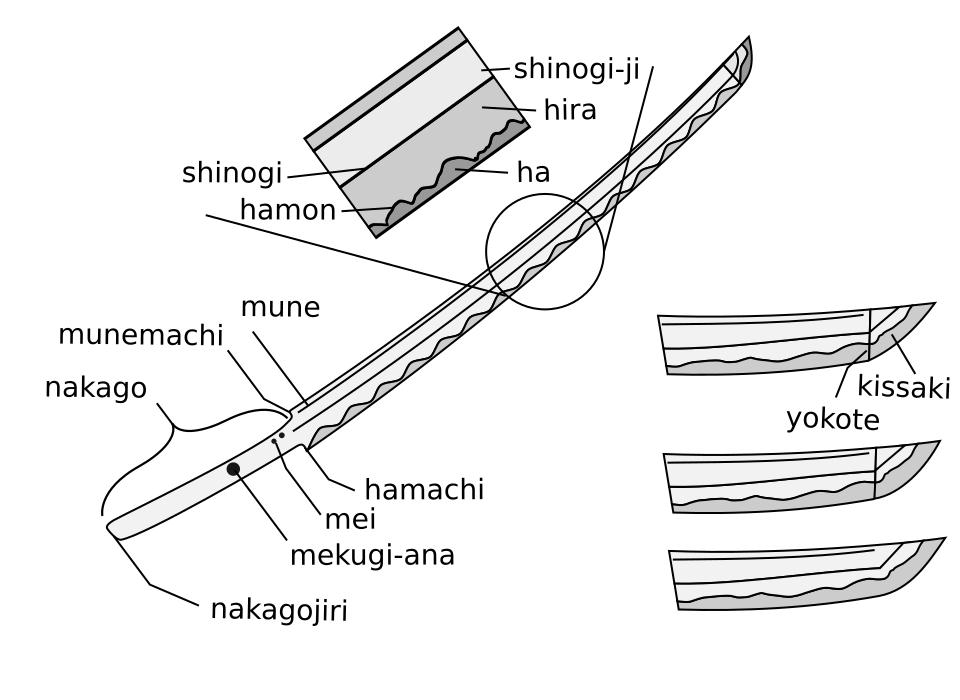
2. Anatomy of a Shinogi-Zukuri Katana
Understanding Japanese sword terminology makes it easier to recognize authentic blade geometry and compare different sword designs.
2.1 Shinogi – The Raised Ridge
The shinogi is the defining feature of Shinogi-Zukuri. It runs longitudinally along the blade and creates a clear division between the main blade face and the upper surface near the spine.
When light reflects across a polished sword, the shinogi can produce a distinct line that makes the geometry easier to recognize. A well-defined ridge also contributes to the blade's traditional appearance.
2.2 Shinogi-Ji – The Upper Blade Surface
The shinogi-ji is the surface between the shinogi ridge and the mune, or spine. This area is often comparatively flat and may reflect light differently from the main blade face.
2.3 Hiraji – The Main Blade Face
The hiraji is the main surface below the shinogi ridge, toward the cutting-edge region. Depending on the blade's construction and polish, this area may reveal steel grain and other important characteristics.
2.4 Ha – The Cutting Edge
The ha refers to the cutting edge. Its sharpness, durability, and cutting behavior depend on edge geometry, steel composition, heat treatment, and finishing quality.
2.5 Mune – The Spine
The mune is the back of the blade opposite the cutting edge. Its thickness and cross-sectional design contribute to the blade's overall construction.
2.6 Yokote and Kissaki – The Tip Geometry
The kissaki is the point section of the blade. On a conventional Shinogi-Zukuri katana, the yokote is the geometric transition line separating the kissaki from the main blade.
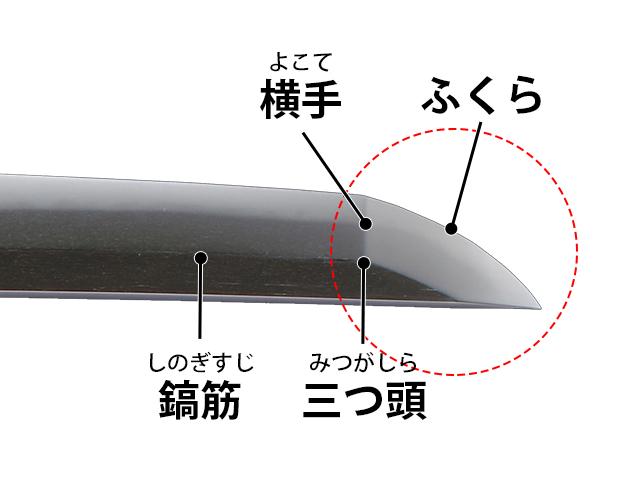
A properly formed yokote represents a transition between blade surfaces rather than merely a decorative line applied during polishing.
| Term | Meaning | Feature |
|---|---|---|
| Shinogi | Raised ridge | Defines the blade geometry |
| Shinogi-ji | Upper blade surface | Between ridge and spine |
| Hiraji | Main blade face | Surface below the ridge |
| Ha | Cutting edge | Sharpened blade edge |
| Mune | Spine | Back of the blade |
| Yokote | Tip division | Transition to kissaki |
| Kissaki | Point section | Blade tip geometry |
3. History and Development of Shinogi-Zukuri
Japanese sword shapes evolved over many centuries as forging methods, military needs, and aesthetic preferences changed.
Early Japanese swords included relatively straight blade forms. During the development of the curved Japanese sword, ridged single-edged blades became an important part of the swordmaking tradition.
Shinogi-Zukuri became closely associated with historical tachi and later katana. Over time, swordsmiths refined blade length, curvature, width, taper, and kissaki proportions according to different periods and traditions.
This blade construction remained popular because it allowed considerable variation while preserving a recognizable overall geometry.
Today, Shinogi-Zukuri continues to be a familiar choice for traditional Japanese sword collectors and modern handmade katana enthusiasts.
4. How Shinogi-Zukuri Geometry Affects Blade Performance
Blade geometry is an important part of sword design. However, the presence of a shinogi ridge alone does not guarantee strength, cutting efficiency, or superior performance.
Blade Thickness and Structure
The thickness of the spine, the location of the shinogi, and the angles of the blade surfaces influence how material is distributed across the blade.
A thicker cross-section may provide additional structural material, but it can also affect weight and cutting resistance.
Shinogi Height
Shinogi height refers to the placement of the ridge relative to the blade's width and surfaces. A higher or lower shinogi changes the blade's cross-sectional proportions.
Neither configuration is universally better. Its suitability depends on blade dimensions, edge geometry, and the intended application.
Niku and Edge Geometry
Niku refers to the convex fullness of the cutting-edge region. This fullness contributes to how the edge is supported.
More niku can provide a more robust edge profile, while a thinner edge may reduce resistance during certain types of cutting. These characteristics should be evaluated together with the blade's heat treatment and overall design.
Weight and Balance
Blade length, taper, thickness, bo-hi configuration, and handle construction all influence the weight and balance of a sword.
Consequently, two Shinogi-Zukuri katana can have very different handling characteristics despite sharing the same general blade shape.
5. Shinogi-Zukuri vs. Other Japanese Blade Shapes
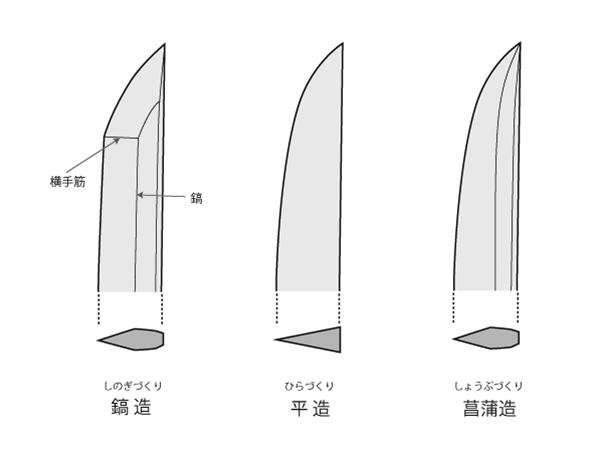
Traditional Japanese swords feature several blade constructions. Understanding their differences helps buyers recognize the geometry of a sword rather than relying only on its overall silhouette.
Shinogi-Zukuri vs. Hira-Zukuri
Hira-Zukuri lacks the prominent longitudinal shinogi ridge found on Shinogi-Zukuri blades. Its side surfaces have a simpler cross-sectional profile.
Hira-Zukuri is frequently associated with traditional tanto and other shorter Japanese blades.
Shinogi-Zukuri vs. Shobu-Zukuri
Shobu-Zukuri is often described as an iris-leaf blade shape. Unlike conventional Shinogi-Zukuri, it does not have the typical yokote dividing the main blade from the kissaki.
Its ridge flows toward the tip, creating a different point geometry and visual transition.
Shinogi-Zukuri vs. Unokubi-Zukuri
Unokubi-Zukuri, sometimes translated as cormorant-neck construction, features a distinctive reduction in the upper blade section.
Its specialized geometry is visually different from the conventional Shinogi-Zukuri katana.
| Blade Shape | Main Feature | Common Association |
|---|---|---|
| Shinogi-Zukuri | Raised ridge and defined yokote | Katana, tachi, wakizashi |
| Hira-Zukuri | No prominent shinogi ridge | Tanto and shorter blades |
| Shobu-Zukuri | Flowing point without conventional yokote | Specialized Japanese sword designs |
| Unokubi-Zukuri | Reduced upper blade section | Specialized Japanese blade forms |
For more information, read our Japanese Blade Shape Styles Guide.
6. Shinogi-Zukuri, Hamon and Hada: Understanding the Differences
Although often discussed together, these terms describe different characteristics of a Japanese sword.
- Shinogi-Zukuri: Describes the blade's geometry and construction.
- Hamon: The visible hardened-edge pattern associated with differential hardening.
- Hada: The visible grain pattern resulting from certain forged steel constructions.
A Shinogi-Zukuri katana may be made from monosteel or folded steel. It can have a genuine hamon produced by differential hardening, or it may be through-hardened without a visible genuine hamon.
The presence of a shinogi ridge does not indicate whether a blade has folded steel, a visible hada, or any particular heat-treatment process.
Collectors should therefore evaluate these characteristics separately rather than assuming that one feature proves the presence of another.
7. How to Choose a Shinogi-Zukuri Katana
Shinogi-Zukuri is a familiar and versatile Japanese blade design, but choosing a suitable katana requires attention to several additional factors.
Blade Geometry
Look for a clearly defined shinogi ridge, consistent blade surfaces, and properly shaped kissaki. A conventional Shinogi-Zukuri katana should generally have a distinct geometric yokote.
Steel and Heat Treatment
Modern handmade katana are commonly produced using materials such as 1060 carbon steel, 1095 carbon steel, T10 tool steel, and 9260 spring steel.
The suitability of each steel depends on heat treatment, blade geometry, manufacturing quality, and intended use. The steel designation alone does not establish sword quality.
Bo-Hi or No Bo-Hi
A bo-hi is a groove running along part of the blade. It removes material and can influence weight distribution depending on its dimensions.
Shinogi-Zukuri blades can be made with or without bo-hi. The groove is an optional feature rather than an essential characteristic of this blade shape.
Fittings and Assembly
The quality of the tsuka, tsuba, habaki, saya, and overall assembly is just as important as the blade's appearance.
Properly secured components and a correctly fitted handle are especially important for swords intended for appropriate martial arts practice.
Intended Purpose
- Collectors: May prioritize traditional geometry, visual craftsmanship, and polishing.
- Display enthusiasts: May focus on fittings, saya finishes, and decorative customization.
- Iaido practitioners: Should confirm that length, weight, and construction meet their instructor's requirements.
- Cutting practitioners: Should consider suitable edge geometry, heat treatment, secure assembly, and qualified instruction.
All sharpened swords require responsible handling, appropriate training, secure storage, and compliance with local laws.
8. Shinogi-Zukuri in Modern Handmade Sword Production
At HanBon Forge, our team works with a variety of Japanese-style blade designs, including Shinogi-Zukuri katana, wakizashi, and other custom swords.
Our production process involves selecting blade geometry, steel, dimensions, heat treatment, polishing, and fittings according to each customer's available customization options.
Workshop Experience: What We Pay Attention To
When producing or inspecting modern Shinogi-Zukuri katana, several details deserve particular attention:
- Shinogi definition: The ridge should be clearly shaped and consistent with the intended geometry.
- Yokote and kissaki: The transition to the tip should be properly formed rather than relying on a superficial decorative line.
- Blade proportions: Thickness, width, curvature, and taper should work together in the finished design.
- Polishing: Surface finishing should make the blade geometry clear without obscuring important transitions.
- Assembly: The handle, habaki, fittings, and saya should be checked for proper fit.
These considerations are useful whether the sword is intended for collection, display, or an appropriate form of supervised martial arts practice.
Can You Customize a Shinogi-Zukuri Katana?
Yes. HanBon Forge offers customizable Japanese-style swords with a variety of available features:
- Blade steel and heat-treatment options
- Blade length and handle dimensions
- Bo-hi or no-bo-hi configurations
- Selected polishing finishes
- Tsuba, fuchi, kashira, and menuki
- Tsuka-ito, samegawa, and saya styles
- Optional engraving and decorative details
Special blade dimensions and non-standard designs should be confirmed before ordering because not every configuration is available for every sword.
Create Your Own Shinogi-Zukuri Katana
Explore the available steel, blade, fittings, handle, and scabbard options to create a Japanese-style sword that reflects your preferences.
Explore Custom Katana Options →
Have a special blade shape or dimension in mind? Contact HanBon Forge to discuss availability before placing your order.
Frequently Asked Questions About Shinogi-Zukuri
Final Thoughts
Shinogi-Zukuri remains one of the most important blade constructions for understanding traditional Japanese swords.
Its raised shinogi ridge, distinctive blade surfaces, and conventional yokote give the katana its recognizable traditional geometry.
For collectors, understanding this structure provides a useful foundation for evaluating blade craftsmanship. For buyers, it helps distinguish sword geometry from steel quality, heat treatment, and decorative appearance.
Ultimately, the quality and suitability of a Japanese-style sword depend on the complete design, materials, workmanship, and intended purpose—not simply the name of its blade shape.
References & Further Reading
For further research into Japanese sword history, terminology, and blade construction, readers may explore the following resources.
- The Society for Preservation of Japanese Art Swords (NBTHK) – Japanese sword preservation and appreciation.
- The Metropolitan Museum of Art – Historical Japanese arms and armor collections.
- The British Museum – Japanese historical and cultural collections.
- HanBon Forge: Japanese Blade Shape Styles – Related explanations and comparisons of traditional Japanese blade profiles.
External resources are provided for further educational reading and do not represent endorsements of HanBon Forge products.
About This Guide & Editorial Experience
Published by: HanBon Forge Editorial Team
Last updated: October 15, 2026
Topic: Japanese sword blade geometry, katana anatomy, and traditional blade construction.
Editorial Experience: This article combines established Japanese sword terminology with observations from HanBon Forge's experience producing modern handmade Japanese-style swords in Longquan, Zhejiang.
Our workshop works with custom katana, wakizashi, tanto, and other Japanese-style sword designs involving different steel options, blade geometries, heat treatments, and fittings.
We aim to explain traditional sword terminology clearly, distinguish historical construction methods from modern manufacturing options, and provide useful educational information for collectors and sword enthusiasts.
This guide is intended for education and does not replace professional appraisal of historical swords or qualified martial arts instruction.
Learn more about HanBon Forge and our workshop.