
Shinogi-Zukuri: The Most Important Katana Blade Shape You Should Know
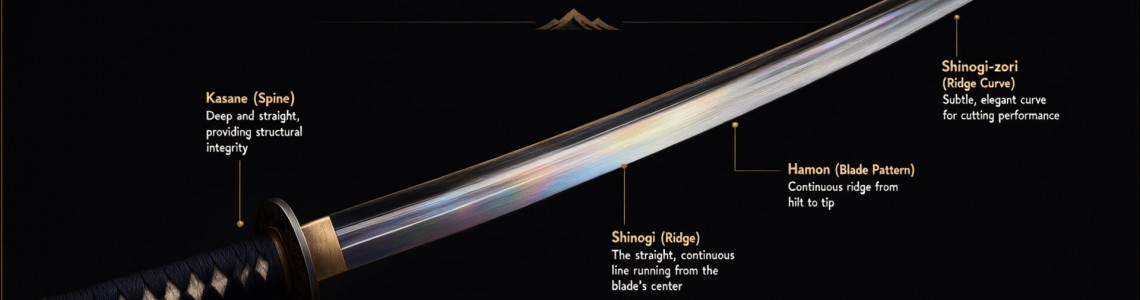
Shinogi-Zukuri (鎬造り) is one of the most recognizable blade shapes in traditional Japanese swordmaking. Its distinctive raised ridge, defined blade surfaces, and classic kissaki geometry are closely associated with the traditional katana.
Quick Answer: What Is Shinogi-Zukuri?
Shinogi-Zukuri is a traditional Japanese sword blade construction characterized by a raised longitudinal ridge called the shinogi. This ridge separates the main blade surface from the upper surface near the spine. A conventional Shinogi-Zukuri katana also features a defined yokote separating the main blade from the kissaki, or tip.
This guide explores Shinogi-Zukuri blade anatomy, historical development, geometry, and practical characteristics. We also compare it with other traditional Japanese blade shapes and share observations from HanBon Forge's experience producing handmade Japanese-style swords.
In This Guide
1. What Does Shinogi-Zukuri Mean?
Shinogi-Zukuri (鎬造り) is a traditional Japanese sword blade construction identified by a prominent raised ridge running lengthwise along the blade.
The name combines two Japanese terms:
- Shinogi (鎬): The raised ridge that runs lengthwise along the blade.
- Zukuri (造り): A Japanese term describing construction or form.
Together, these terms describe a ridged blade profile. The shinogi creates a distinct transition between the main blade surface and the upper surface known as the shinogi-ji, which extends toward the spine.
Shinogi-Zukuri is a form of blade geometry, not a steel type or heat-treatment method. Two swords with the same profile may differ significantly in steel, hardness, curvature, dimensions, balance, and finish.
Although most strongly associated with the katana, this blade shape also appears on many traditional tachi and wakizashi.
2. Anatomy of a Shinogi-Zukuri Katana
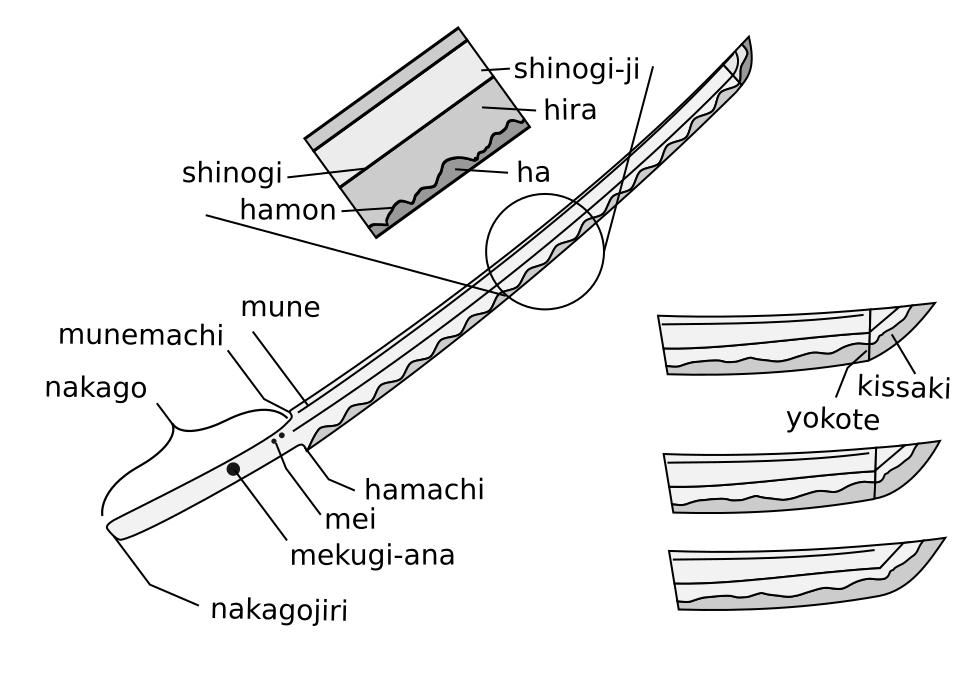
A conventional Shinogi-Zukuri blade contains several important surfaces and structural features. Understanding their Japanese names makes it easier to recognize sword geometry and compare different blade designs.
Shinogi – The Raised Ridge
The shinogi is the defining feature of Shinogi-Zukuri. It is a raised longitudinal ridge running between the main blade face and the surface nearer the spine.
The position of the shinogi helps determine the blade's cross-sectional proportions. Under angled lighting, the ridge can produce a clear reflected line that reveals the precision of the blade's geometry.
Shinogi-Ji – The Upper Blade Surface
The shinogi-ji is the surface between the shinogi ridge and the mune, or spine. This area is often comparatively flat and may be polished differently from the main blade face.
Hiraji – The Main Blade Face
The hiraji is the main surface between the shinogi and the cutting-edge region. On suitable blades, it may reveal forged steel grain and other polishing details.
Ha – The Cutting Edge
The ha refers to the cutting edge. Its sharpness and durability depend on the edge geometry, steel, heat treatment, and finishing process.
Mune – The Spine
The mune is the back of the blade opposite the cutting edge. Its thickness and cross-sectional form contribute to the overall construction of the sword.
Yokote and Kissaki – The Tip Geometry
The kissaki is the point section of the blade. The yokote is the transition line separating the kissaki from the main body of a conventional Shinogi-Zukuri katana.
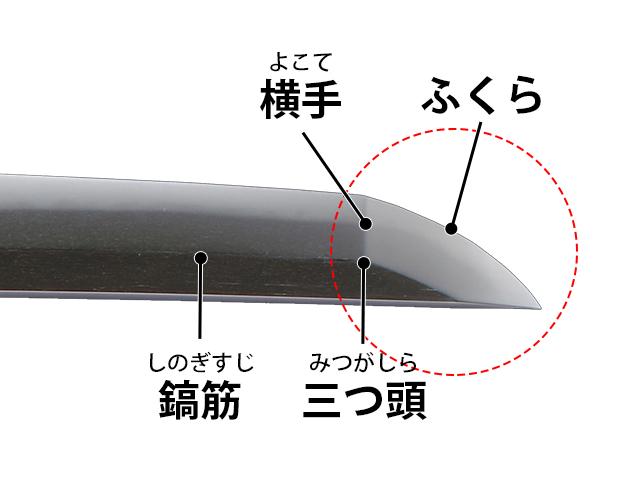
A true geometric yokote is more than a cosmetic line. It marks a transition between carefully shaped blade surfaces.
| Japanese Term | Meaning | Function |
|---|---|---|
| Shinogi | Raised ridge | Defines the ridged geometry |
| Shinogi-ji | Upper blade surface | Between ridge and spine |
| Hiraji | Main blade face | Surface below shinogi |
| Ha | Cutting edge | Sharpened edge |
| Mune | Spine | Back of the blade |
| Yokote | Tip division | Transition to kissaki |
| Kissaki | Point section | Tip geometry |
3. History and Development of Shinogi-Zukuri
Japanese sword shapes developed over many centuries as forging technology, fighting methods, and aesthetic preferences evolved.
Early Japanese swords included relatively straight blade forms. Over time, curved single-edged swords with ridged construction became an important part of the Japanese sword tradition.
Shinogi-Zukuri became particularly associated with the curved tachi and later katana. Swordsmiths adjusted blade length, curvature, width, taper, and point geometry according to the needs and preferences of different periods.
This blade construction remained important because it accommodated considerable variation while preserving a recognizable overall geometry.
Today, Shinogi-Zukuri continues to be one of the most familiar profiles in both historical Japanese swords and modern handmade reproductions.
4. How Shinogi-Zukuri Geometry Affects Blade Performance
The shinogi ridge helps define the blade's cross-section, but its presence alone does not guarantee superior strength, sharpness, or cutting ability. Sword performance depends on several interacting characteristics.
Blade Thickness and Structural Design
The thickness of the spine, the location of the shinogi, and the angles of the blade surfaces determine how material is distributed across the blade. A thicker cross-section may provide additional structural material, but it also affects weight and cutting resistance.
Shinogi Height and Blade Proportions
Shinogi height refers to the ridge's position relative to the blade's width and surrounding surfaces. Changing this position changes the cross-sectional proportions.
A higher or lower shinogi should not be interpreted as universally better. Its effect depends on the overall blade geometry and intended purpose.
Edge Geometry and Niku
Niku refers to the convex fullness of the cutting-edge region. More fullness can support a robust edge geometry, while a thinner profile may reduce cutting resistance in some conditions.
Neither characteristic independently determines performance. Steel, heat treatment, sharpening, and the complete cross-sectional design must also be considered.
Weight, Balance, and Handling
Blade length, width, taper, groove design, and handle construction all affect how a sword feels during movement. Two Shinogi-Zukuri katana may therefore have noticeably different handling characteristics despite sharing the same general blade shape.
5. Shinogi-Zukuri vs. Other Japanese Blade Shapes
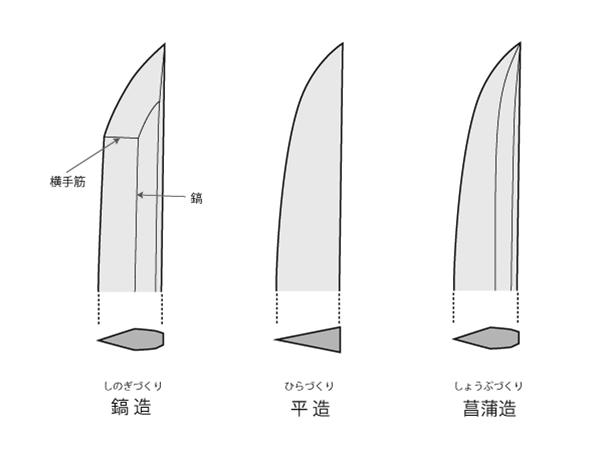
Japanese swords feature several established blade constructions. Their differences are particularly noticeable in the ridge, cross-section, and point geometry.
Shinogi-Zukuri vs. Hira-Zukuri
Hira-Zukuri lacks the prominent longitudinal shinogi ridge found on Shinogi-Zukuri blades. Its surfaces have a simpler cross-sectional form, and the design is frequently associated with traditional tanto and shorter Japanese blades.
Shinogi-Zukuri vs. Shobu-Zukuri
Shobu-Zukuri, often translated as iris-leaf construction, features a point that flows toward the tip without the conventional yokote seen on many Shinogi-Zukuri katana.
Although both forms may have a shinogi ridge, the kissaki geometry and transitions between the blade surfaces are different.
Shinogi-Zukuri vs. Unokubi-Zukuri
Unokubi-Zukuri, or cormorant-neck construction, incorporates a distinctive reduction in the upper blade section. It has a specialized geometry compared with the conventional Shinogi-Zukuri katana.
| Blade Shape | Main Characteristic | Common Association |
|---|---|---|
| Shinogi-Zukuri | Raised ridge and defined yokote | Katana, tachi, wakizashi |
| Hira-Zukuri | No prominent shinogi ridge | Tanto and shorter blades |
| Shobu-Zukuri | Point without conventional yokote | Specialized Japanese sword designs |
| Unokubi-Zukuri | Reduced upper blade section | Specialized sword and blade forms |
For additional examples, read our Japanese Blade Shape Styles Guide.
6. Shinogi-Zukuri, Hamon and Hada: Understanding the Differences
These three Japanese sword terms describe different characteristics and should not be confused when examining or purchasing a katana.
- Shinogi-Zukuri: Ridged blade shape and geometry.
- Hamon: The visible hardened-edge pattern associated with differential hardening.
- Hada: The visible steel grain resulting from certain forged steel constructions.
A Shinogi-Zukuri katana can be made from modern monosteel or folded steel. It may have a genuine hamon created through differential hardening or be through-hardened without a genuine hamon.
Similarly, the presence of a shinogi ridge does not establish whether the blade has visible hada.
7. How to Choose a Shinogi-Zukuri Katana
Shinogi-Zukuri is a practical starting point for understanding the classic Japanese katana. However, choosing a suitable sword involves more than identifying its blade shape.
Check the Blade Geometry
Look for a clearly formed shinogi ridge, consistent blade surfaces, and a properly shaped kissaki. A conventional Shinogi-Zukuri katana should generally have a distinct yokote.
Choose the Steel and Heat Treatment
Common modern katana materials include 1060 carbon steel, 1095 carbon steel, T10 tool steel, and 9260 spring steel. Suitability depends on heat treatment, geometry, manufacturing quality, and intended use.
The steel designation alone does not establish the overall quality of a finished sword.
Consider Bo-Hi and Blade Weight
A bo-hi is a groove running along part of the blade. It removes material and may reduce weight depending on its size and position. Shinogi-Zukuri blades can be made with or without bo-hi.
Examine the Sword's Fittings
The quality of the tsuka, tsuba, habaki, saya, and general assembly is important. Secure construction and properly fitted components are particularly essential for swords intended for appropriate martial arts practice.
Match the Sword to Your Purpose
- Collectors: May prioritize traditional blade geometry, polish, and craftsmanship.
- Display enthusiasts: May prefer specific fittings, saya finishes, and decorative customization.
- Iaido practitioners: Should follow their instructor's requirements regarding length, weight, edge condition, and construction.
- Cutting practitioners: Should consider suitable edge geometry, heat treatment, secure assembly, and qualified instruction.
Sharpened swords require responsible handling, appropriate training, secure storage, and compliance with applicable local laws.
8. Shinogi-Zukuri in Modern Handmade Sword Production
At HanBon Forge, our team works with a variety of traditional Japanese-style blade designs, including Shinogi-Zukuri.
Our custom sword production involves selecting blade geometry, steel, dimensions, polishing, heat treatment, and fittings according to each order's available options.
Workshop Experience: What We Pay Attention To
When producing or reviewing a modern Shinogi-Zukuri katana, several details deserve particular attention:
- Shinogi definition: The ridge should be clearly shaped and visually consistent with the intended geometry.
- Kissaki and yokote: The transition to the tip should be properly formed rather than relying on a decorative surface line.
- Blade proportions: Thickness, width, curvature, and taper should work together as part of the design.
- Polishing: The finish should reveal the blade geometry without obscuring important transitions.
- Assembly: Handle fittings, habaki, and saya fit should be checked as part of the finished sword.
These considerations are useful whether the sword is intended for collection, display, or appropriate supervised practice.
Can You Customize a Shinogi-Zukuri Katana?
Yes. HanBon Forge offers a variety of available customization options for Japanese-style swords:
- Blade steel and heat-treatment options
- Blade and handle dimensions
- Bo-hi or no-bo-hi configurations
- Selected polishing finishes
- Tsuba, fuchi, kashira, and menuki
- Tsuka-ito, samegawa, and saya designs
- Optional engraving and decorative details
Specialized requirements should be confirmed with our team before ordering, as not every combination is available for every blade.
Create Your Own Shinogi-Zukuri Katana
Explore the available blade, fittings, handle, and scabbard options to create a Japanese-style sword that reflects your preferences.
Explore Custom Katana Options →
Have a particular blade shape or dimension in mind? Contact HanBon Forge before ordering.
Frequently Asked Questions About Shinogi-Zukuri
Final Thoughts
Shinogi-Zukuri is one of the foundational blade constructions for understanding traditional Japanese swords.
Its raised shinogi ridge, distinctive blade surfaces, and conventional yokote create the recognizable geometry associated with the classic katana.
For collectors, understanding this structure provides a useful foundation for examining craftsmanship. For buyers, it helps distinguish blade geometry from steel quality, heat treatment, and decorative appearance.
Ultimately, the quality of a Japanese-style sword depends on how all its components work together—not simply on the name of its blade shape.
References & Further Reading
Readers interested in traditional Japanese sword forms can explore the following museum and educational resources.
- Society for the Preservation of Japanese Art Swords (NBTHK) — Japanese sword preservation, study, and appreciation.
- The Metropolitan Museum of Art — Museum resources on Japanese arms and armor.
- The British Museum — Historical Japanese sword collections and cultural context.
- HanBon Forge: Japanese Blade Shape Styles — Comparisons of traditional Japanese sword blade forms.
External museum links are provided for general research, not as endorsements of HanBon Forge products.
About This Guide & Editorial Experience
Published by: HanBon Forge Editorial Team
Last updated: October 15, 2026
Subject: Japanese sword blade geometry, traditional katana construction, and modern handmade sword selection.
Editorial Perspective: This guide combines established Japanese sword terminology with observations from HanBon Forge's experience producing customized Japanese-style swords in Longquan, Zhejiang.
Our work includes modern katana, wakizashi, tanto, and other sword designs with different blade shapes, steel options, heat treatments, and fittings.
We aim to distinguish historical terminology from contemporary manufacturing choices, explain technical characteristics clearly, and help readers make informed comparisons.
This guide is educational and does not replace professional appraisal of historical swords or qualified martial arts instruction.
Learn more about HanBon Forge and our workshop.