
Japanese Katana Blade Engravings: Horimono & Bonji Guide
Japanese Katana Blade Engravings: Horimono, Bonji, and Traditional Motifs Explained
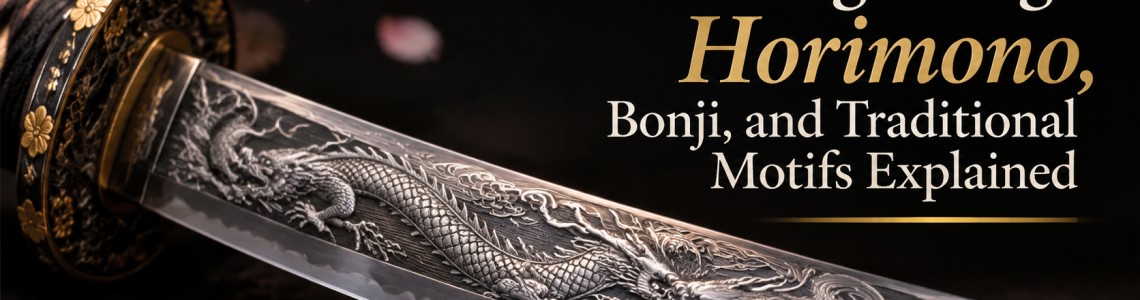
Japanese katana are admired not only for their blade geometry, steel craftsmanship, and distinctive hamon, but also for the artistic details that can appear on their surfaces. Among these details, traditional blade engravings, known as Horimono (彫物), hold a special place in Japanese sword culture.
From Buddhist Sanskrit characters and dragon motifs to engraved representations of swords and religious figures, these carvings can add cultural meaning and visual character to a Japanese sword. Some are associated with religious beliefs, while others reflect artistic traditions or personal preferences.
In this guide, we will explore the meaning of Horimono, examine several traditional Japanese sword engraving motifs, explain how blade engravings differ from a swordsmith's signature, and discuss what to consider when choosing an engraving for a custom katana.
1. What Is Horimono on a Japanese Sword?
Horimono is a Japanese term referring to decorative or symbolic carvings made on the surface of a sword blade. Traditional Japanese sword engravings may feature religious symbols, Buddhist imagery, dragons, or other artistic motifs.
Unlike the hamon, which is a visible temper pattern associated with the blade's heat-treatment process, Horimono is created through carving. It is a separate decorative and artistic feature of the blade.
Traditional Horimono can be found on different areas of a Japanese sword, depending on the design and the blade. The carvings may be relatively simple, such as a single Sanskrit character, or more elaborate compositions featuring religious figures and symbolic objects.
Common examples include:
- Bonji: Sanskrit characters associated with Buddhist traditions.
- Kurikara: A dragon entwined around a sword.
- Suken: An engraved representation of a sword.
- Fudo Myoo imagery: Religious imagery associated with the Buddhist deity Fudo Myoo.
These designs are not simply random decorations. Their meanings can be connected to religious symbolism, cultural beliefs, and the artistic preferences of the people who commissioned or created the sword.
Horimono vs. Hi: What Is the Difference?
Horimono and Hi are sometimes confused because both involve features carved into a Japanese sword blade. However, they describe different things.
Hi refers to a groove or channel formed along the blade. A Bo-Hi, for example, is a long groove commonly found on the blade surface. Horimono generally refers to decorative or symbolic carvings, such as characters and figurative motifs.
Although grooves and decorative carvings can appear together on the same blade, they should not be treated as interchangeable terms.
2. The History and Purpose of Japanese Sword Engravings
Japanese sword engravings developed within a broader tradition of metalworking, religious art, and sword craftsmanship. Over different historical periods, swordsmiths and specialized carvers incorporated various decorative elements into blades.
Some traditional engravings were associated with Buddhist beliefs and spiritual protection. Others reflected the preferences of sword owners, the artistic traditions of particular periods, or the distinctive styles of individual craftsmen.
Religious imagery was particularly significant in some Japanese sword traditions. Symbols connected with Buddhist deities and sacred objects could be incorporated into a blade as expressions of faith, devotion, or spiritual symbolism.
However, not every engraved sword had a religious purpose. Some carvings were primarily artistic, and the meaning of a particular design depends on its historical and cultural context.
It is also important to understand that not all Japanese swords feature Horimono. Many traditional blades have relatively simple surfaces, and the absence of engraving does not indicate inferior craftsmanship.
3. Common Types of Katana Blade Engravings
Traditional Japanese sword engravings come in various forms. Each design has its own visual characteristics and may carry different cultural or symbolic associations.
3.1 Bonji: Sanskrit Characters
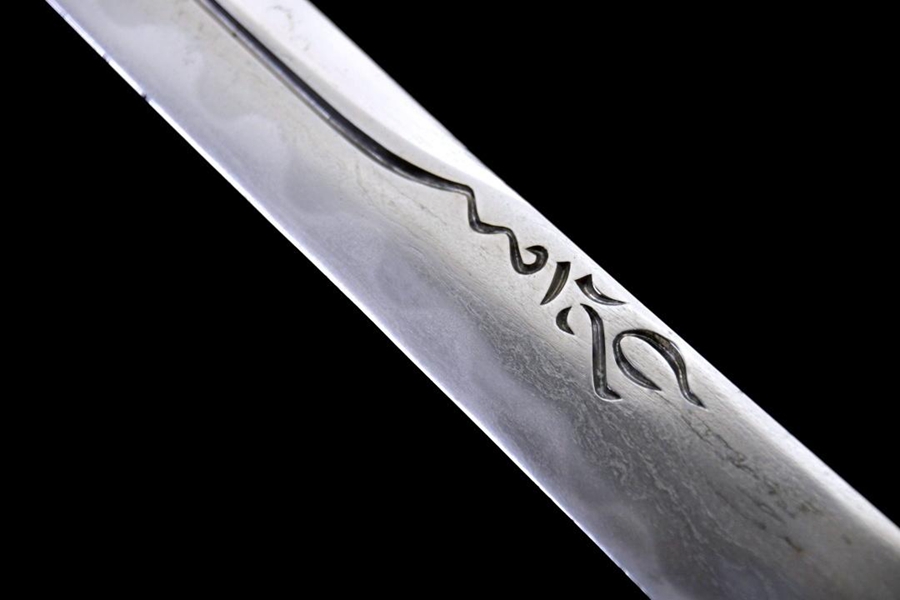
Bonji (梵字) refers to Sanskrit characters used in Japanese Buddhist traditions. These characters are commonly associated with sacred syllables and particular Buddhist figures or concepts.
On traditional Japanese swords, Bonji may appear as individual characters or as part of a larger engraved composition. Their placement and style can vary depending on the blade and the intended design.
Some Bonji are associated with particular Buddhist deities. For this reason, identifying the exact character is important before assigning a specific religious meaning to an engraving.
For collectors and enthusiasts, Bonji engravings offer an interesting connection between Japanese sword craftsmanship and Buddhist artistic traditions.
3.2 Kurikara: The Dragon and Sword Motif
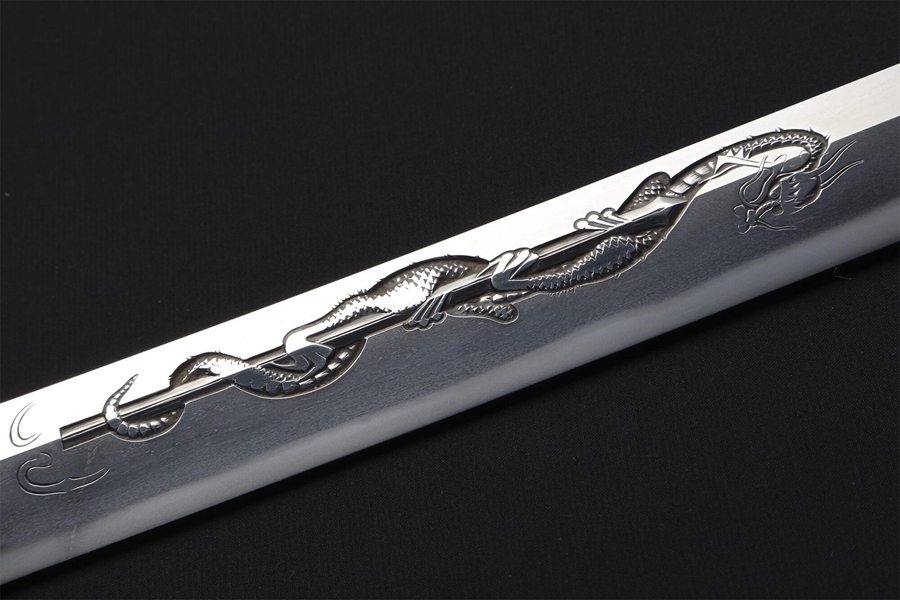
Kurikara (倶利伽羅) is one of the most recognizable motifs found in traditional Japanese sword engravings.
It typically depicts a dragon entwined around a sword. The motif is closely associated with Fudo Myoo, a Buddhist deity known for his fierce appearance and symbolic sword.
The dragon-and-sword composition is visually distinctive. Depending on the carving, the dragon may wrap around the sword, with its body, head, and other details carefully represented along the blade.
In Buddhist symbolism, this imagery is associated with spiritual power and the overcoming of obstacles. Its detailed composition also makes Kurikara an especially recognizable example of Japanese sword carving.
For modern sword enthusiasts, dragon engravings are also popular as decorative design choices. However, a contemporary dragon engraving should not automatically be considered a traditional Kurikara unless it follows the recognizable symbolic composition.
3.3 Suken: The Engraved Sword Motif
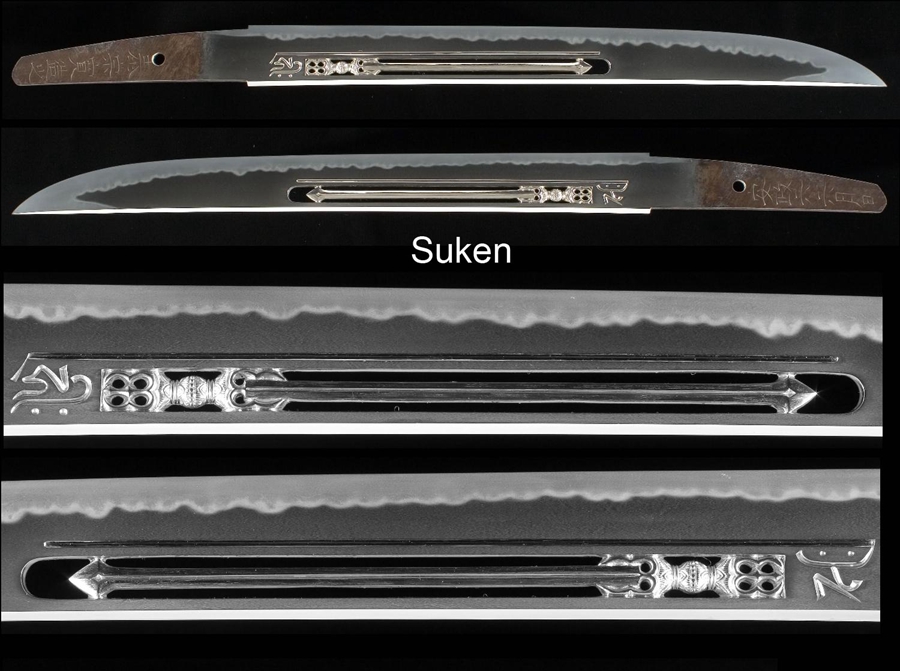
Suken (剣) is an engraved representation of a sword, commonly associated with religious symbolism in traditional Japanese sword art.
The motif may depict a straight, double-edged sword, creating a distinctive contrast with the curved, single-edged Japanese katana blade on which it is carved.
Suken can appear alongside other traditional motifs, including Bonji. In some historical examples, multiple carvings are arranged on different sections or sides of the same blade.
Its simple but recognizable form makes Suken an interesting example of how a relatively small engraving can carry cultural and artistic significance.
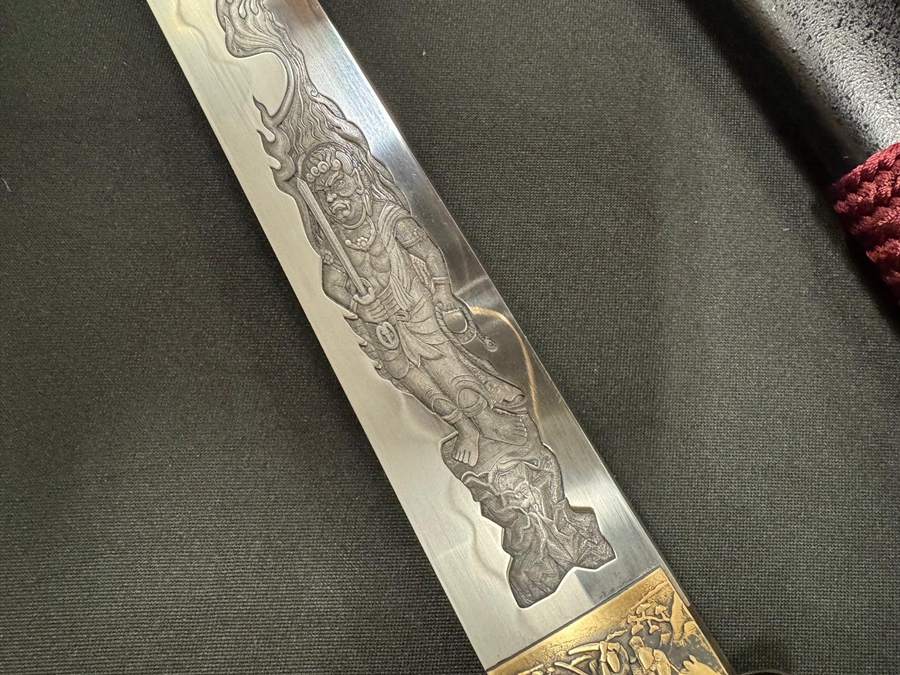
3.4 Fudo Myoo and Other Buddhist Symbols
Fudo Myoo (不動明王), also known as Acala in Sanskrit, is an important figure in Japanese Esoteric Buddhism.
He is often represented with a fierce expression and associated with a sword that symbolizes the cutting away of ignorance and spiritual obstacles.
In Japanese sword art, references to Fudo Myoo may appear through symbolic carvings rather than a complete representation of the deity. The Kurikara dragon-and-sword motif is one notable example of this association.
Other Buddhist-inspired designs may include religious characters and sacred objects. Their meanings should be interpreted carefully, as similar-looking symbols can have different meanings depending on the tradition.
4. Horimono vs. Mei: Understanding the Difference
Another important distinction when studying Japanese swords is the difference between Horimono and Mei (銘).
Although both involve markings or carving, they serve different purposes and are generally found in different locations.
Horimono refers to decorative or symbolic carvings made on the blade. These may include religious characters, dragons, or other traditional motifs.
Mei refers to an inscription or signature on the Nakago, the tang of the sword that extends into the handle. A traditional swordsmith's signature may include the smith's name and, in some cases, additional information such as a date or title.
The distinction matters because a decorative engraving should not automatically be interpreted as evidence of who made the sword.
For collectors, understanding the location and purpose of these markings is an important part of examining a Japanese sword.
5. Decorative Engravings on Modern Katanas
Traditional Horimono is part of Japanese sword history, but blade decoration continues to be an important design consideration for modern katana enthusiasts.
Modern decorative engravings may draw inspiration from traditional Japanese motifs, including dragons, kanji characters, religious symbols, and nature-inspired patterns.
Some modern designs closely reference traditional sword imagery, while others are contemporary interpretations created to reflect an owner's personal preferences.
When choosing a decorative engraving, it is useful to consider several factors:
- Design: Choose a motif that complements the overall appearance of the sword.
- Placement: Consider which area of the blade is suitable for the requested design.
- Complexity: Simple characters and patterns may be easier to accommodate than highly detailed compositions.
- Meaning: Research the cultural or historical significance of symbols before choosing them.
- Compatibility: Confirm that the requested engraving is suitable for the blade design and available production methods.
It is important to distinguish traditional hand-carved Horimono from modern decorative engraving methods. They may look similar in photographs, but their production techniques and historical significance are not necessarily the same.
6. How to Choose an Engraving for Your Custom Katana
A custom katana allows enthusiasts to select different design elements to create a sword that reflects their individual preferences. Blade engravings can be one part of this customization process.
Before requesting an engraving, consider the following steps.
6.1 Decide on the Design
Start by choosing the type of engraving you prefer. You may be interested in traditional Japanese characters, a dragon motif, a simple decorative pattern, or a personalized inscription.
If you are choosing a religious or historical symbol, make sure you understand its meaning and provide an accurate reference image whenever possible.
6.2 Consider the Placement
The position of an engraving can influence the overall appearance of a katana. Some designs are intended for the main blade surface, while others may be positioned closer to the base of the blade.
Providing a reference image with the desired location clearly marked can help communicate your expectations.
6.3 Confirm the Available Engraving Options
Not every engraving design can be reproduced on every sword. The available options may depend on the blade construction, requested design, engraving method, and production requirements.
Before placing an order, contact the seller to confirm whether your requested design can be made and whether additional charges apply.
6.4 Balance the Engraving with the Overall Sword Design
A successful custom design should look cohesive. Consider how the blade engraving will complement the tsuba, handle wrapping, saya, and other fittings.
For example, a simple character engraving may suit a minimalist katana, while a more elaborate decorative motif may work better with a sword designed around a specific visual theme.
If you are planning a custom sword, you can explore the available options through HanBon Forge Custom Swords and review the Available Blade Engravings page.
7. Frequently Asked Questions About Katana Blade Engravings
1. What does Horimono mean on a katana?
Horimono refers to decorative or symbolic carvings made on the surface of a Japanese sword blade. Common examples include Bonji characters, Kurikara dragon motifs, and Suken designs.
2. What is Bonji on a Japanese sword?
Bonji are Sanskrit characters associated with Japanese Buddhist traditions. They may be carved onto a sword blade as religious or symbolic motifs, with specific meanings depending on the character.
3. What does a dragon engraving on a katana represent?
A traditional Kurikara engraving depicts a dragon entwined around a sword and is associated with Fudo Myoo in Buddhist symbolism. Modern dragon decorations may also be inspired by broader Japanese artistic traditions and personal design preferences.
4. What is the difference between Horimono and Mei?
Horimono refers to decorative or symbolic blade carvings, while Mei is an inscription or signature generally found on the Nakago, or tang. They have different locations and purposes.
5. Do katana engravings affect the blade's performance?
The effect depends on the engraving's depth, location, and execution. Decorative carvings should not automatically be assumed to improve blade performance. Deep or poorly executed alterations can affect the blade's structure, so engraving work should be evaluated by qualified craftsmen.
6. Can I order a custom katana with a personalized engraving?
Some custom katana designs can accommodate personalized engravings, depending on the requested artwork and available production methods. Contact HanBon Forge with your reference image and preferred placement to confirm the available options before ordering.
Conclusion: Adding Meaning and Character to a Custom Katana
Japanese katana blade engravings represent an interesting combination of craftsmanship, artistic expression, and cultural tradition. From Bonji and Kurikara to Suken and other symbolic motifs, each design offers a different way to appreciate the artistic details of Japanese swords.
Understanding the differences between traditional Horimono, decorative engravings, and swordsmith signatures can also help collectors make more informed decisions when choosing a Japanese sword.
Whether you appreciate traditional Japanese sword artistry or want to create a personalized katana, choosing an appropriate engraving can add another distinctive element to your sword's overall design.
Explore HanBon Forge Custom Swords to discover customization possibilities and create a Japanese sword that reflects your preferred style.