
Common Tsuba Shapes: A Guide to Japanese Sword Guards
/20181213152007-1140x300w.jpg "Common Tsuba Shapes: A Guide to Japanese Sword Guards")
Common Tsuba Shapes: A Guide to Japanese Sword Guards
The tsuba is one of the most recognizable parts of a traditional Japanese sword. Positioned between the blade and the handle, the tsuba serves as the sword's guard and is an important element of the overall sword mounting, or koshirae. On a katana, wakizashi, or other Japanese sword, the tsuba can be both practical and decorative.
Over centuries of Japanese sword-making, craftsmen developed many different tsuba shapes. Some are simple and symmetrical, while others feature flowing outlines, multiple lobes, or unusual ceremonial forms. Among the many variations, several shapes appear especially frequently in Japanese sword fittings.
This guide explains the most common types of tsuba, including Maru-gata, Kaku-gata, Mokko-gata, and Shitogi-gata, and helps you understand the visual differences between these classic Japanese sword guards.
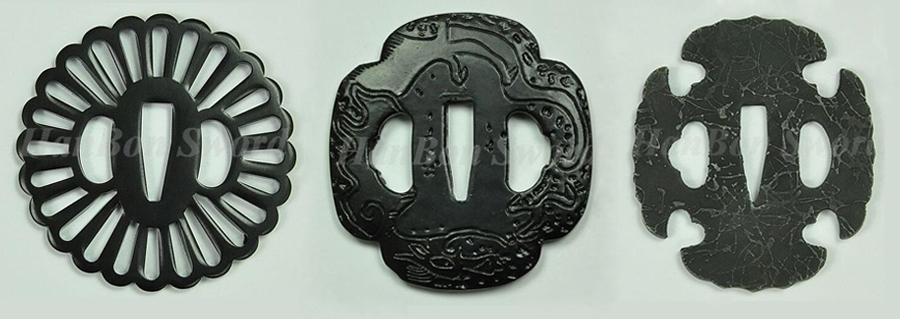
What Is a Tsuba?
A tsuba is the guard fitted between the blade and the handle of a Japanese sword. It is commonly associated with the katana, although tsuba are also found on other traditional Japanese swords, including the wakizashi and tachi.
The central opening allows the sword tang to pass through the guard, while the overall shape and size help form part of the sword's mounting. Depending on the period, school, purpose, and artistic style, a tsuba may be plain and functional or highly decorative.
Traditional tsuba have been made from materials such as iron, copper, brass, and various metal alloys. Decorative examples may include carving, inlay, engraving, openwork designs, and detailed scenes inspired by nature, mythology, religion, or Japanese culture.
Because the tsuba is one of the most visible components of a Japanese sword, its design became an important form of artistic expression. The shape of the guard provides the foundation for its decoration and strongly influences the overall appearance of the sword.
Why Are There Different Tsuba Shapes?
Different tsuba shapes developed for a variety of reasons. Japanese sword fittings changed over time, and sword owners often selected fittings according to personal taste, artistic fashion, practical requirements, or the type of sword being mounted.
The outline of a tsuba also creates a visual framework for decorative designs. A round tsuba offers a balanced and simple surface, while a four-lobed Mokko-gata creates a softer and more organic appearance. Square and angular forms can give a sword a stronger, more formal character.
As a result, the shape of a katana tsuba is often one of the first details collectors and enthusiasts notice when examining Japanese sword fittings.
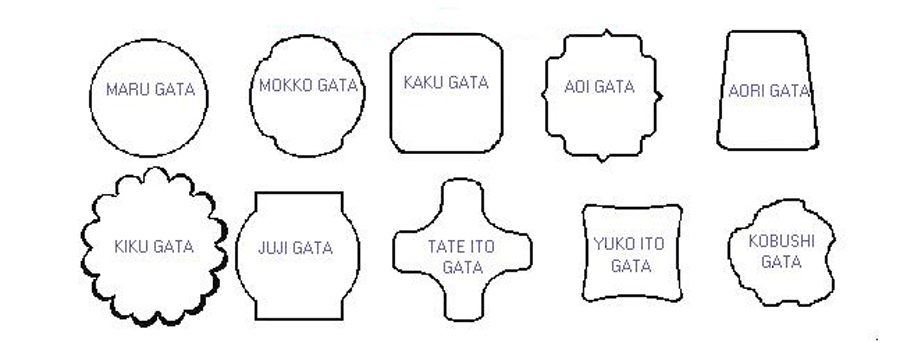
1. Maru-gata: The Classic Round Tsuba
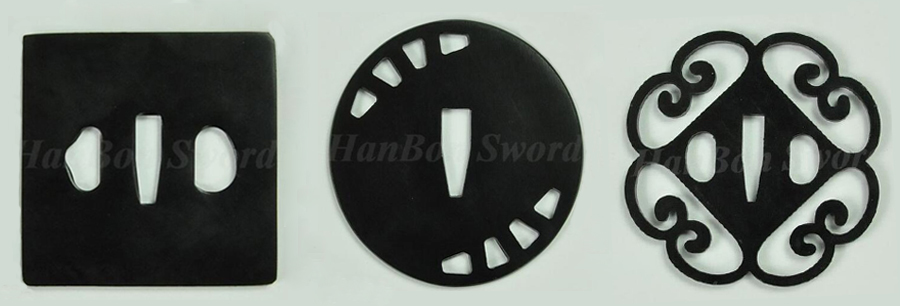
Maru-gata (丸形) refers to a round tsuba and is one of the most common shapes found on Japanese swords. The word maru means "round," making this one of the easiest tsuba shapes to recognize.
A Maru-gata tsuba usually has a circular outline, although some examples may be slightly oval or elliptical rather than perfectly round. Its balanced shape makes it suitable for many different sword styles and decorative themes.
The simple circular form also provides a large and flexible surface for artistic work. Depending on the design, a round tsuba may feature openwork patterns, engraved scenes, animals, plants, family crests, or completely plain surfaces.
For sword enthusiasts looking for a traditional and versatile Japanese sword guard, the Maru-gata is one of the most recognizable choices.
Key characteristics of Maru-gata:
- Round or nearly circular outline
- One of the most common tsuba shapes
- May also appear slightly oval or elliptical
- Suitable for both simple and highly decorative designs
- Common on many styles of Japanese swords
2. Kaku-gata: The Square or Angular Tsuba
Kaku-gata (角形) is generally used to describe a square or angular tsuba shape. Compared with the smooth and balanced appearance of a Maru-gata, a Kaku-gata tsuba has a more structured and geometric outline.
Many Kaku-gata tsuba are approximately square, often with softened or rounded corners. However, the category can include several related angular forms. Some examples may appear rectangular, hexagonal, octagonal, or slightly trapezoidal.
The geometric outline gives the tsuba a distinctive appearance and can work particularly well with architectural patterns, family crests, geometric decoration, and bold openwork designs.
One common variation is Nade-kaku-gata, which has a square-like form with more rounded and softened edges.
Key characteristics of Kaku-gata:
- Square or angular overall outline
- Often features rounded corners
- May include hexagonal or octagonal variations
- Creates a bold and structured visual appearance
- Offers a strong contrast to round tsuba designs
3. Mokko-gata: The Four-Lobed Tsuba
Mokko-gata (木瓜形) is one of the most distinctive and attractive traditional tsuba shapes. It is characterized by a lobed outline, commonly featuring four rounded sections separated by gentle inward curves.
The overall appearance is often compared to a cut melon, gourd, quince, or a four-lobed floral form. This organic outline creates a softer and more decorative look than a simple round or square tsuba.
Mokko-gata tsuba have many variations. Some have deep and pronounced lobes, while others feature subtle curves that make the outline appear almost oval. The shape can also be combined with elaborate carvings, openwork patterns, or decorative metalwork.
Because of its flowing form, the Mokko-gata is particularly well suited to designs inspired by nature, including flowers, leaves, animals, waves, and other organic motifs.
Key characteristics of Mokko-gata:
- Four-lobed or quatrefoil-like outline
- Soft and organic appearance
- Often compared to a melon, gourd, or quince shape
- Available in many different variations
- Popular for decorative Japanese sword fittings
4. Shitogi-gata: An Early and Unusual Tsuba Shape
Shitogi-gata (粢形) is a less common but historically interesting type of Japanese sword guard. Its unusual form differs significantly from the familiar round, square, and four-lobed tsuba shapes.
Traditional Shitogi-gata examples are associated with early Japanese sword fittings and have a distinctive outline that can appear elongated, ceremonial, or reminiscent of older ritual objects. The form is often discussed in connection with early tachi-style mountings and the development of other Japanese sword guard shapes.
Because of its distinctive historical appearance, the Shitogi-gata is particularly interesting to collectors and enthusiasts studying the evolution of Japanese sword fittings.
Key characteristics of Shitogi-gata:
- An unusual and historically significant tsuba form
- Associated with early Japanese sword fittings
- Distinctly different from round and square guards
- Important when studying the development of traditional tsuba designs
- Less commonly seen than Maru-gata or Mokko-gata
Other Types of Tsuba Shapes
While Maru-gata, Kaku-gata, Mokko-gata, and Shitogi-gata are among the best-known traditional forms, Japanese sword guards exist in many other shapes and variations.
Some common variations include oval forms, rounded square forms, leaf-inspired designs, flower-shaped guards, and irregular outlines. Over time, sword fitting makers developed increasingly creative designs, particularly as the tsuba became an important artistic object as well as a functional sword component.
Examples of additional tsuba shapes include:
- Nade-kaku-gata – a rounded square form
- Nade-maru-gata – a softened or oval variation of the round form
- Aoi-gata – a shape associated with the hollyhock motif
- Kiku-gata – a chrysanthemum-inspired shape
- Kawari-gata – an unusual or irregular-shaped tsuba
These variations demonstrate how diverse Japanese sword guard designs can be. Even within the same basic shape category, individual tsuba may look completely different depending on the artist, period, material, and decorative technique.
How to Identify a Tsuba Shape
The easiest way to identify a tsuba is to begin with its outer outline. Ignore the decorative pattern at first and focus on the overall silhouette.
- Round outline: Usually Maru-gata
- Square or angular outline: Usually Kaku-gata or one of its variations
- Four rounded lobes: Usually Mokko-gata
- Unusual early or ceremonial form: May be Shitogi-gata or another specialized type
After identifying the basic shape, examine the rim, material, decorative technique, central opening, and any additional openings. These details can provide more information about the style and construction of the Japanese sword fitting.
Does Tsuba Shape Affect the Appearance of a Katana?
Yes. The shape of the tsuba can significantly influence the overall appearance of a katana.
A round Maru-gata tsuba often creates a balanced and traditional look. A Kaku-gata guard can make the sword appear more structured and bold. A Mokko-gata adds softer curves and a more decorative character.
When choosing a katana tsuba, the shape should work visually with the rest of the sword, including the blade, handle, saya, menuki, fuchi, and kashira.
For a custom Japanese sword, selecting the right tsuba shape can be an effective way to create a particular historical style or personal aesthetic.
Which Tsuba Shape Is the Most Common?
The Maru-gata, or round tsuba, is generally considered one of the most common and recognizable Japanese sword guard shapes.
Its simple circular outline is versatile, balanced, and suitable for many different decorative styles. However, Mokko-gata and various square or rounded-square forms are also widely recognized in traditional Japanese sword fittings.
The best choice depends on the style of sword and the appearance you want to achieve. Collectors interested in historical Japanese swords may also consider the period, school, and type of sword mounting when selecting or studying a tsuba.
Choosing the Right Tsuba for a Japanese Sword
If you are selecting a tsuba for a katana or custom Japanese sword, appearance is only one factor to consider. The guard should also be compatible with the sword's mounting and overall design.
For a traditional and versatile look, a round Maru-gata is an excellent option. For a more distinctive design, a Mokko-gata can add flowing curves and visual character. A Kaku-gata may be suitable for those who prefer a stronger geometric appearance.
The best tsuba is not necessarily the most elaborate one. A simple design that complements the sword can often create a more balanced and authentic-looking result.
Conclusion
The tsuba is far more than a simple Japanese sword guard. Over centuries, it developed into one of the most recognizable and artistic parts of Japanese sword fittings.
Understanding the common types of tsuba makes it easier to appreciate the design of a katana and other Japanese swords. The classic Maru-gata, Kaku-gata, Mokko-gata, and Shitogi-gata forms each have their own distinctive appearance and historical character.
Whether you are interested in Japanese sword history, collecting katana, studying sword fittings, or designing a custom sword, learning to recognize different tsuba shapes is a useful first step.
From the simple balance of a round Maru-gata to the flowing curves of a Mokko-gata, the shape of a tsuba plays an important role in defining the character of a Japanese sword.
Frequently Asked Questions About Tsuba Shapes
What is a tsuba on a Japanese sword?
A tsuba is the guard positioned between the blade and handle of a Japanese sword. It is commonly found on katana and other traditional Japanese swords and is an important part of the sword's mounting.
What are the most common tsuba shapes?
Some of the most common traditional tsuba shapes include Maru-gata (round), Kaku-gata (square or angular), Mokko-gata (four-lobed), and Shitogi-gata.
What is a Maru-gata tsuba?
A Maru-gata tsuba is a round Japanese sword guard. It is one of the most common and recognizable tsuba shapes and may be perfectly circular or slightly oval.
What is a Mokko-gata tsuba?
A Mokko-gata tsuba is a four-lobed Japanese sword guard. Its outline has soft curves and is often compared to a melon, gourd, quince, or four-petaled shape.
What is the difference between Maru-gata and Kaku-gata?
Maru-gata refers to a round tsuba, while Kaku-gata refers to a square or angular tsuba. Maru-gata has a smooth circular appearance, while Kaku-gata has a more geometric outline.
Does the shape of a tsuba affect a katana?
The shape of a tsuba strongly affects the visual appearance and style of a katana. Different shapes create different aesthetic impressions and can complement specific sword designs and decorative themes.
Are all katana tsuba round?
No. Although round Maru-gata tsuba are very common, Japanese sword guards can also be square, oval, four-lobed, flower-shaped, leaf-shaped, or irregularly shaped.
What material is a traditional tsuba made from?
Traditional tsuba can be made from iron, copper, brass, and different metal alloys. Some examples also feature decorative inlays or details made from precious metals.
Related Keywords: common tsuba shapes, tsuba shapes, types of tsuba, Japanese sword guard, katana tsuba, Japanese sword fittings, Maru-gata, Kaku-gata, Mokko-gata, Shitogi-gata.