
How to Remove the Handle from a Katana: Tsuka Removal Guide
How to Remove the Handle from a Katana: A Guide to Tsuka Removal
The handle of a traditional Japanese sword is called the tsuka. It fits over the nakago, or tang, and is secured with one or more small retaining pegs known as mekugi.
Understanding how a katana handle is assembled can be useful for collectors, sword enthusiasts, and owners who need to inspect the fittings. However, removing a tsuka should always be done carefully. A katana blade can be extremely sharp, and improper handling may damage the sword or cause serious injury.
This guide explains the basic construction of a Japanese sword handle, when tsuka removal may be necessary, and the precautions to consider before attempting to remove the handle from a katana.
How Is a Katana Handle Attached?
A traditional katana handle is not permanently attached to the blade with ordinary glue. Instead, the tsuka is fitted over the nakago, which is the portion of the blade that extends inside the handle.
The handle is held in place by one or more mekugi. A mekugi is traditionally made from bamboo and passes through the tsuka and the nakago to help secure the blade inside the handle.
The close fit between the wooden core of the tsuka and the nakago is also an important part of the overall construction. For this reason, a properly fitted handle may feel very tight and should not be forced off unnecessarily.
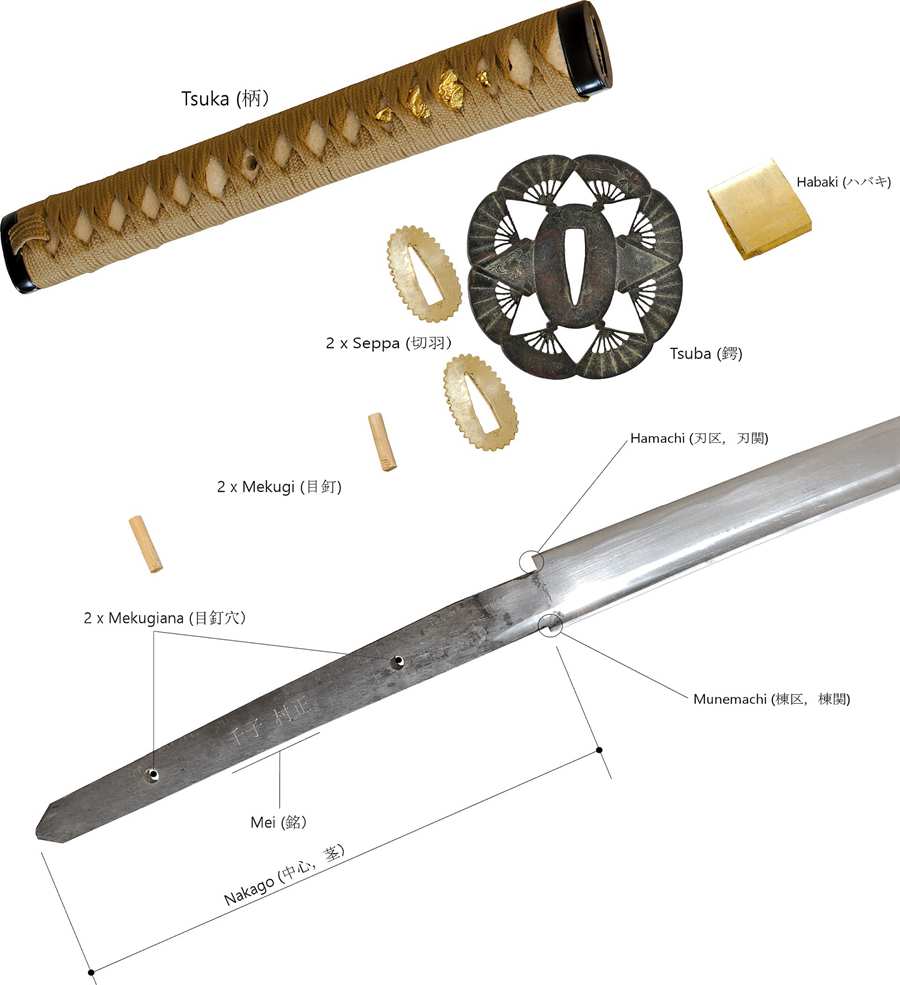
The main parts involved in katana handle construction include:
- Tsuka – the handle of the Japanese sword
- Nakago – the tang of the blade
- Mekugi – the retaining peg
- Mekugi-ana – the hole for the retaining peg
- Fuchi – the collar at the front of the handle
- Kashira – the pommel at the end of the handle
- Tsuba – the sword guard
- Seppa – the spacer washers around the tsuba
- Habaki – the collar fitted around the base of the blade
Understanding these parts makes it easier to appreciate how a Japanese sword is assembled.
Why Would You Remove the Tsuka from a Katana?
In most situations, there is no reason to remove the handle simply out of curiosity. A katana should not be repeatedly disassembled unless there is a specific reason.
Possible reasons for removing the tsuka may include:
- Inspecting the nakago
- Checking the condition of the mekugi
- Inspecting loose sword fittings
- Examining the construction of the sword
- Performing appropriate maintenance
- Repairing or replacing damaged fittings
If a sword has historical or collectible value, additional care is necessary. The nakago of an antique Japanese sword may contain a signature, inscriptions, filing marks, and an important natural patina.
For valuable antique swords, disassembly and restoration are best left to experienced specialists.
Before Removing a Katana Handle
Before working on any Japanese sword, prepare a clean, stable, and well-lit workspace.
The sword should be handled carefully at all times. Keep other people away from the work area, especially when the blade is outside the saya.
Before inspecting or disassembling a katana, consider the following precautions:
- Work on a clean and stable surface
- Make sure the workspace is well lit
- Keep the blade away from other people
- Avoid placing the edge where it may contact a hard surface
- Keep small fittings and mekugi in a safe location
- Do not use excessive force
- Stop if you are unsure about the construction of the sword
The blade should always be treated as sharp, even if you believe it is primarily decorative.
Understanding the Mekugi Before Tsuka Removal
The mekugi is one of the most important components involved in securing the handle to a Japanese sword.
On many traditionally constructed swords, the mekugi is made from bamboo. Depending on the sword and its mounting style, there may be one or more retaining pegs.
Before attempting to remove the tsuka, the mekugi must first be carefully examined.
A mekugi may be slightly tapered, meaning that one side can be narrower than the other. It is important to inspect the peg carefully rather than forcing it in the wrong direction.
If the peg appears damaged, cracked, unusually tight, or difficult to identify, it is best to stop and seek assistance from someone familiar with Japanese sword construction.
Basic Tools for Katana Handle Inspection
The exact tools required depend on the type of sword and the work being performed. For a basic inspection, specialized tools designed for Japanese sword fittings are preferable to improvised household tools.
Common items may include:
- A mekugi removal tool
- A soft cloth
- A clean work surface
- A soft support for the sword
- A small container for loose fittings
Avoid using sharp tools, metal objects that may scratch the fittings, or excessive impact to force parts apart.
Improvised methods can damage the tsuka, scratch the blade, deform the habaki, or cause damage to the fittings.
How the Tsuka Is Normally Removed
Once the retaining peg or pegs have been properly removed, the tsuka may be separated from the nakago if inspection is necessary.
A properly fitted katana handle can remain firmly attached to the tang even after the mekugi has been removed. This is normal because the tsuka is designed to fit closely around the nakago.
The handle should never be twisted aggressively, pried off with a screwdriver, or forced with uncontrolled impact.
If the tsuka begins to loosen, the blade and fittings should be supported carefully. The handle should separate in line with the nakago rather than being pulled sideways.
Work slowly and pay attention to the position of the blade at all times. If the handle does not come loose easily, stop rather than increasing the amount of force.
A tightly fitted tsuka may require professional attention, particularly if the sword is valuable, antique, or unfamiliar in construction.
What Not to Do When Removing a Katana Handle
Many problems occur when people attempt to remove a katana handle using excessive force or inappropriate tools.
Avoid the following:
- Do not twist the handle aggressively
- Do not pry the tsuka away from the blade with metal tools
- Do not strike the blade or edge
- Do not force a damaged or stuck mekugi
- Do not use excessive impact
- Do not pull the blade sideways
- Do not allow loose fittings to fall onto a hard surface
- Do not attempt unnecessary disassembly of a valuable antique sword
Forcing a Japanese sword apart can damage the wooden tsuka, fittings, habaki, or other components.
What Happens After the Tsuka Is Removed?
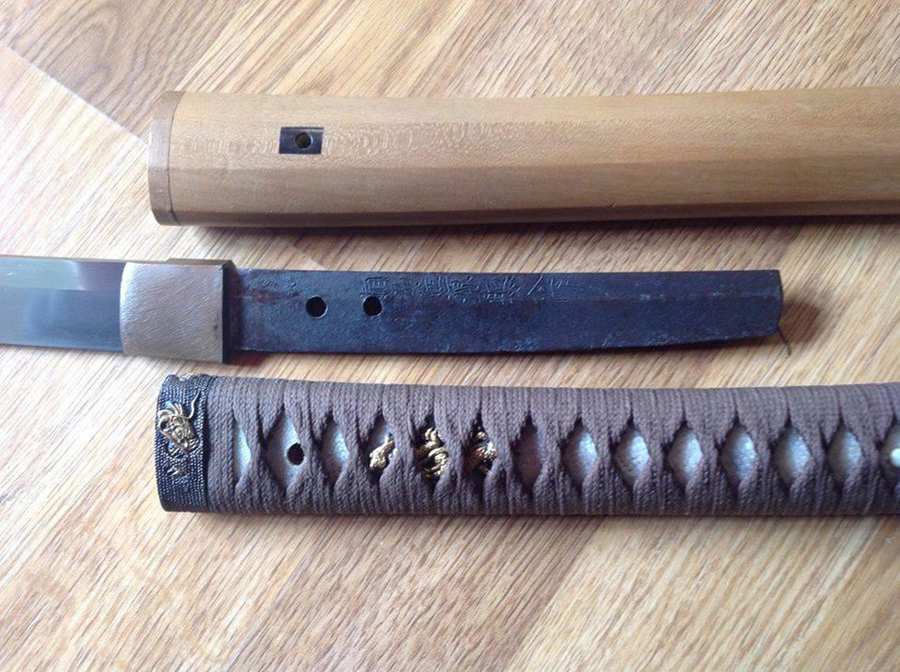
Once the tsuka has been removed, the nakago becomes visible. Depending on the sword, other components may also be present around the base of the blade.
These may include the tsuba, seppa, and habaki.
The nakago may contain important information about the sword. On traditional Japanese swords, it can include:
- A swordsmith's signature, known as a Mei
- The date of manufacture
- Historical inscriptions
- Mekugi-ana
- Yasurime filing marks
- Natural age-related patina
For antique Japanese swords, the surface of the nakago should not be polished or aggressively cleaned.
Should You Clean the Nakago?
The answer depends greatly on the type and age of the sword.
For antique Japanese swords, the nakago may have significant historical value. Its natural surface, patina, inscriptions, and filing marks can provide information about the sword's history.
Aggressive cleaning may permanently alter these features.
Do not use sandpaper, polishing compounds, grinding tools, or abrasive materials on the tang of an antique Japanese sword.
If rust, damage, or corrosion is present on a valuable sword, professional advice should be obtained before attempting treatment.
How to Inspect the Nakago
If the handle has been removed for inspection, the nakago should be examined carefully without unnecessary handling.
Important details to observe include:
- The overall shape of the tang
- The condition of the mekugi-ana
- The number of peg holes
- Any swordsmith signature or Mei
- Yasurime filing marks
- The condition of the surface
- Any signs of damage or unusual corrosion
Avoid touching the blade unnecessarily, as fingerprints and moisture can affect the surface of steel over time.
Reassembling the Katana
Reassembly should be performed carefully and only when all components are in good condition.
The fittings should be returned in their correct order and orientation. The tsuka should fit properly over the nakago without forcing or modifying the components.
The mekugi must be correctly installed and should fit securely.
Never use a damaged retaining peg. If a mekugi is cracked, loose, or improperly fitted, it should be inspected and replaced with an appropriate component.
After reassembly, check that the handle and fittings are secure before moving or storing the sword.
Common Problems When Removing a Katana Handle
The most common issue is a tsuka that remains tightly fitted to the nakago after the mekugi has been removed.
This does not necessarily indicate a problem. A properly constructed handle may have a close friction fit.
Other common issues include:
- A mekugi that is difficult to remove
- A damaged or cracked bamboo peg
- A loose tsuka
- Loose fittings
- A damaged mekugi-ana
- A handle that does not align correctly
If you encounter any of these problems, avoid forcing the sword apart. Continuing to apply pressure may create additional damage.
For valuable swords or complex repairs, consulting an experienced sword specialist is usually the safest option.
Katana Handle Removal and Regular Maintenance
Removing the tsuka is not usually required for routine katana maintenance.
Regular care generally focuses on keeping the blade clean, dry, and protected from corrosion. The condition of the handle, fittings, and saya should also be checked periodically.
A sword should only be disassembled when there is a clear reason for inspection, repair, or maintenance.
Unnecessary disassembly increases the possibility of losing small components, damaging fittings, or affecting the fit of the tsuka.
When Should You Ask a Professional for Help?
Professional assistance is recommended if the sword is antique, historically significant, unusually valuable, or difficult to disassemble.
You should also seek assistance if:
- The tsuka appears damaged
- The mekugi is cracked or broken
- The handle will not loosen
- The fittings are loose or misaligned
- The nakago shows significant corrosion
- You are unsure how the sword is constructed
Japanese swords are complex objects with both functional and historical value. In many cases, avoiding unnecessary damage is more important than completing a quick inspection.
Frequently Asked Questions About Removing a Katana Handle
How is a katana handle attached to the blade?
A katana handle, or tsuka, fits over the nakago, which is the tang of the blade. One or more mekugi retaining pegs pass through the handle and tang to help secure the sword.
What is a mekugi?
A mekugi is a small retaining peg used in Japanese sword construction. Traditional mekugi are commonly made from bamboo and pass through the tsuka and nakago.
Why is my katana handle so difficult to remove?
A tightly fitted tsuka is often normal. The wooden handle is designed to fit closely around the nakago. Avoid forcing the handle, twisting it aggressively, or using inappropriate tools.
Do all katana have two mekugi?
No. The number of mekugi can vary depending on the sword, its construction, and the mounting style. Some swords use one retaining peg, while others use more.
Can I remove a katana handle for routine cleaning?
Removing the tsuka is usually not necessary for routine maintenance. The blade can normally be inspected and maintained without repeatedly disassembling the sword.
Can I clean the nakago?
Antique Japanese sword tangs should generally not be aggressively cleaned. The nakago may contain historical inscriptions, filing marks, and natural patina that can be permanently altered by abrasive cleaning.
What should I do if the tsuka will not come off?
Do not continue increasing the force. A tightly fitted handle may require careful inspection by someone experienced with Japanese sword construction.
What is the nakago on a katana?
The nakago is the tang of a Japanese sword. It extends from the blade into the tsuka and may contain signatures, filing marks, peg holes, and other historical information.
Final Thoughts
Learning how a katana handle is constructed provides a better understanding of traditional Japanese sword design. The tsuka, mekugi, nakago, and fittings work together as part of a carefully designed mounting system.
If you need to inspect a katana, patience and careful handling are essential. A properly fitted tsuka should never be removed through unnecessary force, and valuable or antique swords deserve additional caution.
For most owners, understanding the structure of the sword and performing regular visual inspections is more important than frequent disassembly.
By treating the tsuka, nakago, and fittings with care, you can help preserve both the appearance and condition of your Japanese sword.