
Japanese Sword Tang Shapes (Nakago): Types and Identification Guide
/Shapes%20of%20Japanese%20sword%20tangs%20(nakago)-1140x300w.jpg "Japanese Sword Tang Shapes (Nakago): Types and Identification Guide")
Shapes of Japanese Sword Tang (Nakago): A Guide to Traditional Nakago Shapes
When people examine a Japanese sword, most attention naturally goes to the polished blade, the hamon, or the decorative fittings. However, one of the most important parts of a traditional Japanese sword is hidden inside the handle. This section is called the nakago, commonly known in English as the Japanese sword tang.
The nakago is the portion of the blade that extends into the tsuka, or handle. Although it is normally concealed when the sword is fully mounted, the shape, surface, file marks, and signature found on the nakago can provide valuable information about a sword's history and construction.
For collectors and students of Japanese swords, studying different nakago shapes can help reveal characteristics associated with particular periods, swordsmiths, schools, and blade types. The tang is therefore much more than a structural component—it is an important part of Japanese sword identification and appreciation.
What Is a Nakago?
The nakago is the unpolished portion of a Japanese sword blade that fits inside the handle. In a katana, wakizashi, tanto, or tachi, the nakago provides the connection between the blade and the tsuka.
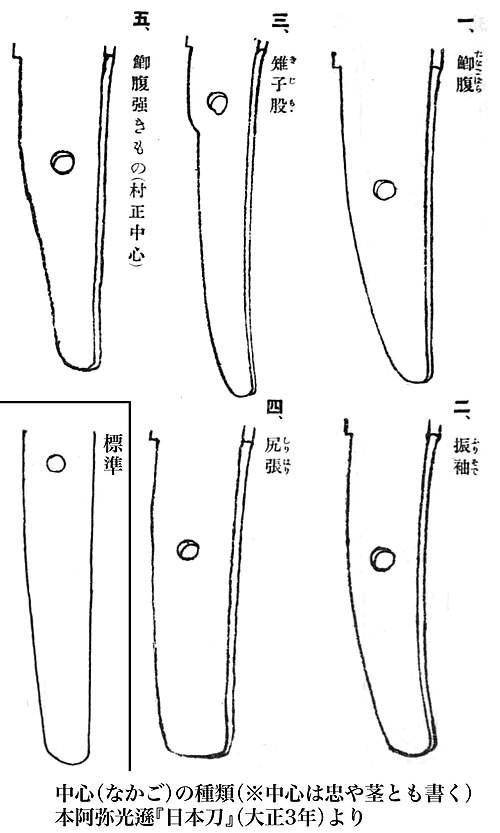
A traditional Japanese sword is generally constructed from one continuous piece of steel. The blade does not simply stop at the guard. Instead, the steel continues into the handle as the tang. This construction allows the blade to be securely mounted using a bamboo peg called a mekugi.
Unlike the polished blade, the nakago is usually left unpolished. Over time, it develops a natural patina. For this reason, collectors generally avoid cleaning or polishing an old nakago, as the surface may contain important historical evidence.
The nakago may also include a swordsmith's signature, known as a mei, as well as dates, locations, ownership marks, or other inscriptions.
Why Are Nakago Shapes Important?
The shape of a Japanese sword tang can provide useful clues about the sword. Nakago forms changed over time and were influenced by regional traditions, individual swordsmiths, and the type of blade being produced.
When examining a nakago, specialists may consider several characteristics:
- The overall shape of the tang
- The width and thickness of the nakago
- The degree of curvature
- The shape of the nakago-jiri, or tang tip
- The placement and number of mekugi-ana
- The style of yasurime, or file marks
- The presence of a mei or other inscriptions
No single feature can identify a Japanese sword by itself. However, when the nakago is studied together with the blade's shape, steel structure, hamon, and other details, it can provide valuable information about the sword's origin.
Different nakago shapes are therefore an important part of Japanese sword study.
Common Shapes of Japanese Sword Tang (Nakago)
Over the centuries, Japanese swordsmiths produced a variety of tang shapes. Some forms became common across different periods, while others are closely associated with particular sword types or individual smiths.
Below are several traditional shapes of Japanese sword tangs.
1. Futsu Gata – The Standard Nakago Shape
Futsu Gata is one of the most common forms of Japanese sword tang. It is often considered a standard or ordinary nakago shape and can be found on swords from different historical periods.

An ubu nakago with a Futsu Gata form generally has a straightforward and balanced profile. Because this shape appears frequently on both older and newer Japanese swords, it is not limited to a single school or era.
The term ubu nakago refers to a tang that remains in its original length and has not been significantly shortened. Preserved ubu nakago can be particularly valuable for sword study because they retain original features such as the tang shape, file marks, and signature placement.
For students learning about katana tang shapes, Futsu Gata is often one of the easiest forms to recognize.
2. Kiji Momo Gata – The “Pheasant Thigh” Shape
Kiji Momo Gata, sometimes referred to as Kiji Mata Gata, takes its name from its resemblance to the thigh of a pheasant.

This distinctive Japanese sword tang shape is associated with certain older blades and is often encountered on tachi from the Heian and Kamakura periods.
The shape reflects the development of Japanese sword construction during an era when the tachi was one of the dominant sword forms. Early Japanese swords often display features that differ significantly from later katana, including differences in blade curvature, mounting style, and tang design.
Because of its historical associations, Kiji Momo Gata is an interesting form for collectors studying early Japanese swords.
3. Shiribari Gata – A Broad and Flattened Tang Form
Shiribari Gata is characterized by a noticeably flattened or broadened lower section of the nakago.
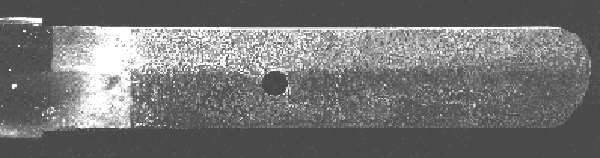
The proportions of the tang create a distinctive appearance that separates it from the more straightforward Futsu Gata form. Nakago shapes such as this demonstrate how Japanese swordsmiths used different profiles and proportions depending on their traditions and working methods.
When examining an older Japanese sword, the overall shape of the nakago should always be considered together with other details. The tang alone cannot provide a complete identification, but its form may help narrow the historical context of a blade.
4. Gohei Gata – A Rare and Distinctive Nakago Shape
Gohei Gata is named after its resemblance to the paper streamers associated with Shinto religious traditions.
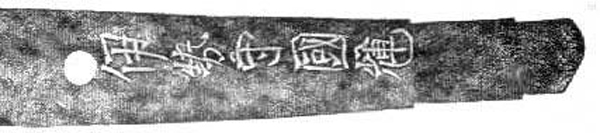
Compared with common Japanese sword tang forms, Gohei Gata is much more distinctive and unusual. Certain rare nakago shapes may be associated with specific swordsmiths or limited traditions.
This is one reason why the nakago is so important in Japanese sword study. Small details in the tang—including its shape, file marks, and edges—can sometimes reveal information that is not immediately visible on the polished blade.
For collectors, unusual nakago forms can be especially interesting when supported by other identifying characteristics.
5. Funa Gata – The Boat-Shaped Nakago
The name Funa Gata comes from the Japanese word for “boat.” As the name suggests, this tang shape has a profile that resembles the outline of a boat.
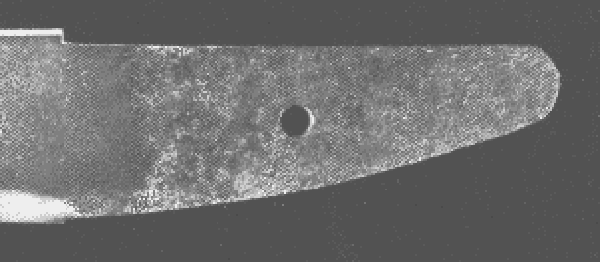
Funa Gata can be found on swords from different periods, including some Showa-era military swords as well as earlier blades.
The appearance of this form across different periods is a reminder that Japanese sword features should not be used in isolation. A particular tang shape may appear on more than one type of sword, so researchers must consider the entire blade and its construction.
When identifying a Japanese sword nakago, features such as the blade style, signature, patina, yasurime, and mekugi-ana should also be examined.
6. Furisode Gata – The Long-Sleeve Shape
Furisode Gata is named after the long sleeves of a furisode kimono. The tang has a profile that resembles the flowing shape of a sleeve.
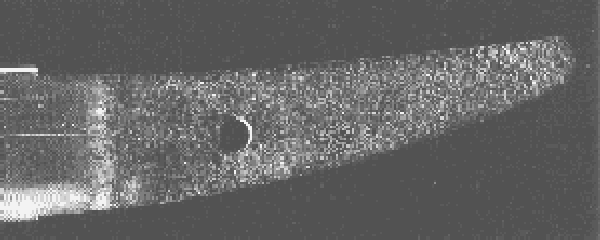
This form is often associated with shorter Japanese blades, including certain tanto. It is particularly interesting because the shape of a nakago can sometimes reflect the proportions and style of the blade itself.
Shorter blades often developed their own construction traditions, and their nakago may differ considerably from those found on long katana or tachi.
For this reason, studying the relationship between blade type and tang shape is useful when learning about traditional Japanese swords.
7. Tanago Bara Gata – The “Fish Belly” Shape
Tanago Bara Gata is named because its shape resembles the belly of a tanago, a small freshwater fish.
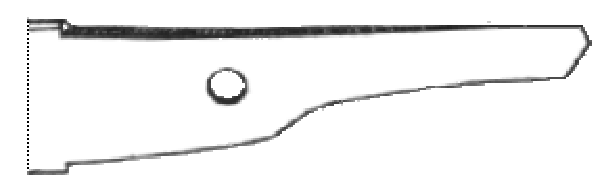
The broader and distinctive profile makes this form different from more conventional nakago shapes. As with other specialized Japanese sword tang forms, the exact significance of the shape depends on the sword's period, school, construction, and other characteristics.
For collectors, unusual tang shapes can be useful reference points when comparing swords. However, accurate identification requires a broader examination rather than relying on a single feature.
Nakago Shape and Japanese Sword Identification
The nakago is often described as one of the most informative parts of a Japanese sword. While the polished blade may receive more attention, the tang preserves many details related to the sword's history.
When specialists examine a Japanese sword, they may study:
- Nakago shape
- Nakago-jiri shape
- Yasurime file marks
- Mekugi-ana placement
- Natural patina
- Mei or swordsmith signature
- The relationship between the blade and the tang
Together, these details can help establish whether a blade has been shortened, altered, or remounted during its lifetime.
For example, many older Japanese swords were shortened through a process known as suriage. When a sword is shortened, the original nakago may be altered and the original signature may be lost or moved.
This makes the study of the tang especially important for understanding the history of an individual blade.
Why Should You Not Clean an Old Nakago?
One of the most important rules for collectors is to avoid cleaning the tang of an antique Japanese sword.
An old nakago naturally develops a dark patina over many years. This surface is not simply dirt or rust. The condition and appearance of the patina may provide information about the sword's age and history.
Aggressively cleaning, sanding, polishing, or grinding the nakago can permanently remove historical evidence and reduce the sword's value to collectors.
If an antique Japanese sword requires evaluation or conservation, it is generally best to consult an experienced professional.
Modern reproduction swords are different. Their tangs may have different finishes and construction methods, but unnecessary modification should still be avoided.
Nakago Shapes in Modern Katana
Modern handmade katana continue to use the traditional concept of the nakago. In a properly constructed sword, the tang is an extension of the blade rather than a separate piece attached to it.
Modern sword enthusiasts often use the term full tang katana. In the context of Japanese swords, it is important to understand that traditional construction differs from many modern Western-style knives and swords.
A traditional Japanese sword blade is forged with a nakago extending into the tsuka. The tang is shaped according to the intended construction of the sword and secured within the handle.
For custom Japanese swords, the shape and length of the nakago can influence how the sword is mounted and balanced.
Final Thoughts: Understanding the Japanese Sword Tang
The nakago may be hidden inside the handle, but it is one of the most important parts of a Japanese sword.
From common forms such as Futsu Gata to distinctive shapes such as Kiji Momo Gata, Funa Gata, Furisode Gata, and Tanago Bara Gata, the shape of the Japanese sword tang reflects centuries of swordmaking traditions.
For anyone interested in katana, tanto, wakizashi, or antique Japanese swords, learning about nakago shapes is an excellent way to better understand Japanese sword construction.
The blade may be the most visible part of a sword, but the nakago often preserves some of its most important historical details.
Frequently Asked Questions About Japanese Sword Tang (Nakago)
What is the tang of a Japanese sword called?
The tang of a Japanese sword is called the nakago. It is the portion of the blade that extends into the handle, or tsuka.
What is the purpose of the nakago?
The nakago connects the blade to the handle. It also provides important information about the sword, including its shape, file marks, patina, and sometimes the swordsmith's signature.
What are the different shapes of Japanese sword tangs?
Common and traditional nakago shapes include Futsu Gata, Kiji Momo Gata, Shiribari Gata, Gohei Gata, Funa Gata, Furisode Gata, and Tanago Bara Gata.
Why is the nakago important for Japanese sword identification?
The nakago may contain identifying features such as its overall shape, yasurime file marks, mekugi-ana, patina, and swordsmith's signature. These characteristics can help specialists study the history and origin of a Japanese sword.
Should you clean a Japanese sword tang?
Antique Japanese sword tangs should generally not be cleaned or polished. The natural patina may contain important historical information, and cleaning can permanently damage the surface.
What is an ubu nakago?
An ubu nakago is a tang that remains close to its original form and has not been significantly shortened. Original tangs can preserve valuable information about the sword's original construction.
Can a katana tang be shortened?
Yes. Historically, some Japanese swords were shortened through a process known as suriage. This could alter the original nakago shape and sometimes remove or affect the swordsmith's signature.
Are all katana full tang?
Traditional Japanese swords are forged with a nakago extending from the blade into the handle. However, modern reproduction swords can vary in construction quality, so buyers should examine how a particular sword is made rather than relying only on marketing terminology.