How to Choose the Right Sword Size: Katana Size Guide
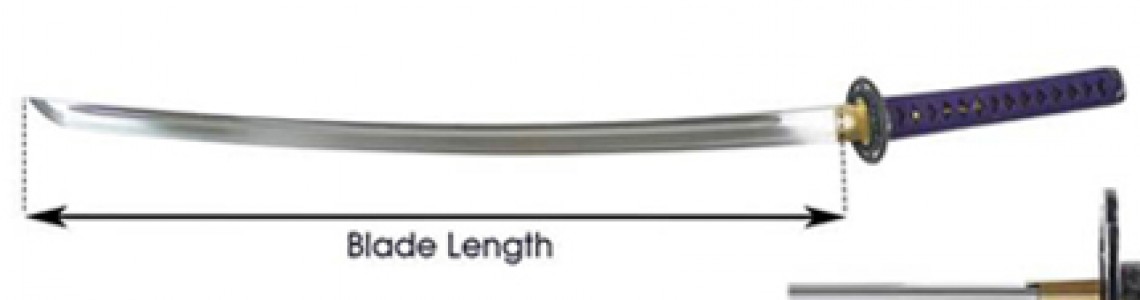
Choosing the right katana size depends on your height, arm length, hand size, experience, and intended use. A standard modern katana commonly has a blade around 27–29 inches and a handle approximately 10–12 inches long, but these measurements are not universal. This complete Japanese sword size guide explains nagasa, tsuka length, overall length, blade weight, balance, and how to choose a sword that suits your needs.
How to Choose the Right Sword Size: Complete Katana Length & Measurement Guide
Choosing the right sword size is one of the most important considerations before buying a katana or another Japanese sword.
A sword may look impressive in photographs, but if the blade is too long, the handle feels uncomfortable, or the weight is difficult to manage, it may not be the right choice for you.
So, what size katana should you get?
The answer depends on your body proportions, experience, personal preferences, and how the sword will be used.
At HanBon Forge, we produce standard and custom-length Japanese-style swords, including katana, wakizashi, tanto, and longer sword designs.
This guide explains how to compare sword dimensions, interpret traditional Japanese measurements, and choose a suitable blade and handle length before ordering.
For many adult collectors, a modern katana with a blade of approximately 27–29 inches and a handle of approximately 10–12 inches is a common starting point.
However, there is no universally correct size for everyone. The right length depends on height, arm length, hand size, balance, intended use, and individual handling preferences.
For martial arts: Your instructor's requirements should take priority over general sizing charts.
1. What Is the Standard Size of a Katana?
A typical modern katana has an overall length of approximately 38–42 inches, although many swords fall outside this range.
The blade itself commonly measures approximately 27–29 inches, while the handle is often around 10–12 inches.
These are common modern manufacturing dimensions, not strict historical limits.
Japanese sword dimensions have varied across historical periods, schools, and individual swords.
Three Important Katana Measurements
| Measurement | Meaning | Typical Modern Example |
|---|---|---|
| Nagasa | Blade length measured in the Japanese sword tradition | 27–29 inches |
| Tsuka Length | Handle length | 10–12 inches |
| Overall Length | Total assembled sword length, excluding saya | Approximately 38–42 inches |
A katana's overall length is not always exactly the blade length plus the stated handle length, because the specific measuring points and assembled components may vary.
When comparing products, check how the manufacturer defines each measurement.
2. Choose the Right Tsuka Length
The tsuka (柄) is the handle of a Japanese sword.
Its length affects grip space, leverage, comfort, and the overall handling characteristics of the sword.
A handle that is too short may feel cramped for two-handed use, while an excessively long handle may feel awkward or change the sword's proportions.
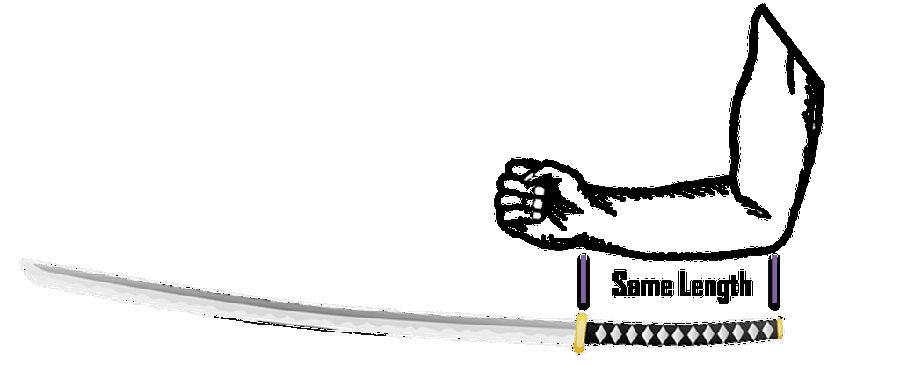
Can You Estimate Tsuka Length Using Your Forearm?
One informal starting point is to compare the length of your forearm, measured from the elbow to the wrist, with possible handle dimensions.
This can help you visualize the scale of the handle, but it is not a precise or universally accepted sizing formula.
When considering tsuka length, evaluate your:
- Hand size and comfortable grip spacing.
- Forearm length and body proportions.
- Preferred handling style.
- Training requirements, if applicable.
- Desired sword balance.
- Blade length and overall proportions.
Common Modern Tsuka Lengths
| Tsuka Length | General Consideration |
|---|---|
| 9–10 inches | A comparatively compact handle arrangement |
| 10–11 inches | Common modern katana handle proportions |
| 11–12 inches | Offers additional grip length for suitable configurations |
| 12 inches and above | Specialized or customized handle proportions |
These are examples, not universal recommendations. A proper handle must also have sound internal construction and securely fitted components.
3. Choose the Right Katana Blade Length (Nagasa)
The blade length of a Japanese sword is called the nagasa (長さ).
For traditional Japanese sword measurement, nagasa is generally measured from the kissaki to the mune-machi along a straight measurement line.
Because the blade is curved, nagasa is not simply the length obtained by following the curved cutting edge.
A longer blade can offer more reach but may require additional control and appropriate clearance.
A shorter blade may feel more manageable for some people, depending on the complete sword's weight and balance.
Typical Modern Katana Blade Lengths
| Blade Length | Approximate Metric Length | General Description |
|---|---|---|
| 24 inches | 61.0 cm | Compact katana-style blade |
| 26 inches | 66.0 cm | Shorter modern katana configuration |
| 28 inches | 71.1 cm | Common modern standard |
| 30 inches | 76.2 cm | Longer custom configuration |
| 31 inches | 78.7 cm | Specialized longer blade option |
These lengths describe common modern sword options rather than rigid historical categories.
For martial arts training, the appropriate length should be selected according to the requirements of your instructor or school.
4. Are Shorter or Longer Katana Blades Better?
There is no universal answer. Both shorter and longer blades have advantages and limitations.
Shorter Katana Blades
A shorter blade may offer a more compact handling experience and can be convenient for collectors who have limited display space.
However, shorter does not automatically mean lighter or easier to control because blade geometry, fittings, and weight distribution also matter.
Longer Katana Blades
A longer blade offers greater reach and creates a different handling experience.
However, greater length may also increase the space and control required for comfortable handling.
| Feature | Shorter Katana | Longer Katana |
|---|---|---|
| Reach | Less | More |
| Space Required | Generally less | Generally more |
| Handling | May feel more compact | May require more control |
| Weight | Depends on construction | Depends on construction |
| Best Choice | Depends on individual requirements | Depends on individual requirements |
5. Katana Size and Your Height
Many buyers search for a katana size chart based on their height.
Height can be a useful starting point, but it should not be treated as the only deciding factor.
Two people of the same height may have different arm lengths, hand sizes, physical strength, and sword-handling preferences.
Different martial arts schools may also recommend different sword dimensions.
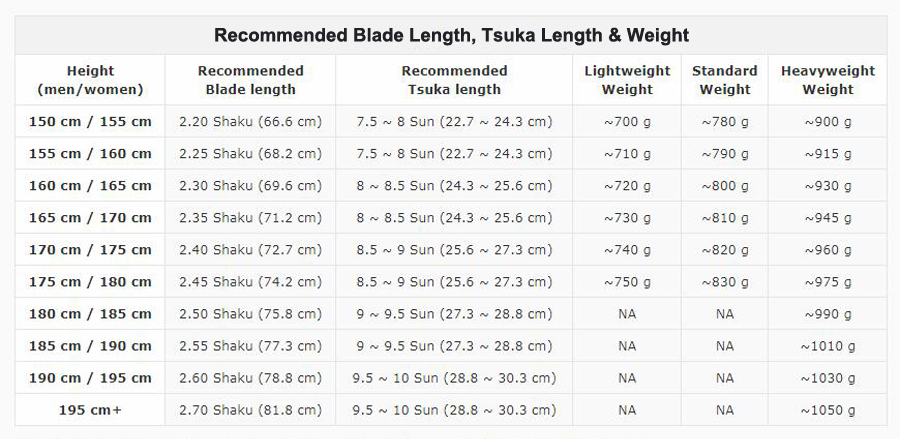
Traditional-Inspired Sword Size Reference Chart
The following chart is retained from the original HanBon Forge article as a historical-style sizing reference used in modern sword discussions.
What Should You Consider Besides Height?
- Arm length and comfortable reach.
- Hand size and grip spacing.
- Experience and control.
- Blade weight and balance.
- Intended use.
- Training requirements.
A sizing chart can help narrow the options, but the final decision should account for the actual sword and the individual user.
6. Consider Sword Weight and Balance
Weight is another important factor when choosing a Japanese sword.
A heavier sword may require more effort to handle, particularly during extended activities.
However, two swords with the same weight may feel very different because of their balance and blade geometry.
What Is the Point of Balance?
The point of balance is the location along the sword where its mass balances.
Its position contributes to how the sword feels during controlled movement.
But the point of balance does not describe every handling characteristic by itself. The distribution of mass throughout the blade also matters.
How Does Blade Geometry Affect Handling?
Blade width, thickness, distal taper, and the presence or absence of a bohi can influence sword weight and distribution.
Therefore, choosing a suitable sword requires more than comparing blade lengths and advertised total weights.
7. What Sword Size Is Best for Beginners?
For a beginner, an appropriately sized sword is generally preferable to the longest or heaviest option available.
A suitable first sword should provide comfortable proportions and manageable handling characteristics.
Important considerations include:
- A blade length suited to the intended purpose.
- A handle providing suitable grip space.
- Manageable weight.
- Appropriate balance.
- Secure sword construction.
- Requirements of the training discipline, if applicable.
For collecting or display, appearance and personal preference may play a larger role.
For martial arts training, the correct dimensions and blade type should be selected with an instructor.
A sharpened katana is not necessarily the best starting point for someone learning sword-handling fundamentals.
8. Choose Your Sword Size Based on Its Intended Use
Different purposes place different demands on sword dimensions.
| Purpose | Sizing Priority | Recommendation |
|---|---|---|
| Martial Arts Training | Instructor and school requirements | Choose an approved training sword |
| Collecting | Historical interest and design preferences | Select appropriate sword type and proportions |
| Display | Available space and desired presentation | Consider overall sword and saya dimensions |
| Supervised Cutting | Safe handling and appropriate blade construction | Use a suitable sword under qualified supervision |
| Custom Sword Project | Dimensions, balance, compatibility | Discuss unusual sizing requirements before production |
If your main purpose is display, remember to account for the sword's dimensions with the saya attached, not just the blade length.
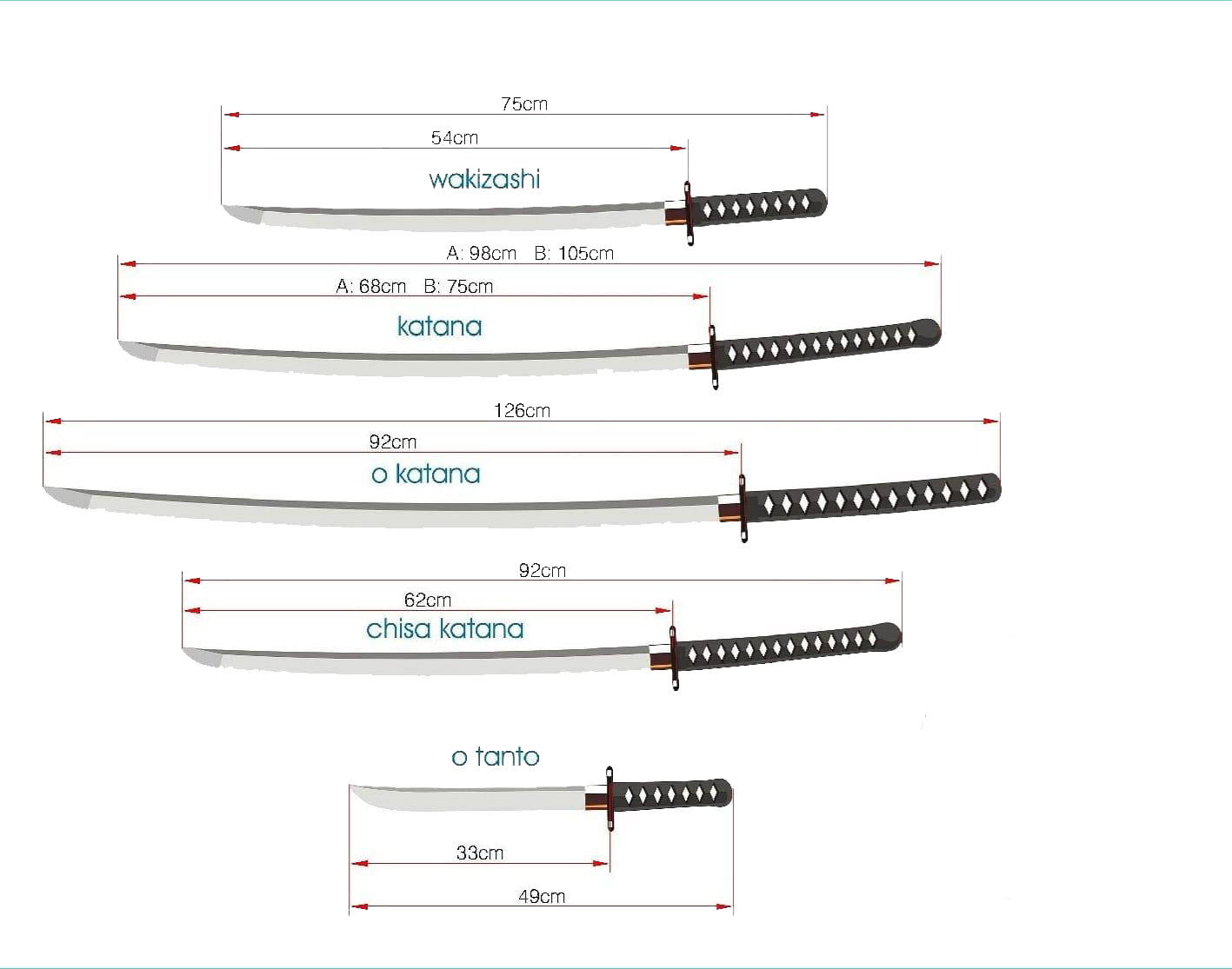
9. Katana, Wakizashi, Tanto, Ko-Katana and Odachi: Size Differences
Japanese-style swords are available in different lengths and configurations.
The following original illustration compares several sword categories, including wakizashi, katana, longer swords, and tanto.
Katana
A katana is a long Japanese sword typically associated with the edge-up mounting style and commonly configured for two-handed use.
Modern katana frequently have blades around 27–29 inches, but other lengths are common.
Wakizashi
A wakizashi is a shorter Japanese sword, traditionally associated with a blade length of approximately one to two shaku.
Many modern wakizashi have blades around 18–22 inches.
Tanto
A tanto is a shorter Japanese blade commonly classified as a dagger.
Traditional size classifications generally place tanto below one shaku, although actual historical and modern examples vary.
Ko-Katana
In modern retail descriptions, ko-katana is often used for a compact katana-style sword with a shorter blade than a standard modern katana.
The expression is not a universal historical sizing category and should be interpreted according to the seller's specifications.
Odachi and Nodachi
Odachi and nodachi refer to large Japanese sword traditions, with terminology and historical classification varying by context.
Modern examples often feature substantially longer blades and handles than conventional katana.
Because of their large dimensions, custom long swords may also involve special production, balance, storage, and shipping considerations.
For a deeper comparison, read our Katana vs Wakizashi vs Tanto Guide.
10. How to Measure a Katana Properly
A clear understanding of sword measurements helps buyers avoid misunderstandings when comparing products or requesting custom dimensions.
Nagasa
Traditionally measured from the kissaki to the mune-machi along the appropriate straight measuring line.
Tsuka Length
The length of the assembled handle. When ordering a custom sword, clarify whether the dimension includes or excludes specific end fittings.
Overall Sword Length
The complete length of the sword from the tip to the end of the handle, excluding the saya.
Length with Saya
The overall length when the sword is sheathed. This matters for storage, display, shipping, and travel planning.
Traditional Japanese Units
| Unit | Approximate Metric Equivalent |
|---|---|
| 1 Shaku | 30.3 cm |
| 1 Sun | 3.03 cm |
| 1 Bu | 3.03 mm |
Historical measurements can vary by period and context; the table uses the commonly referenced modern Japanese shaku for sword discussions.
11. Custom Katana Lengths at HanBon Forge
HanBon Forge produces standard and custom Japanese-style swords, with selected options for blade length, handle length, geometry, and fittings.
Standard Katana Dimensions
A commonly selected HanBon Forge katana configuration is a 28-inch blade with an 11-inch handle.
This is a practical starting point for many modern custom designs, but customers can request different dimensions where production permits.
Longer Custom Blades
Longer blade options, including approximately 30–31 inches, may be available for compatible sword designs.
Unusual lengths may require additional production work, and customers should confirm feasibility, costs, and lead time.
Custom Handle Lengths
Handle length may also be adjusted on compatible custom swords.
However, extremely long or unusual handles require consideration of tang geometry, the wooden core, fittings, wrapping, and balance.
Specialized Long Swords
For odachi and nodachi projects, extra-long blades can introduce additional production and international shipping constraints.
The final size must be reviewed together with the saya and the resulting shipping package dimensions.
Finished Sword Photo Approval
For custom orders, HanBon Forge provides finished-sword photographs for customer review before shipment.
When a specific dimension is important, we recommend clearly confirming the measurement method in advance rather than relying only on visual proportions in photographs.
Explore our Custom Katana Builder to select compatible blade and handle options.
12. Simple Checklist for Choosing the Right Sword Size
Before ordering a Japanese sword, review the following questions.
| Question | Why It Matters |
|---|---|
| What is the sword for? | Use determines the most important requirements |
| Is the blade length appropriate? | Affects reach, size, and handling |
| Is the handle comfortable? | Influences grip and control |
| Can I manage the sword's weight? | Affects fatigue and handling |
| How is the sword balanced? | Changes the handling experience |
| Does my school require a specific size? | Important for formal martial arts training |
| Will it fit my storage or display area? | Overall length with saya may matter |
| Are custom dimensions necessary? | May affect production, pricing, and lead time |
13. Common Misconceptions About Katana Size
Several common assumptions can lead buyers to choose the wrong sword dimensions.
Is a Longer Katana Always Better?
No. Longer blades offer more reach but may require additional control and space. The best length depends on the user's purpose and requirements.
Does Your Height Determine the Perfect Sword Length?
No. Height is only one factor. Arm length, grip preference, training style, strength, and sword balance can also affect the choice.
Is a Heavier Sword Automatically Stronger?
No. Sword strength and durability depend on steel, heat treatment, geometry, and construction. Total weight alone does not determine quality.
Should the Katana Tsuka Always Match Forearm Length?
No. Forearm length may provide a visual reference, but it is not a universal measurement rule. Handle length should suit the complete sword and its intended use.
Are All 28-Inch Katana Identical in Handling?
No. Blade thickness, geometry, distal taper, fittings, handle dimensions, and weight distribution can make two equally long swords feel very different.
Does a Shorter Katana Automatically Mean a Safer Sword?
No. A shorter sharpened sword still presents serious risks. Safe use depends on training, blade condition, suitable equipment, and controlled handling.
Frequently Asked Questions About Sword Size
Click a question below to expand the answer.
What Size Katana Should I Get?
The best size depends on your height, arm length, hand size, physical ability, experience, and intended use. A blade around 27–29 inches is common, but the ideal length varies.
What Is the Standard Length of a Katana?
Many modern katana have an overall length around 38–42 inches, with blades approximately 27–29 inches long. Historical and custom dimensions vary.
How Do I Choose the Right Katana Blade Length?
Consider body proportions, handling comfort, sword balance, and intended use. If you practice a Japanese sword art, follow your instructor's guidance.
Should a Beginner Choose a Shorter Katana?
A shorter or lighter sword may suit some beginners, but no single dimension is best for everyone. Select the appropriate type and size for your intended activity.
Does a Longer Sword Always Give You an Advantage?
No. Greater reach comes with different handling demands. Overall suitability depends on context and the complete sword.
How Long Should a Katana Handle Be?
The appropriate tsuka length depends on hand size, grip preference, blade dimensions, and intended use. A modern handle around 10–12 inches is common.
Is Sword Weight More Important Than Sword Length?
Both matter. Length affects dimensions and reach, while weight and mass distribution influence fatigue and handling.
Should I Ask My Instructor Before Buying a Sword?
Yes. If you practice Iaido, Kenjutsu, or another martial art, your instructor can recommend the appropriate sword type, length, balance, and training specifications.
What Is the Difference Between Nagasa and Overall Length?
Nagasa is the blade length as measured in the Japanese sword tradition. Overall length includes the assembled handle and blade, but not the saya.
Can HanBon Forge Make a Longer Custom Katana?
Yes. Selected custom blade and handle lengths may be available. Contact HanBon Forge to confirm dimensions, feasibility, pricing, and production time.
Does a 30-Inch Katana Need a Longer Handle?
Not automatically. Handle dimensions should be chosen according to the complete design, balance, tang geometry, and intended use rather than blade length alone.
Is an Odachi Suitable for Beginners?
An odachi is substantially larger than a conventional katana and can introduce additional handling and storage challenges. For martial arts practice, select the appropriate training equipment according to qualified instruction.
Final Thoughts: The Right Sword Size Is About Balance
Choosing the right sword size is not simply a matter of selecting the longest blade available.
The most suitable katana combines appropriate blade length, comfortable handle proportions, manageable weight, and a balance that matches the intended purpose.
A standard modern katana can provide a useful starting point for collectors, while martial arts practitioners may require dimensions specified by their instructor.
Before ordering a custom sword, clarify exactly how its blade, handle, and overall length will be measured.
At HanBon Forge, we encourage customers to consider the complete sword rather than focusing on a single dimension or sizing chart.
Find Your Ideal Katana Size at HanBon Forge
Explore standard handmade Japanese-style swords or create a custom katana with your preferred blade length, tsuka dimensions, steel, fittings, and saya.
Customize Your KatanaExplore Handmade KatanaReferences & Further Reading
For further information about Japanese sword dimensions, classification, craftsmanship, and selecting suitable sword designs, consult the following resources.
- Kokan Nagayama — The Connoisseur's Book of Japanese Swords. A reference on Japanese swords, blade forms, terminology, and historical classification.
- Leon Kapp, Hiroko Kapp, and Yoshindo Yoshihara — The Craft of the Japanese Sword. A reference describing traditional Japanese swordmaking and blade construction.
- The Metropolitan Museum of Art — Japanese Arms and Armor. Historical examples of Japanese swords and their mountings. Explore the Collection.
- HanBon Forge — Katana vs Wakizashi vs Tanto. Compare common Japanese sword categories. Read the Comparison Guide.
- HanBon Forge — The Ultimate Guide to Choosing Your First Katana. Learn about steel, heat treatment, handle construction, and customization. Read the Beginner Guide.
Editorial Note: The blade lengths, weight examples, and size charts in this article are educational references. They are not universal recommendations for every person or Japanese sword tradition.
About This Guide & Editorial Experience
Prepared by: HanBon Forge Team
Topic: Katana Size, Nagasa, Tsuka Length, Japanese Sword Measurements and Custom Sword Dimensions.
Content Focus: Practical sizing guidance for collectors, first-time buyers, and customers considering custom Japanese-style swords.
HanBon Forge produces handmade and custom Japanese-style swords, including katana, wakizashi, tanto, ko-katana, and longer sword designs.
Our production experience includes standard and custom blade dimensions, handle construction, blade geometry, fittings, and saya compatibility.
For custom orders, finished-sword photographs are provided for customer review before shipment.
Last Reviewed: October 2026
Related Products