
Japanese Swords Fittings
Japanese Sword Fittings & Katana Parts
Build a Japanese sword that reflects your preferred style with our wide selection of katana fittings and Japanese sword parts. HanBon Forge offers tsuba, fuchi-kashira, menuki, samegawa, tsuka-ito, sageo, saya, habaki, seppa and other components for custom katana, wakizashi, tanto and related Japanese-style swords.
Fittings influence far more than appearance. The materials, dimensions and combination of components also affect the feel, balance, fit and overall character of the finished sword. Use the option codes shown in the photographs below when configuring your custom sword.
Availability may change over time. If a selected fitting is temporarily unavailable, we will contact you before completing your sword.
Custom fitting upgrade prices: All additional prices listed below are in USD and apply when selecting the indicated option for a new custom sword. These are upgrade charges added to the sword price, not standalone replacement-part prices. Please quote the exact fitting code when ordering so our team can confirm your selection and check fit during assembly.

Understanding Japanese Sword Fittings
The complete exterior mounting of a Japanese sword is commonly known as koshirae. It includes the handle assembly, guard, scabbard and the various metal and decorative components surrounding the blade.
Individual decorative metal fittings are often referred to as tōsōgu. When designing a custom katana, the fittings do not necessarily need to be made from the same material. Iron, brass, alloy and contrasting finishes can be combined successfully when the complete design remains visually balanced.
| Part | Japanese Term | Main Function |
|---|---|---|
| Sword Guard | Tsuba | Separates the blade and handle and helps prevent the hand from sliding toward the blade. |
| Handle Collar | Fuchi | Reinforces and finishes the front of the tsuka. |
| Handle End Cap | Kashira | Finishes and reinforces the end of the tsuka. |
| Handle Ornaments | Menuki | Decorative fittings positioned beneath the handle wrapping. |
| Ray Skin | Samegawa | Creates a textured surface beneath the handle wrapping. |
| Handle Wrap | Tsuka-Ito | Provides grip and helps secure the handle assembly. |
| Scabbard | Saya | Protects the blade and forms a major part of the sword's appearance. |
| Scabbard Cord | Sageo | Attaches to the saya and can be used when wearing or securing the sword. |
| Blade Collar | Habaki | Fits into the mouth of the saya and helps keep the sword securely seated when sheathed. |
| Spacers | Seppa | Help create a tight, properly aligned fitting around the tsuba. |
Samegawa – Genuine Ray Skin
Samegawa is genuine ray skin traditionally applied to the wooden tsuka core. Its naturally textured surface provides a stable foundation beneath the tsuka-ito while giving the handle the distinctive appearance associated with Japanese sword mountings.
A variety of colors is available. Choose the corresponding R-code when ordering your custom sword.
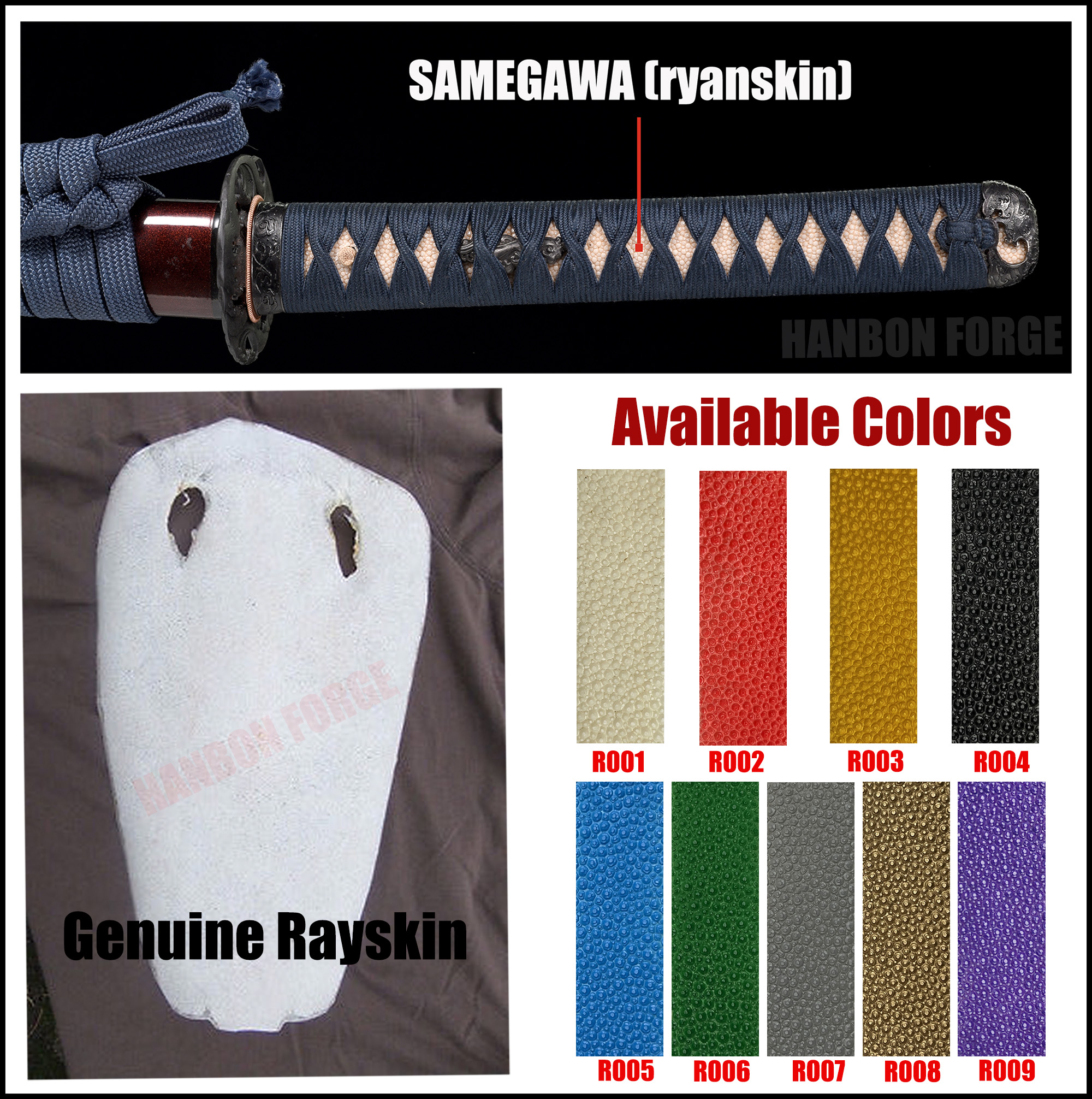
Available colors: R001 Natural, R002 Red, R003 Yellow, R004 Black, R005 Blue, R006 Green, R007 Gray, R008 Gold and R009 Purple.
Full Samegawa Wrap
For a more premium tsuka construction, a full samegawa wrap surrounds the wooden handle core instead of using separate ray-skin panels. It offers a more traditional construction and provides a continuous ray-skin layer beneath the wrapping.
Full Samegawa Wrap: +$55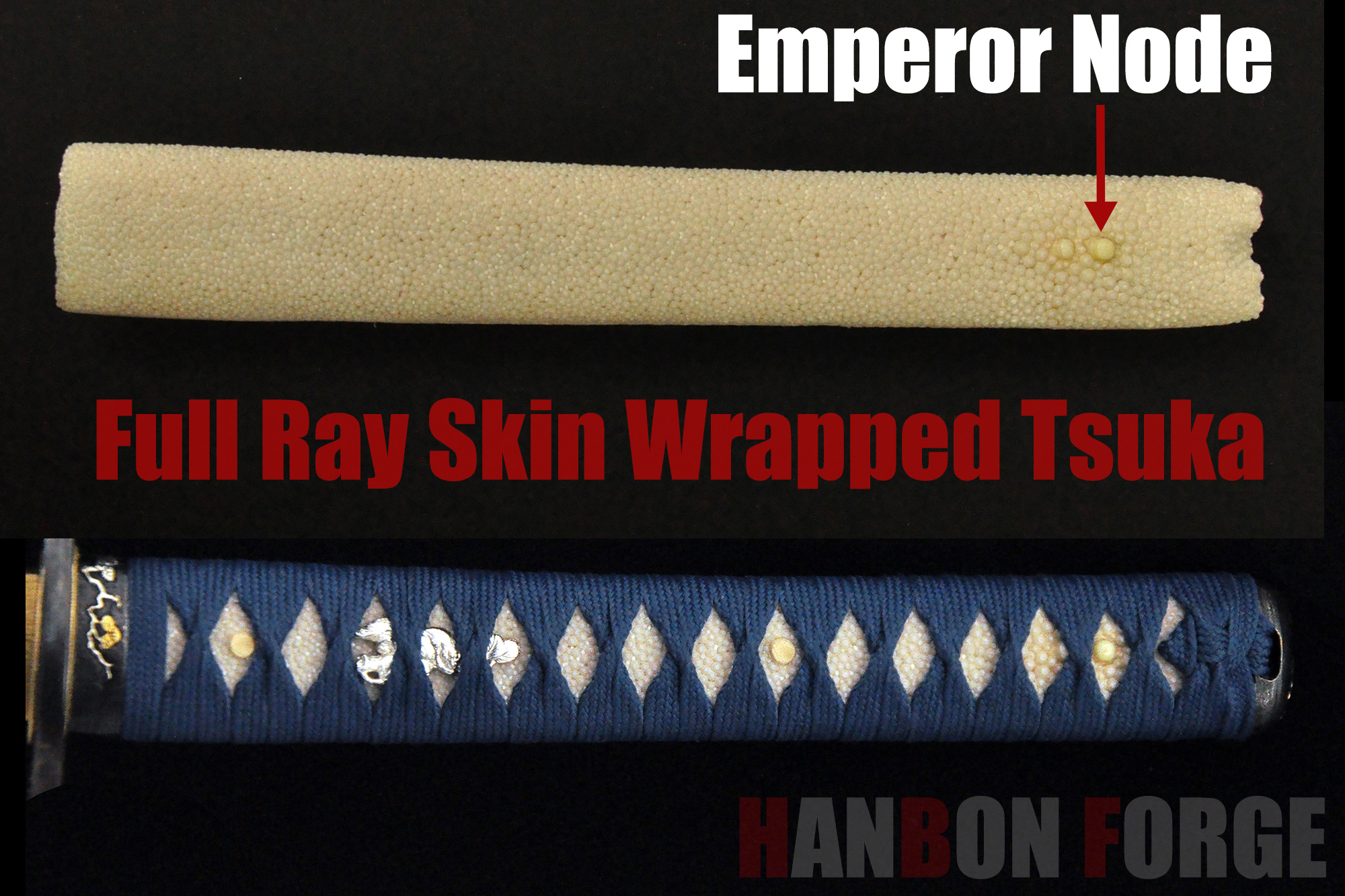
Tsuka-Ito – Japanese Sword Handle Wrap
Tsuka-ito is the cord wrapped around the sword handle. It provides grip, reinforces the handle assembly and is one of the most visually important choices when designing a custom katana.
Synthetic Silk & Cotton Tsuka-Ito
Our standard selection includes multiple traditional and contemporary colors. Use the C-code shown in the image when choosing your handle wrap.

Genuine Japanese Silk Ito
Genuine Japanese silk ito is available for customers seeking a more refined, traditional texture and appearance.
Genuine Japanese Silk Ito: +$40
Leather Tsuka-Ito
Leather tsuka-ito provides a distinctive texture and works particularly well on understated, dark or rugged sword designs.
Leather Tsuka-Ito: +$20
Sageo – Japanese Sword Saya Cord
The sageo is the cord attached to the kurikata on the saya. Traditionally it is associated with wearing and securing the sword, while on a modern custom build it also plays an important role in the overall color scheme.
Matching the sageo with the tsuka-ito creates a coordinated appearance, while choosing a contrasting color can create a more decorative style.
Standard Sageo

Japanese Sageo
Japanese Sageo Upgrade: +$20 USD
Tsukamaki – Katana Handle Wrapping Styles
Tsukamaki refers to the art and technique of wrapping the sword handle. Different wrapping styles change both the visual character and the feel of the tsuka.

Hishigami Wrapping
Hishigami are small folded wedges placed beneath the ito at the crossovers. They help maintain more consistent diamonds, improve the shape of the wrapping and reduce unwanted movement of the ito.
Hishigami Wrapping: +$20
Saya – Japanese Sword Scabbards
The saya is the wooden scabbard that protects the blade. Because it occupies such a large part of the sword's visual profile, the saya is one of the most effective ways to change the appearance of a custom katana.
HanBon Forge offers matte, gloss, patterned, textured and decorative finishes suitable for both restrained traditional builds and more elaborate custom designs.
Standard Saya Options
Options S101–S118 are standard choices. Saya options S119–S125 are available as paid upgrades for a custom sword.
Standard Saya Upgrade (S119–S125): +$25 USD
Premium Saya Options
Premium saya include more elaborate finishes and selected upgraded construction details. Most premium saya options have a $45 USD upgrade charge. The full rayskin-wrapped S233 and the S301–S304 series have separate prices as shown below. Refer to the exact code beside each saya when ordering.
Premium Saya Options (Except S233 and S301–S304): +$45 USD S233 Full Rayskin-Wrapped Saya: +$150 USD S301–S304 Premium Saya: +$55 USD
Saya Engraving & Hand-Carved Designs
Decorative saya carving is available with selected traditional motifs. Choose one of the reference designs below or contact us before ordering if you require a different custom pattern.
Saya Engraving: +$20 for the designs shown below
Fuchi & Kashira – Katana Handle Fittings
The fuchi is the collar positioned at the front of the tsuka, directly behind the tsuba assembly. The kashira is the fitting at the end of the handle.
Together, fuchi and kashira reinforce and finish the tsuka while also providing an important decorative theme for the sword.

Alloy Fuchi-Kashira
Standard alloy options provide a wide variety of motifs for custom sword builds.
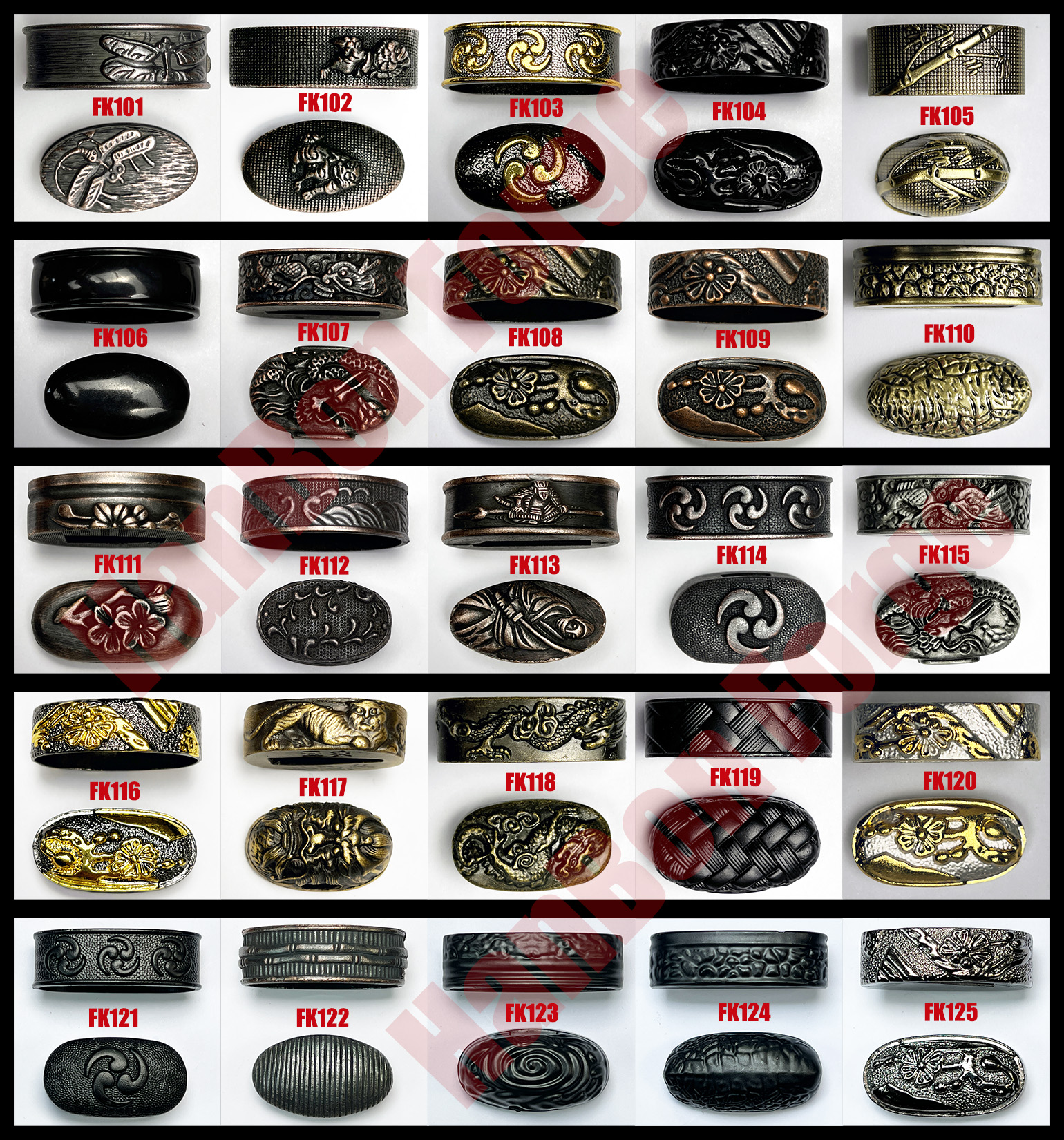
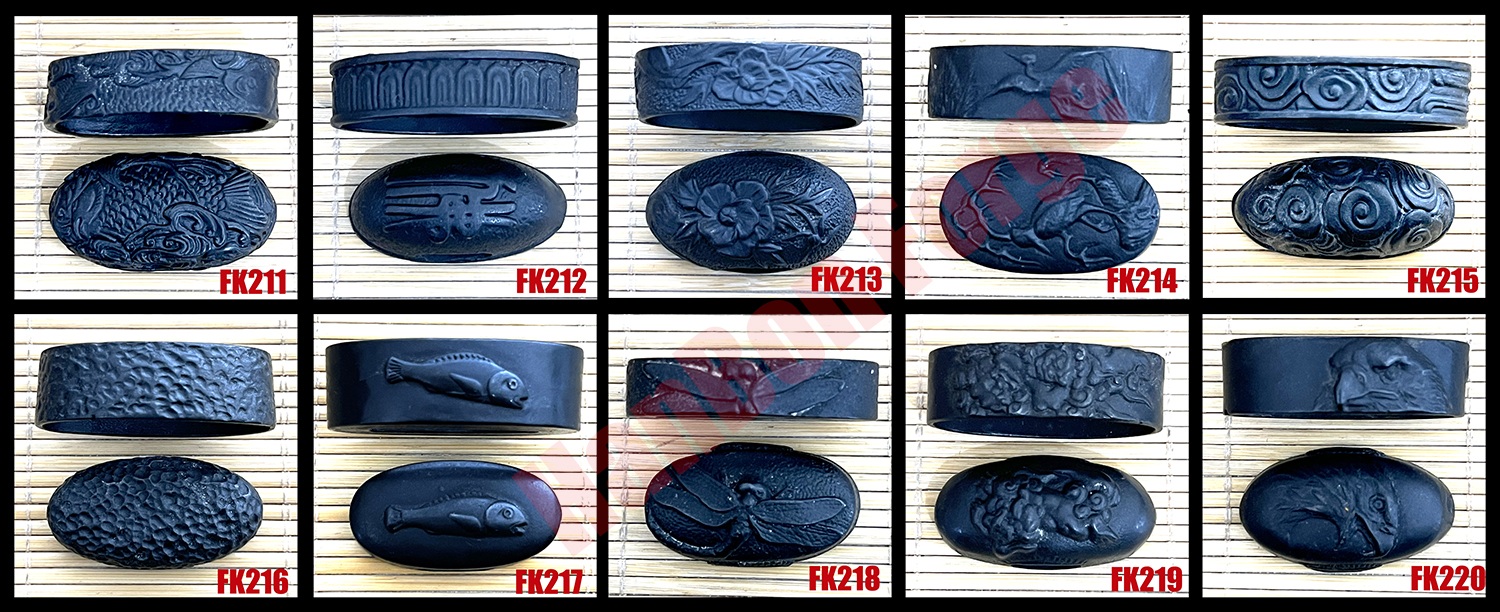
Iron Fuchi-Kashira
Iron Fuchi-Kashira Upgrade: +$20 USDIron fittings are well suited to darker, understated and traditional-style koshirae.

Brass Fuchi-Kashira – FK401 Series
Brass Fuchi-Kashira FK401 Series: +$20 USD
Brass Fuchi-Kashira – FK501 Series
Brass Fuchi-Kashira FK501 Series: +$25 USD

Premium Brass Fuchi-Kashira – FK601 Series
Premium Brass Fuchi-Kashira FK601 Series: +$30 USD
In many cases, yes. For example, you may prefer a tsuba from one design and fuchi-kashira or menuki from another. Include the exact fitting codes in your order notes and we will check compatibility during production.
Menuki – Decorative Handle Ornaments
Menuki are small decorative fittings positioned beneath the tsuka-ito. Traditional designs include animals, flowers, plants, dragons, mythological subjects and geometric motifs.
Although small compared with the tsuba, menuki add important visual detail to the finished handle.

Alloy Menuki

Brass Menuki
Brass Menuki Upgrade: +$10 USD
Tsuba – Katana Sword Guards
The tsuba is the sword guard positioned between the blade and the tsuka. It helps prevent the hand from sliding toward the blade and is also one of the most visually distinctive components of Japanese sword furniture.
HanBon Forge offers a large selection of alloy, iron, brass and premium decorative tsuba. Designs range from simple geometric patterns to dragons, flowers, animals, waves, samurai motifs and traditional Japanese imagery.
Alloy Tsuba – AT101 to AT196


Fine-Finished Brass-Color Tsuba Sets – BT Series

Iron Tsuba – IT201 to IT256
Iron Tsuba (IT201–IT256): +$20 USDIron tsuba are ideal for customers who prefer a darker and generally more restrained appearance.


Decorative Iron Tsuba – IT281 to IT296
Decorative Iron Tsuba (IT281–IT296): +$25 USD
Brass Tsuba Sets – CT401 to CT415
Brass Tsuba Sets (CT401–CT415): +$35 USDThese coordinated sets combine the tsuba with matching or complementary fuchi-kashira and menuki.

CT416 Wolf Theme Fitting Set

Premium Iron & Mixed-Metal Tsuba Sets – HT601 to HT618
Premium Iron & Mixed-Metal Tsuba Sets (HT601–HT618): +$55 USD

Decorative Tsuba Sets – HT001 to HT033
Decorative Tsuba Sets (HT001–HT033): +$45 USD


Habaki – Japanese Sword Blade Collar
The habaki is the metal collar fitted around the base of the blade immediately in front of the seppa and tsuba assembly.
When the sword is sheathed, the habaki seats into the koiguchi at the mouth of the saya. The quality of this fit is important because it helps keep the sword securely seated inside the scabbard.

Brass Habaki Options
Choose the habaki style by its H-code. The upgrade charge depends on the selected design; the prices below apply to the specified codes.
Brass Habaki H01–H03: +$5 USD Brass Habaki H05–H12: +$10 USD Brass Habaki H13–H15: +$15 USD
Seppa – Katana Tsuba Spacers
Seppa are thin metal spacers positioned on either side of the tsuba. They help create a tight assembly and maintain proper alignment between the habaki, tsuba and tsuka.

How to Choose Fittings for a Custom Katana
A good custom sword is usually designed as a complete composition rather than by choosing every component separately. Start with the overall style you want, then coordinate the tsuba, fuchi-kashira, menuki, samegawa, ito, sageo and saya around it.
| Design Style | Suggested Direction |
|---|---|
| Traditional & Understated | Black or dark saya, natural samegawa, black or brown ito and a relatively simple iron tsuba. |
| Dragon Theme | Dragon tsuba with complementary menuki and fuchi-kashira, combined with a restrained saya so the metalwork remains the focus. |
| Floral Theme | Cherry blossom, plum blossom or floral fittings paired with coordinated saya and ito colors. |
| Minimalist | Simple iron tsuba, dark fittings, matte saya and a limited color palette. |
| Decorative | Detailed brass or mixed-metal fittings, premium saya and coordinated decorative motifs. |
| Personal Custom Build | Select a central motif or color palette first, then choose each fitting to support the same overall theme. |
Sword Bags, Stands & Storage
In addition to sword fittings, several storage and display accessories are available.
Sword Bag
A sword bag is included with complete sword orders. Available styles may vary, and if no specific option is requested, the available design may be selected for you.

Sword Display Stands
Sword stands are available separately for displaying a katana, wakizashi, tanto or sword set.

Sword Box
Sword Box Upgrade: +$45 USD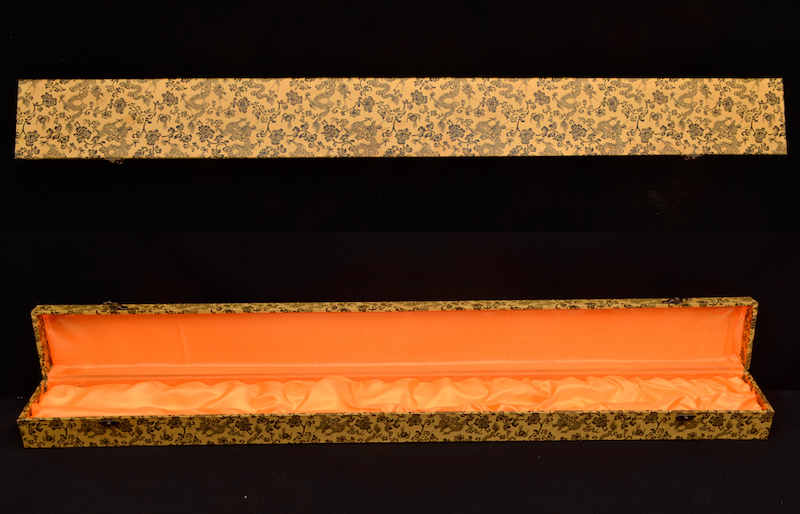
Using These Fittings on Your Custom Sword
When configuring your sword, select the appropriate fitting codes shown in the images on this page. If the ordering form does not provide a field for a particular option, enter the code and your request in the order notes.
If you want to combine fittings from different sets, request unusual colors or use a special arrangement, please provide clear instructions. A simple reference image or sketch can also be helpful for complex custom designs.
Because individual fittings vary slightly in dimensions and construction, some combinations may require adjustment during assembly. If an unusual selection cannot be fitted correctly, we will contact you before completing the sword.
You can also learn more about Japanese sword mounting terminology in our Japanese Koshirae Guide .
Japanese Sword Fittings FAQ
Are the katana fitting prices additional charges or total prices?
All amounts marked with a plus sign (+) are upgrade prices in USD added to the price of a new custom sword when that option is selected. They are not full sword prices or prices for standalone replacement fittings. Please include the fitting code in your order notes so we can confirm availability and compatibility before finishing your sword.
What are Japanese sword fittings called?
Decorative metal fittings are commonly referred to as tōsōgu, while the complete exterior mounting of a Japanese sword is generally called koshirae.
What parts can I choose when customizing a katana?
Depending on the sword model, you can select components such as the tsuba, fuchi-kashira, menuki, samegawa, tsuka-ito, sageo, saya, habaki and seppa, in addition to blade-related options.
Can I mix katana fittings from different sets?
Yes, in many cases. You may choose a tsuba from one set and combine it with different fuchi-kashira or menuki. Include the exact fitting codes in your order notes so compatibility can be checked.
Do the tsuba, fuchi-kashira and menuki need to use the same material?
No. Different metals and finishes can be combined successfully. Visual harmony, correct dimensions and proper assembly are more important than using exactly the same material throughout the sword.
Can I request a custom tsuba or special fitting design?
Special requests may be possible depending on the design. Please send a clear drawing or reference image before ordering so feasibility and any additional cost can be confirmed.
Will HanBon Forge fittings fit a sword made by another manufacturer?
Compatibility cannot be guaranteed. Nakago openings, fuchi dimensions, habaki size, tsuka dimensions and other measurements can differ between swords. The fittings on this page are primarily intended for swords assembled by HanBon Forge.
Can I purchase a replacement saya for an existing sword?
A saya needs to be fitted closely to the actual blade and habaki. For this reason, producing a properly fitted replacement saya for a sword when the blade is not available for fitting may not be possible.
What is the difference between samegawa panels and a full samegawa wrap?
Standard construction commonly uses ray-skin panels on the wooden tsuka core. A full samegawa wrap surrounds the complete core with ray skin before the ito is applied and is considered a more premium handle construction.
What is hishigami wrapping?
Hishigami are folded wedges placed beneath the ito crossovers during tsukamaki. They help form more consistent diamonds and assist in keeping the handle wrap stable and evenly shaped.
What fittings make the biggest visual difference?
The tsuba and saya usually have the greatest visual impact because of their size and visibility. Tsuka-ito color, samegawa and the fuchi-kashira also strongly influence the overall appearance of the finished sword.
Are all fittings shown on this page always available?
Availability can change as individual designs are sold out, updated or replaced. If a selected fitting is unavailable when your sword enters production, we will contact you to discuss an alternative.
Create Your Own Custom Japanese Sword
Choose your blade, hamon, tsuba, tsuka, samegawa, ito, menuki, saya and other fittings to create a sword built around your preferred style.
Start Customizing Your Sword →