
How to distinguish fake and real Hamon?
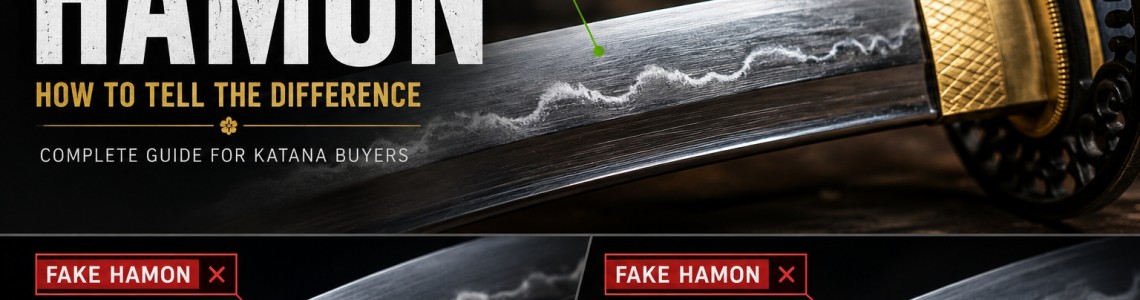
A genuine katana hamon is created by differential hardening during heat treatment, while a fake hamon is a decorative pattern made through etching, abrasion, or polishing. Although both may look similar in photographs, they differ in origin and metallurgical significance. Learn how to distinguish real and artificial hamon, what to look for when buying a katana, and why the complete blade matters more than appearance alone.
Real vs Fake Hamon: How to Identify an Authentic Katana Hamon
When buying a Japanese katana, one of the most attractive features is often the hamon (刃文), the distinctive pattern visible along the cutting-edge region of the blade.
Hamon patterns are closely associated with traditional Japanese sword craftsmanship and can vary from elegant straight lines to complex waves and clove-shaped formations.
However, not every visible hamon pattern is genuine. Some modern sword manufacturers use chemical etching, abrasive finishing, or other surface treatments to imitate the appearance of a differentially hardened blade.
For first-time buyers, collectors, and martial arts enthusiasts, understanding this distinction helps prevent confusion about the blade's construction and value.
At HanBon Forge, we produce modern handmade Japanese-style swords using different steels and heat-treatment methods, including clay-assisted differential hardening.
This guide explains how genuine hamon forms, how artificial patterns are produced, what visual clues are useful, and how to evaluate a katana before purchasing.
Real Hamon: Associated with the hardened steel microstructure produced by differential heat treatment. Appropriate polishing may reveal complex internal features such as nioi, nie, and ashi.
Fake Hamon: A decorative surface pattern produced by techniques such as etching, wire brushing, sandblasting, or contrasting polishing.
Important: Appearance alone is not conclusive. The most reliable approach combines close examination with confirmed steel and heat-treatment information from the manufacturer.
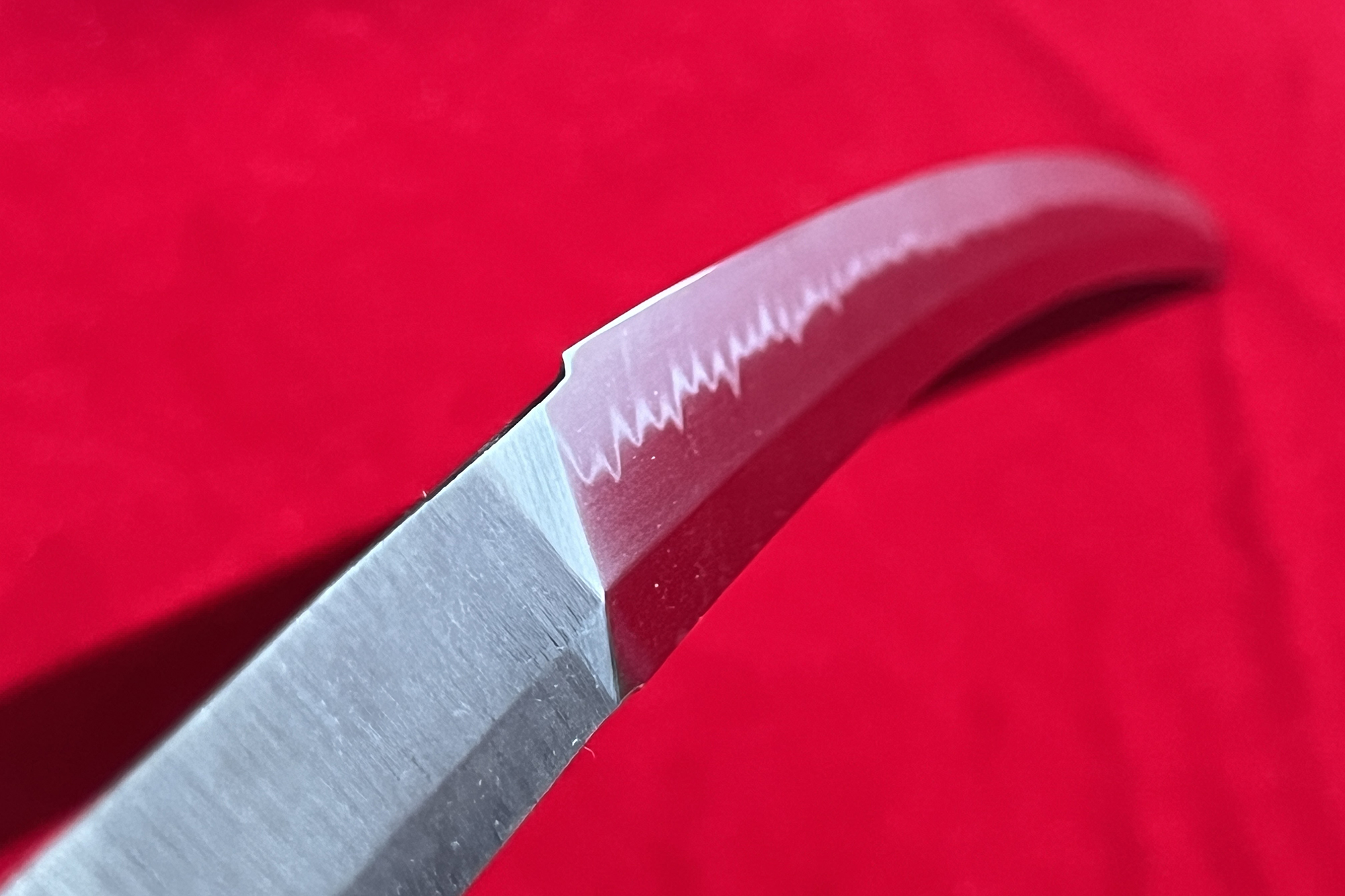
1. What Is a Genuine Katana Hamon?
A genuine hamon is the visible pattern associated with differential hardening on a Japanese sword blade.
In traditional Japanese swordmaking, the swordsmith uses controlled heating and quenching to produce different microstructures within the blade.
The cutting-edge region generally develops harder martensitic steel, while other regions may develop relatively softer microstructures.
The visual boundary and activity associated with these hardened areas form the hamon when revealed by suitable polishing.
A genuine hamon is therefore not simply a line painted or ground onto the steel. It is related to changes in the blade's physical structure during heat treatment.
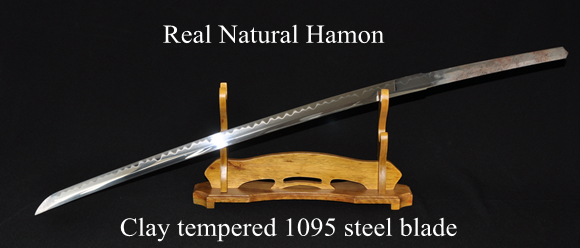
Why Is a Genuine Hamon Important?
Collectors value genuine hamon because it reflects an important aspect of Japanese swordmaking: controlled heat treatment.
A properly executed differential-hardening process can produce a hard cutting-edge region while retaining different mechanical characteristics elsewhere in the blade.
However, a genuine hamon is only one indicator of the manufacturing process.
It does not independently establish that the sword has excellent edge geometry, proper tempering, high toughness, secure fittings, or superior cutting performance.
2. How Does Clay Tempering Create a Real Hamon?
The formation of a traditional-style hamon involves several stages of blade production.
Step 1: Forging and Blade Preparation
The swordsmith first forges or shapes the blade to its intended dimensions and geometry.
Blade thickness, width, curvature, and steel composition influence how the sword responds to heat treatment.
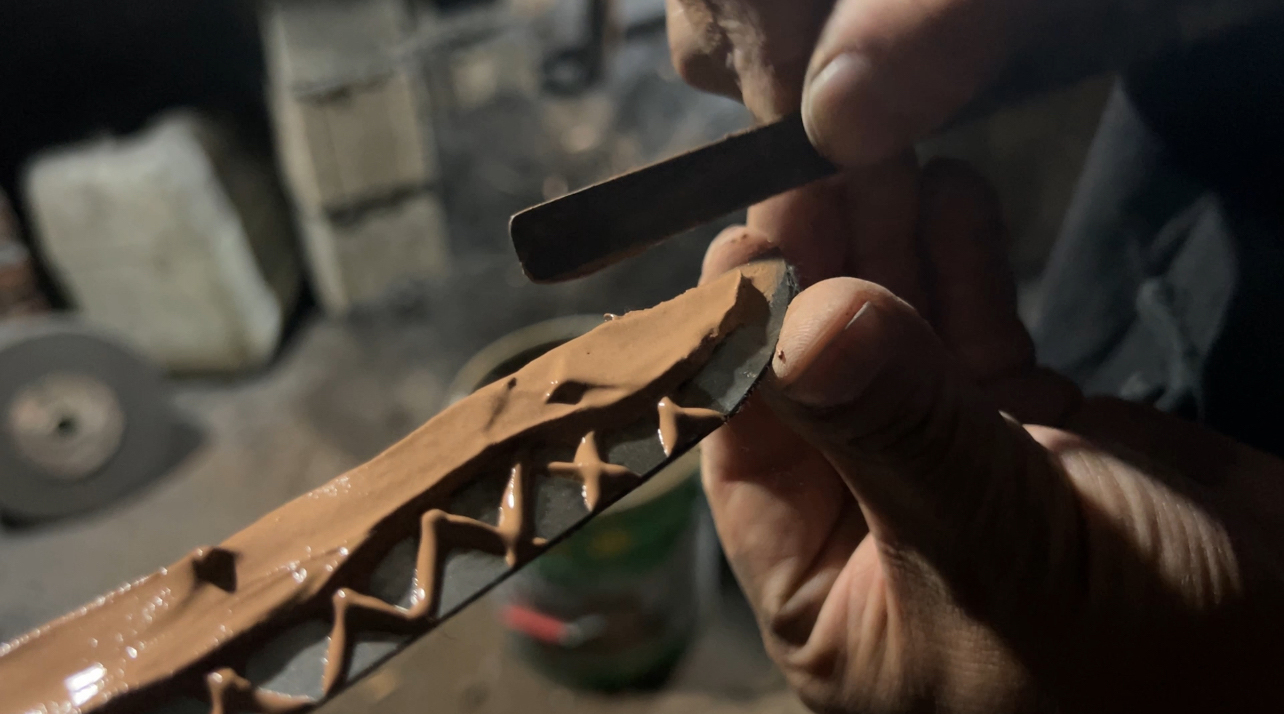
Step 2: Applying the Clay Mixture
A clay-based refractory mixture is applied to selected parts of the blade.
Typically, the spine receives a thicker insulating layer, while the cutting-edge region receives little or less clay.
The clay arrangement helps influence cooling behavior during quenching.
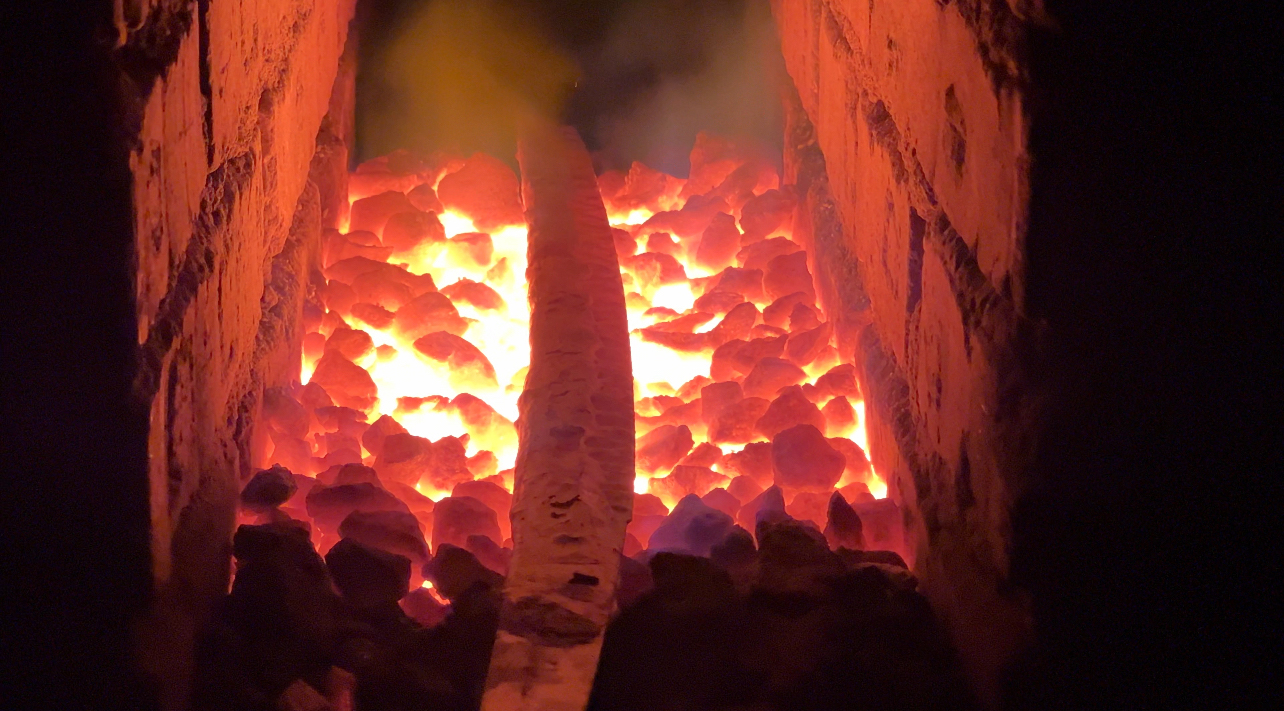
Step 3: Heating the Blade
The prepared blade is heated to a temperature appropriate for the selected steel and heat-treatment process.
Accurate temperature control is essential because the steel must reach the required condition before quenching.
Different steel grades may require different treatment parameters.
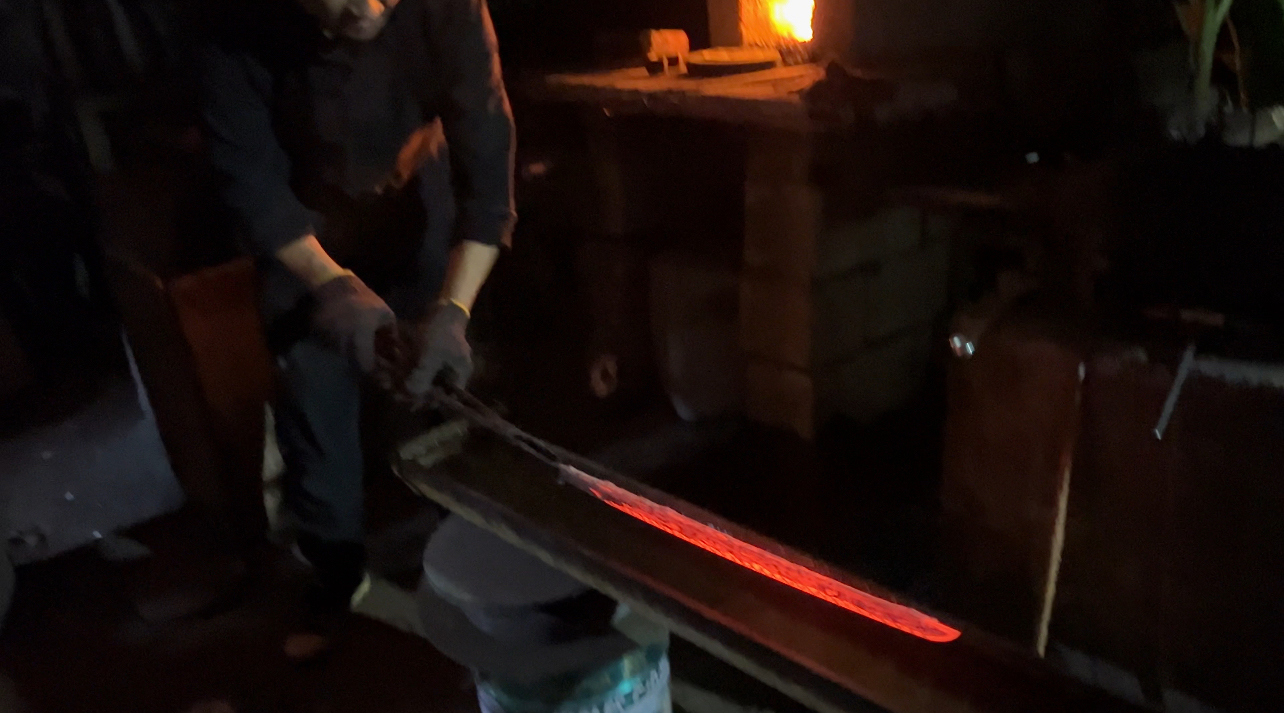
Step 4: Quenching
The heated blade is cooled using an appropriate quenching medium, such as water or oil, depending on the manufacturing process.
Cooling-rate differences can produce a harder martensitic cutting-edge region and relatively softer structures elsewhere.
This process also involves significant risks. Improper quenching may cause distortion, cracking, or other defects.
Step 5: Polishing and Revealing the Hamon
Once the blade has completed the appropriate heat-treatment and finishing stages, polishing helps reveal the characteristics of the hardened steel.
A genuine hamon may appear subtle under one lighting condition and more pronounced under another.
Its appearance depends on the actual hardening structure, blade surface finish, and lighting.
HanBon Forge Clay-Tempering Process Video
The following workshop video demonstrates the clay-tempering process used in the production of modern handmade Japanese-style swords.
HanBon Forge workshop video showing the clay-tempering process.
3. Common Types of Fake Hamon
An artificial hamon is created primarily to imitate the appearance of a genuine differential-hardening pattern.
Several surface-finishing methods can produce visible lines, waves, or contrasting regions on a blade.
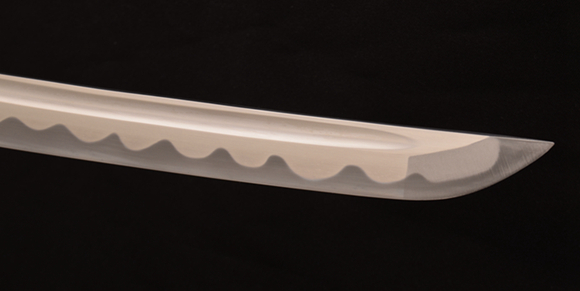
1. Acid-Etched Hamon
Chemical etching can alter the appearance of selected areas of a steel surface.
When used decoratively, it may create a contrasting wave-like pattern that resembles a traditional hamon.
Some artificial etching patterns display strong contrast or unusually uniform boundaries.
However, the brightness or regularity of a line is not sufficient to prove it is fake.
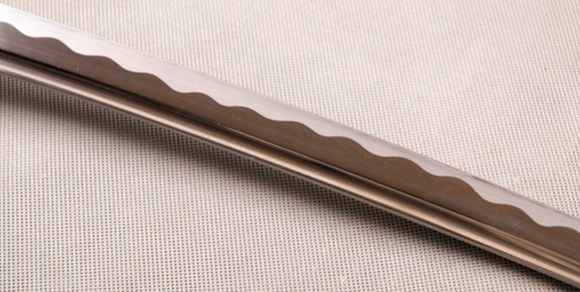
2. Wire-Brushed or Abrasive Hamon
Some manufacturers use abrasive wheels, wire brushes, or other mechanical finishing techniques to change the way light reflects from selected blade surfaces.
The result may resemble a traditional hardened-edge pattern.
Possible visual clues include visible directional scratch marks, repetitive finishing textures, or sharp changes in surface reflectivity.
These clues should be assessed carefully because ordinary polishing marks can also be present on genuinely hardened blades.
3. Contrasting Cosmetic Polishing
Different polishing directions and abrasive grades can create visible contrast between adjacent areas of a blade.
These methods may produce an attractive wave pattern without a corresponding difference in the underlying steel microstructure.
Decorative finishing does not automatically make the sword unsuitable for display, but it should not be represented as evidence of traditional differential hardening.
4. Sandblasted or Patterned Surface Finishes
Controlled surface texturing can also be used to imitate hamon.
By modifying surface roughness, manufacturers can produce areas that reflect light differently and create a hamon-like appearance.
Some modern decorative finishes can be visually convincing, making manufacturing records particularly important when determining authenticity.
4. Real vs Fake Hamon: Side-by-Side Comparison
The following chart summarizes how genuine and decorative patterns differ in origin and what buyers should verify.
| Feature | Genuine Hamon | Artificial Hamon |
|---|---|---|
| Primary Origin | Differential hardening | Decorative surface treatment |
| Steel Microstructure | Associated with different hardened regions | Pattern alone does not establish differential hardening |
| Appearance | May show fine internal activity | May imitate the same appearance |
| Common Methods | Controlled heating and quenching | Etching, abrasion, polishing, or texturing |
| Lighting Response | Depends on polish and illumination | Also depends on polish and illumination |
| Polishing Effect | Can reveal actual hardening characteristics | Can create or enhance visual contrast |
| Hardness Information | Associated with heat-treated steel structures | Not independently indicated by the pattern |
| Verification | Manufacturing information and expert examination | Manufacturing information and expert examination |
| Performance Guarantee | No automatic guarantee | No automatic guarantee |
The most important difference is metallurgical, not merely visual. A genuine hamon reflects differential hardening; a purely decorative hamon imitates the appearance without establishing that heat-treatment structure.
5. How to Identify a Real Hamon: Five Practical Checks
No single quick visual test can reliably authenticate every hamon.
However, the following checks help buyers evaluate a blade more carefully before purchasing.
1. Examine the Blade Under Different Lighting
Soft, indirect lighting can make subtle blade details easier to observe.
Gently changing the viewing angle may reveal internal features of the hamon or differences in surface finish.
However, a fake hamon may also change in appearance under different lighting. Lighting response alone is not definitive evidence.
2. Look for Fine Hardening Activity
Collectors often examine fine features associated with genuine Japanese sword hamon.
These may include:
- Nioi: Fine, mist-like visual activity associated with very small hardening particles.
- Nie: More individually visible crystalline-looking hardening particles.
- Ashi: Leg-like features extending within the hardened region.
- Internal Activity: Complex transitions and variations that can be revealed through suitable polishing.
These details can be useful when assessed by an experienced specialist, but their visibility depends heavily on the blade and finish.
3. Check for Artificial Surface Patterns
Look for obvious polishing-direction changes, repetitive scratch patterns, or decorative contrast that appears unrelated to the blade's actual hardening structure.
Such features may raise questions, but they are not conclusive on their own.
A genuine hamon can be relatively straight or regular, particularly in traditional Suguha styles. Therefore, an orderly pattern is not automatically artificial.
4. Verify the Blade Steel and Heat Treatment
Check whether the seller clearly identifies the steel and its heat-treatment method.
A product advertised as through hardened will generally not have the traditional differential-hardening hamon associated with a clay-tempered blade.
Likewise, decorative stainless-steel replica swords often use cosmetic surface patterns, although material descriptions should still be evaluated individually.
The steel grade itself does not establish whether a genuine hamon is present.
5. Ask the Manufacturer Directly
A transparent manufacturer should be able to explain the difference between a genuine hamon and a decorative finish.
Useful questions include:
- What steel was used for the blade?
- Was the blade differentially hardened?
- Was a clay-based coating used during heat treatment?
- Was the hamon produced by hardening or added as decoration?
- Can you provide close-up photographs of the blade?
- What type of polishing or finishing was used?
If the answers are vague or inconsistent with the product description, consider requesting more information before purchasing.
6. Common Hamon Styles on Genuine Japanese Swords
Traditional Japanese swordsmiths developed a variety of hamon styles, each with recognizable visual characteristics.
| Hamon Style | Visual Character |
|---|---|
| Suguha | Relatively straight hardened-edge pattern |
| Notare | Broad, gently flowing wave |
| Gunome | Repeated rounded or semicircular elements |
| Choji | Clove-shaped or clustered formations |
| Midare | Irregular or varied pattern |
These patterns describe aspects of visual appearance, not a universal ranking of blade quality.
A well-executed straight Suguha hamon may be just as historically significant and technically demanding as a complex Choji pattern.
For more detailed information, read our Katana Hamon vs Hada Guide.
7. Which Steel Types Can Produce a Genuine Hamon?
A genuine hamon depends on differential hardening, not simply on the name of the steel.
Several steels used in modern Japanese-style swords can develop genuine hardened-edge patterns when appropriately treated.
T10 Tool Steel
T10 is a high-carbon tool steel commonly used in modern clay-tempered katana.
When correctly differentially hardened, it can produce a genuine hamon with a variety of visual characteristics.
1095 High-Carbon Steel
1095 is another high-carbon steel frequently used for differentially hardened Japanese-style swords.
It can develop a genuine hamon under suitable heating, quenching, and polishing conditions.
Folded Steel
Folded steel may display visible forging grain, often called hada.
However, folding is separate from differential hardening. A folded-steel sword does not automatically have a genuine hamon.
A suitable folded-steel blade can be differentially hardened, allowing both forging grain and a genuine hamon to appear on the same blade.
Through-Hardened Steel
Through-hardened blades generally do not feature the traditional differential-hardening boundary associated with a genuine hamon.
However, a through-hardened katana can still be a well-made functional sword when properly designed, heat-treated, and assembled.
| Blade Type | Genuine Hamon Possible? | Important Note |
|---|---|---|
| T10 Differentially Hardened | Yes | Depends on proper heat treatment |
| 1095 Differentially Hardened | Yes | Depends on proper heat treatment |
| Folded and Differentially Hardened | Yes | Forging grain and hamon are separate features |
| Through-Hardened Monosteel | Not normally a traditional hamon | May use decorative finishing |
| Decorative Stainless Steel Replica | Generally not | Often manufactured for display |
To understand the mechanical differences, visit our Clay Tempered vs Through Hardened Katana Guide.
8. Is a Fake Hamon Always Bad?
No. A decorative hamon is not inherently unacceptable when it is accurately described and appropriate for the product.
For a display sword, decorative appearance may be the buyer's primary concern.
However, a decorative pattern should not be presented as evidence of differential hardening if the manufacturing process did not create it.
When a Decorative Hamon May Be Acceptable
- Decorative Japanese-style swords.
- Costume or theatrical replicas intended for display.
- Entry-level products sold with accurate material descriptions.
- Buyers who prioritize appearance over traditional heat-treatment characteristics.
When a Genuine Hamon May Be Preferred
- Collectors interested in differential hardening.
- Buyers seeking traditional-inspired swordmaking methods.
- Enthusiasts studying hamon and blade microstructures.
- Custom sword customers who specifically request an authentic hardened-edge pattern.
Neither a genuine nor a decorative hamon alone establishes whether a sword is suitable for cutting practice.
Intended use must be evaluated from the complete specifications and construction.
9. Does a Real Hamon Make a Katana Stronger or Better?
A genuine hamon indicates that the blade has undergone differential hardening, but it does not automatically make the sword stronger, tougher, or more effective than every through-hardened blade.
Actual sword performance depends on multiple factors:
- Steel composition and quality.
- Heat-treatment consistency.
- Hardness distribution.
- Blade geometry and thickness.
- Edge sharpness and niku.
- Correct tempering.
- Handle and tang construction.
- Secure fittings.
- Appropriate use and maintenance.
A genuine hamon is an important characteristic for collectors who value traditional-style heat treatment, but it should be evaluated as one part of the finished sword.
Likewise, an unusually elaborate hamon does not guarantee superior edge retention or resistance to damage.
10. Why Collectors Value Genuine Hamon
For Japanese sword collectors, genuine hamon is important because it provides visible evidence associated with the sword's heat-treatment history.
The appearance of the hardened-edge region can reveal characteristics of the steel, quenching process, and polishing.
Traditional sword appreciation also examines finer details such as nie, nioi, ashi, and other forms of internal activity.
These characteristics can contribute to the visual identity of a blade.
However, collector value depends on more than the presence of a genuine hamon.
Historical provenance, craftsmanship, blade condition, polishing quality, documentation, and overall authenticity may be equally or more important.
A genuine hamon should not be interpreted as a guarantee of future resale value.
11. HanBon Forge: Real Hamon and Modern Custom Swordmaking
HanBon Forge produces modern handmade Japanese-style swords using different steels, blade geometries, and heat-treatment methods.
Our custom sword options include clay-tempered T10 and 1095 blades for customers seeking a genuine hamon, as well as through-hardened steel configurations for different requirements.
Genuine Hamon Options
Depending on the selected blade and manufacturing requirements, customers may request traditional-inspired hamon styles such as:
- Suguha.
- Notare.
- Gunome.
- Choji.
The exact visual outcome depends on the heat-treatment process and finishing. A handmade genuine hamon may not reproduce every detail of a reference photograph identically.
Polishing and Hamon Visibility
Polishing influences how clearly the hardened-edge pattern appears.
For compatible clay-tempered blades, HanBon Forge also offers additional polishing options, including Hazuya polishing.
A suitable polish can enhance the appearance of the existing hardened structure, but it does not create a genuine hamon on a blade that was never differentially hardened.
Finished Sword Inspection
When evaluating a completed sword, the visible hamon is only one part of the quality-control process.
Other considerations include blade finish, kissaki geometry, edge condition, fitting security, handle construction, and saya fit.
For custom orders, HanBon Forge provides finished-sword photographs for customer approval before shipment.
These photographs help customers review the appearance and requested details of their sword, although photographs alone cannot independently verify every metallurgical characteristic.
We encourage buyers to confirm whether a blade has been genuinely differentially hardened or merely given a decorative hamon-like finish.
Explore our Custom Katana Builder or browse the Handmade Katana Collection.
12. Common Misconceptions About Real and Fake Hamon
Several commonly repeated assumptions about hamon can be misleading. Click the questions below to explore the facts.
Is a Very Bright White Hamon Always Fake?
No. Surface brightness depends on polishing, lighting, and photography. Some genuine hamon patterns appear highly contrasting, while some artificial finishes appear subtle. Brightness alone cannot establish authenticity.
Is a Perfectly Straight Hamon Artificial?
No. Suguha is a recognized traditional straight hamon style. A regular or straight pattern is not automatically fake.
Does a Genuine Hamon Always Change Appearance with Lighting?
Lighting can reveal different details of a genuine hamon, but artificial patterns also change in appearance with viewing angle and surface reflections. This is a useful observation, not a conclusive test.
Does Acid Etching Always Mean the Hamon Is Fake?
No. Chemical etching can be used to enhance the visibility of genuinely hardened structures. A fake hamon is one where the apparent hardening pattern is merely decorative and does not reflect the claimed differential-hardening process.
Is Every Clay-Tempered Katana High Quality?
No. Quality depends on steel selection, heat treatment, blade geometry, polishing, handle construction, fitting security, and overall workmanship. Differential hardening alone is not a guarantee.
Is a Through-Hardened Katana Inferior?
No. A well-made through-hardened katana can be a reliable functional sword. Differential hardening and through hardening represent different manufacturing approaches with different characteristics.
Frequently Asked Questions About Genuine Katana Hamon
Find answers to common questions about real hamon, fake hamon, clay tempering, blade steel, and authentic Japanese sword craftsmanship.
How can you tell if a katana hamon is real?
Examine the blade under suitable lighting, look for fine hardening activity, and check the manufacturer's steel and heat-treatment specifications. Appearance alone is not always conclusive, so confirmed production information is important.
Can fake hamon fade over time?
Some decorative patterns may become less visible through polishing, abrasion, or refinishing. However, the durability of a surface pattern depends on the method used to create it.
Does a real hamon make a sword stronger?
Not automatically. A genuine hamon indicates differential hardening, but overall blade performance depends on steel, hardness distribution, geometry, construction, and heat-treatment quality.
Do all expensive katanas have a genuine hamon?
No. Price alone does not establish whether a sword was differentially hardened. Some expensive swords are through hardened or have different construction priorities.
Can folded steel have a genuine hamon?
Yes. Folded steel may develop a genuine hamon when it is appropriately differentially hardened. Folding and differential hardening are separate processes.
Can T10 steel produce a real hamon?
Yes. T10 steel can develop a genuine hamon through suitable differential hardening and polishing.
Can 1095 steel produce a real hamon?
Yes. Properly differentially hardened 1095 high-carbon steel can produce a genuine hamon. The final appearance depends on the complete manufacturing process.
Can a through-hardened katana have a fake hamon?
Yes. A through-hardened blade may be given a decorative surface pattern that imitates a traditional hamon. Such a pattern should not be represented as evidence of differential hardening.
Is a fake hamon acceptable on a display sword?
Yes, if the sword is accurately represented as decorative and the buyer understands the construction. Problems arise when a purely decorative pattern is misleadingly described as a genuine differential-hardening hamon.
Does a genuine hamon guarantee better cutting performance?
No. Cutting performance depends on the complete sword, including blade geometry, steel, heat treatment, edge sharpness, toughness, and suitable use.
Can you identify a genuine hamon from photographs alone?
Photographs may reveal useful visual features, but they are not always sufficient for definitive authentication. Manufacturer information and qualified examination can provide stronger evidence.
Does HanBon Forge offer katana with genuine hamon?
Yes. HanBon Forge offers clay-tempered T10 and 1095 blade options with genuine hamon for compatible custom Japanese-style swords.
Final Thoughts: Look Beyond the Hamon Pattern
A beautiful hamon can be one of the most attractive features of a Japanese sword, but its appearance alone does not establish authenticity or quality.
A genuine hamon is associated with the blade's differential-hardening structure, while a purely decorative hamon imitates that appearance using surface treatment.
Visual clues such as nioi, nie, internal activity, polish, and lighting response can be useful, but they should be interpreted carefully.
Before purchasing a katana, confirm the blade steel, heat-treatment method, polishing, construction, and intended use.
The most reliable sword evaluation considers the complete blade and mounting rather than focusing on one attractive feature.
At HanBon Forge, we encourage customers to understand the materials and craftsmanship behind their swords so they can choose the most suitable configuration.
Explore Genuine Hamon Katana at HanBon Forge
Discover handmade Japanese-style swords featuring clay-tempered T10 and 1095 steel blades, genuine hamon patterns, and customizable traditional-inspired fittings.
Choose a blade, select your preferred hamon style, and customize the handle, tsuba, saya, and other details.
Customize Your KatanaExplore Katana CollectionReferences & Further Reading
The following resources provide technical and historical information about Japanese sword heat treatment, hamon formation, polishing, and blade appraisal.
-
The Metropolitan Museum of Art — The Japanese Blade: Technology and Manufacture.
A historical and technical overview of Japanese swordmaking and blade construction.
Read the Museum Article. -
Leon Kapp, Hiroko Kapp, and Yoshindo Yoshihara — The Craft of the Japanese Sword.
A reference covering traditional Japanese sword forging, hardening, polishing, and associated craftsmanship.
-
Kokan Nagayama — The Connoisseur's Book of Japanese Swords.
A reference for Japanese sword terminology, hamon patterns, blade appreciation, and historical characteristics.
-
Nobuo Nakahara — Facts and Fundamentals of Japanese Swords: A Collector's Guide.
A guide to evaluating Japanese swords and understanding their construction and historical characteristics.
-
HanBon Forge — Katana Hamon vs Hada: What Is the Difference?
Learn how forged steel grain differs from the visible hardened-edge pattern of a Japanese sword.
Read the Hamon vs Hada Guide. -
HanBon Forge — Clay Tempered vs Through Hardened Katana.
Compare differential hardening with through hardening and learn how steel and heat treatment affect the finished sword.
Read the Heat Treatment Comparison.
Editorial Note: The visual appearance of a hamon can vary depending on blade steel, heat treatment, polishing, photography, and lighting. This guide provides educational identification methods rather than a metallurgical certification of any individual sword.
About This Guide & Editorial Experience
Prepared by: HanBon Forge Team
Topic: Genuine Hamon, Artificial Hamon, Differential Hardening & Japanese Sword Heat Treatment.
Content Focus: Understanding hamon formation, recognizing decorative imitations, and evaluating modern handmade Japanese-style swords.
HanBon Forge specializes in handmade and custom Japanese-style swords, including katana, wakizashi, tanto, and traditional-inspired blade designs.
Our production experience includes clay-assisted differential hardening, blade polishing, custom hamon styles, and finished-sword inspection.
We provide finished-sword photographs to customers for custom-order approval before shipment, helping them confirm visible specifications and requested design details.
This educational guide combines established Japanese swordmaking references with practical manufacturing and quality-control considerations.
Last Reviewed: October 2026