
Clay Tempered vs Through Hardened Katana: Which One Should You Choose?
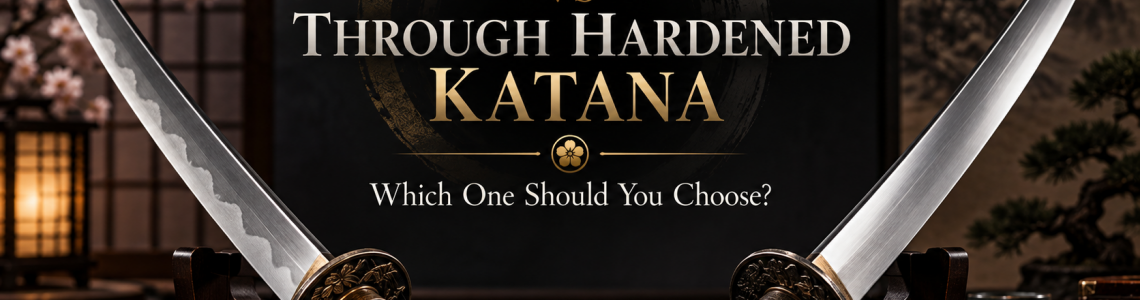
When choosing a handmade katana, one of the most important decisions is not simply the type of steel—it is how the blade is heat treated.
Two terms you will frequently encounter when shopping for a functional Japanese-style sword are clay tempered and through hardened.
Both methods can produce excellent swords, but they emphasize different characteristics. A clay tempered blade is generally chosen for its traditional construction, differential hardness, and genuine hamon, while a through hardened blade is often selected for toughness, consistency, and practical durability.
So, which one is better?
The answer depends on how you intend to use your sword. In this guide, we will explain the differences between clay tempered and through hardened katana blades, their advantages and limitations, and which option may be better for collectors, beginners, martial arts practitioners, and cutting enthusiasts.
1. What Does Heat Treatment Do to a Katana Blade?
Forging gives a katana blade its basic shape, but heat treatment plays a major role in determining how the finished blade performs.
During heat treatment, steel is heated and cooled under controlled conditions to alter its hardness, toughness, and mechanical properties.
For a functional katana, sword makers generally aim to balance several important characteristics:
- Edge hardness
- Toughness
- Resistance to bending or deformation
- Edge retention
- Durability during practical use
- Overall blade geometry and balance
Different heat-treatment methods create different compromises between these properties.
The two most common methods used on modern functional katana are through hardening and differential hardening, commonly referred to as clay tempering.
2. What Is a Through Hardened Katana?
A through hardened katana is heat treated so that the blade develops relatively consistent hardness throughout most of its structure.
Instead of intentionally creating a very hard edge and a substantially softer spine, the goal is a more uniform heat treatment across the blade.
This construction is common among modern functional swords because it can provide excellent toughness and predictable performance.
Steels commonly used for through hardened katana include:
- 1060 carbon steel
- 1095 carbon steel
- T10 tool steel
- 9260 spring steel
It is important to remember that the steel name alone does not determine sword quality. Blade geometry, tempering, grinding, polishing, assembly, and overall workmanship are equally important.
Advantages of a Through Hardened Katana
High Overall Toughness
One of the primary advantages of a through hardened blade is durability.
Because the hardness is relatively consistent throughout the blade, a properly heat-treated sword can offer excellent resistance to normal stresses encountered during practical use.
A Practical Choice for Beginners
Beginners sometimes make cuts with imperfect edge alignment. This can place sideways stress on the blade.
No katana should be abused, but a tough through hardened blade can be a practical choice for someone learning basic cutting technique.
Consistent Mechanical Properties
Because the blade receives relatively uniform heat treatment, it tends to behave consistently throughout its structure.
This is one reason many practical sword users value through hardened blades.
Excellent Value
Through hardened blades usually require fewer specialized finishing processes than high-end clay tempered blades with elaborate hamon polishing.
As a result, they can offer very strong functional performance at an accessible price.
3. What Is a Clay Tempered Katana?
A clay tempered katana uses a form of differential heat treatment.
Before quenching, the sword maker applies a clay mixture to selected areas of the blade. The cutting edge is left with little or no insulating clay, while the spine receives a thicker layer.
During quenching, the edge cools faster and becomes harder, while the clay-covered spine cools more slowly and remains comparatively softer and tougher.
This difference in hardness is responsible for one of the most recognizable characteristics of a traditionally inspired Japanese sword:
The Hamon
The visible transition between the hardened cutting edge and the softer section of the blade is known as the hamon.
Depending on how the clay is applied and how the blade is heat treated, different hamon patterns can be created, including:
- Choji
- Gunome
- Notare
- Suguha
- Midare
A genuine hamon created through differential hardening is part of the blade's metallurgical structure rather than simply a decorative pattern placed on the surface.
Advantages of a Clay Tempered Katana
Traditional Appearance
For many collectors, the genuine hamon is one of the main attractions of a clay tempered katana.
A properly polished hamon changes subtly depending on the lighting and viewing angle, giving each handmade blade its own visual character.
Hard Cutting Edge
Differential hardening allows the cutting edge to reach a relatively high hardness while keeping the spine softer.
High-carbon steels such as T10 steel and 1095 carbon steel are popular choices for clay tempered katana.
Softer and Tougher Spine
The softer spine provides different mechanical properties from the hardened edge.
This combination of a hard edge and comparatively softer spine is a defining characteristic of differential hardening.
Individual Character
Because clay application, polishing, hamon activity, and blade geometry vary slightly from blade to blade, handmade clay tempered swords naturally display individual differences.
For collectors, these small variations are often part of the appeal.
4. Clay Tempered vs Through Hardened Katana
| Feature | Clay Tempered | Through Hardened |
|---|---|---|
| Heat Treatment | Differential | Relatively uniform |
| Genuine Hamon | Yes | Normally no |
| Edge Hardness | Usually harder than spine | More uniform throughout blade |
| Spine | Comparatively softer | Similar hardness to rest of blade |
| Traditional Appearance | Excellent | More practical / modern |
| Toughness | Good when properly made | Generally very good |
| Collector Appeal | High | Moderate to high |
| Typical Cost | Usually higher | Usually lower |
| Beginner Friendly | Yes, with proper technique | Very good |
| Maintenance | Regular carbon-steel care | Regular carbon-steel care |
5. Does a Clay Tempered Katana Cut Better?
Not necessarily.
A common misconception is that a visible hamon automatically means a sword will perform better in cutting.
In reality, cutting performance depends on several factors:
- Blade geometry
- Edge geometry
- Sharpness
- Niku
- Weight and balance
- Distal taper
- Heat treatment
- Steel quality
- User technique
A well-designed through hardened blade can outperform a poorly designed clay tempered blade.
Likewise, a properly made clay tempered sword can deliver excellent cutting performance.
The complete blade design is more important than any single specification.
6. Does Through Hardened Mean Lower Quality?
No.
Through hardening is simply a different heat-treatment method. In many practical applications, it may actually be the more appropriate choice.
For example, 9260 spring steel is widely appreciated for its toughness and resilience when correctly heat treated.
A quality katana should therefore be evaluated by its overall construction rather than whether or not it has a visible hamon.
7. Which Steel Is Best for Clay Tempering?
At HanBon Forge, two of the most popular steels for clay tempered blades are 1095 carbon steel and T10 steel.
1095 Carbon Steel
1095 is a high-carbon steel capable of achieving high hardness when properly heat treated.
When used for differential hardening, it can provide:
- A hard cutting edge
- A clearly visible genuine hamon
- Good edge retention
- Traditional-style appearance
It is a popular choice for collectors seeking a more traditional-looking handmade katana.
T10 Steel
T10 is another high-carbon tool steel frequently used in modern katana production.
When correctly heat treated, it can offer a strong combination of:
- High hardness
- Good edge retention
- Strong cutting performance
- Excellent hamon visibility when clay tempered
You can view our T10 Steel Katana Collection for different examples.
8. What About 9260 Spring Steel?
If toughness is your highest priority, 9260 spring steel is worth considering.
9260 contains silicon, which contributes to its toughness and elastic properties when correctly heat treated.
It is frequently selected for functional swords because it can provide a good balance between resilience and cutting performance.
Buyers who prioritize practical use over a prominent traditional hamon may find a 9260 spring steel katana to be an excellent choice.
9. What About Folded Steel?
Folded steel is another subject that often causes confusion among first-time buyers.
A folded steel blade can still be:
- Through hardened
- Differentially hardened
- Clay tempered
Historically, folding helped distribute and reduce impurities in traditional steel.
With modern homogeneous steels, repeated folding is generally not necessary for purification. Today, folded steel is often selected primarily for its distinctive layered grain pattern.
Therefore, folded steel should not automatically be interpreted as stronger or better than monosteel.
10. What Is a Real Hamon?
A genuine hamon is created during differential hardening.
It is not simply painted onto the blade.
When properly polished, a real hamon can show subtle differences depending on lighting and viewing angle.
Different patterns have different visual characteristics:
Suguha
A restrained, relatively straight hamon pattern.
Notare
A gently undulating wave pattern.
Gunome
A repeating rounded or wave-like pattern.
Choji
A more complex clove-shaped pattern that is particularly popular among collectors.
The appearance of the hamon itself does not determine whether a blade is strong or weak. It is primarily the result of the differential hardening process, clay layout, steel, polishing, and craftsmanship.
11. Which One Is Better for Cutting Practice?
For many beginners, a tough through hardened blade is the simplest practical choice.
Common options include:
A balanced and affordable option for general functional use and light cutting practice.
A strong choice when toughness and resilience are priorities.
Suitable for buyers looking for strong edge performance without requiring a traditional hamon.
Experienced practitioners may also prefer clay tempered 1095 or T10 blades for their harder edge and traditional construction.
Regardless of steel or heat treatment, correct cutting technique remains essential.
Hard objects such as metal, stone, concrete, dry hardwood, or other swords should never be used as cutting targets.
12. Which One Is Better for Collectors?
For collectors, clay tempered blades are often particularly attractive.
The combination of:
- Genuine hamon
- Traditional blade geometry
- Hand polishing
- Individual blade variation
- Differential hardening
gives each sword a distinctive appearance.
Collectors who appreciate traditional Japanese sword aesthetics often choose 1095 or T10 clay tempered blades combined with a Shinogi-Zukuri profile and a natural hamon.
For an even more refined blade appearance, a traditional-style Hazuya polish can further highlight the hamon and surface activity.
13. Which One Is Better for a First Katana?
There is no single correct answer, but the following guide can make the decision easier.
Choose Through Hardened If:
- This is your first functional katana
- Durability is your main priority
- You plan to practice cutting
- You prefer straightforward maintenance
- You want strong performance for your budget
Choose Clay Tempered If:
- Traditional appearance is important to you
- You specifically want a genuine hamon
- You are building a sword collection
- You appreciate traditional-style craftsmanship
- You understand proper sword handling and maintenance
14. What About Blade Sharpness?
Heat treatment and sharpness are different characteristics.
Both through hardened and clay tempered blades can be sharpened to a very keen cutting edge.
For general light cutting, a standard sharp edge may be sufficient.
For heavier cutting applications, additional niku—the convexity behind the cutting edge—can provide additional edge support.
The most appropriate edge geometry depends on the intended use of the sword rather than simply how sharp it feels.
15. Maintenance Is Important for Both Types
Both clay tempered and through hardened carbon-steel katana require regular maintenance.
After handling or cutting:
- Wipe the blade clean.
- Remove moisture, fingerprints, and cutting residue.
- Apply a very thin protective layer of sword oil.
- Store the sword in a dry environment.
- Avoid unnecessarily touching the polished blade with bare fingers.
Carbon steel can rust regardless of whether the blade is clay tempered or through hardened.
For more detailed care instructions, see our Katana Maintenance Guide .
16. Can You Customize Either Type?
Yes.
One of the major advantages of ordering a custom katana is that blade construction can be selected alongside numerous aesthetic and functional options.
Depending on the configuration, HanBon Forge customers can select options such as:
- Blade steel
- Heat treatment
- Hamon style
- Blade shape
- Bohi
- Sharpness
- Blade length
- Tsuka length
- Tsuka-ito material and color
- Samegawa
- Tsuba and fittings
- Habaki and seppa
- Saya
- Sageo
- Blade engraving
Visit our Custom Sword Builder to explore the available combinations.
17. Our Practical Recommendation
Instead of asking which heat treatment is universally better, consider a more useful question:
| Your Priority | Recommended Direction |
|---|---|
| Durability and practical use | Through hardened 1060, T10 or 9260 |
| Traditional appearance | Clay tempered T10 or 1095 |
| Genuine visible hamon | Clay tempered blade |
| Maximum toughness | 9260 spring steel |
| Collector-focused appearance | 1095 or T10 clay tempered + Hazuya polish |
The most important point is that steel, heat treatment, blade geometry, sharpening, and overall craftsmanship must work together as a complete system.
Frequently Asked Questions
Below are answers to some of the most common questions buyers ask when comparing clay tempered and through hardened katana blades.
Is a clay tempered katana stronger than a through hardened katana?
Does every clay tempered katana have a real hamon?
Is a through hardened katana suitable for cutting?
Is T10 better than 1095 steel?
Is 9260 spring steel good for beginners?
Does folded steel make a katana stronger?
Which katana is better for collectors?
Which type is better for a first katana?
Final Thoughts
Choosing between a clay tempered katana and a through hardened katana ultimately comes down to the balance you want between traditional aesthetics, toughness, cutting performance, and intended use.
A through hardened blade offers excellent practical durability and value, making it a strong option for beginners and regular cutting practice.
A clay tempered blade offers something different: differential hardness, a genuine hamon, and the visual character associated with traditionally inspired Japanese sword construction.
Neither method is inherently superior.
A well-made katana should be evaluated as a complete sword—its steel, heat treatment, geometry, sharpening, fittings, assembly, balance, and intended purpose must all work together.
Find the Katana That Fits Your Needs
Explore different steels, heat treatments, hamon styles, fittings, and custom options from HanBon Forge.
Shop Katana T10 Katana 1095 Katana 9260 Katana Customize Your Sword