
Clay Tempered vs Through Hardened Katana: Which One Should You Choose?
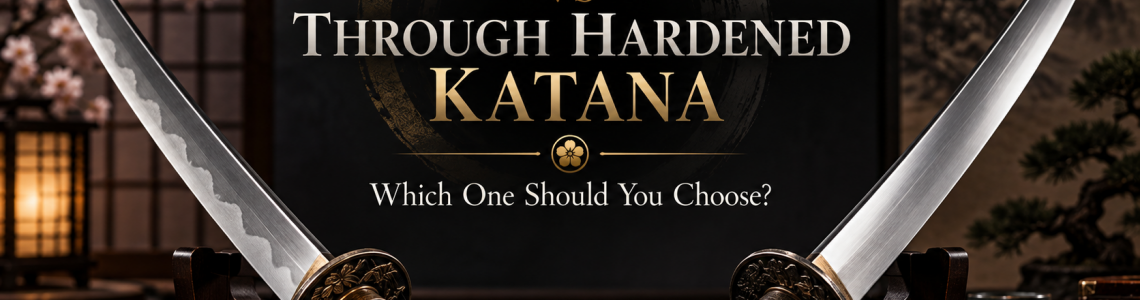
Clay-tempered and through-hardened katana use different heat-treatment methods, producing different hardness distributions and blade characteristics. Clay-tempered swords can feature a genuine hamon and a harder edge relative to the spine, while through-hardened swords are often valued for practical durability and affordability. Learn how the two compare, which steels work well with each method, and how to choose the right katana for your needs.
Clay Tempered vs Through Hardened Katana: Which Is Better?
When choosing a handmade Japanese katana, steel type is only part of the decision. One of the most important factors affecting the finished blade is how the steel is heat treated.
Two common options are clay tempered (differentially hardened) and through hardened blades. Both methods can produce high-quality functional swords, but they create different hardness distributions and may suit different preferences.
Clay-tempered katana are often appreciated for their hardened edges and genuine hamon patterns. Through-hardened katana are frequently chosen for practical durability, value, and consistent heat-treatment characteristics.
But is one actually better?
This guide compares the two methods, explains their metallurgy, examines popular steels including 1060, 1095, T10, and 9260, and offers practical buying advice based on the experience of HanBon Forge in producing modern handmade Japanese-style swords.
Clay Tempered: Uses clay-assisted differential hardening to produce a harder cutting edge and a comparatively softer spine. It can create a genuine hamon and is popular among collectors and enthusiasts of traditional Japanese sword aesthetics.
Through Hardened: Uses heat treatment intended to produce a more uniform hardness distribution across the blade, followed by appropriate tempering. It is commonly selected for practical durability and value.
Bottom Line: Neither method is universally superior. Steel quality, heat treatment, blade geometry, assembly, and intended use matter more than the label alone.
1. Why Heat Treatment Matters in a Katana
Forging and grinding establish the shape of a blade, but heat treatment plays a major role in determining its hardness, toughness, and resistance to damage.
During hardening, suitable steel is heated and then cooled under controlled conditions. Rapid cooling can transform austenite into a hard microstructure called martensite.
Hardening is commonly followed by tempering, a separate controlled heating process that reduces some of the brittleness and internal stresses associated with quenching.
The objective is not simply to make the steel as hard as possible. A functional blade needs an appropriate balance of:
- Hardness: Resistance to indentation and deformation.
- Toughness: Ability to resist fracture and absorb energy.
- Edge Retention: Ability to maintain a useful cutting edge.
- Flexural Behavior: How the blade responds to bending forces.
- Wear Resistance: Resistance to gradual material loss.
- Structural Integrity: Sound construction without damaging defects.
An excessively hard edge may be vulnerable to chipping under inappropriate loading, while an excessively soft edge can deform or lose sharpness more easily.
2. What Is a Through Hardened Katana?
A through-hardened katana is made using a heat-treatment process intended to harden the blade relatively uniformly rather than deliberately creating a large hardness difference between the cutting edge and spine.
After quenching, the blade is typically tempered to reach the desired combination of hardness and toughness.
Through hardening does not mean that every location in the blade has exactly the same hardness. Actual results depend on steel hardenability, thickness, geometry, heating, and cooling conditions.
Advantages of Through Hardened Katana
- Practical Toughness: Proper steel selection and heat treatment can produce a blade with useful resistance to impact-related damage.
- Accessible Pricing: Many through-hardened swords cost less than comparable differentially hardened blades requiring specialized hamon finishing.
- Consistent Treatment Approach: The process avoids intentionally creating a pronounced difference between a very hard edge and substantially softer spine.
- Beginner Appeal: A well-designed through-hardened blade can be a sensible first functional sword for supervised cutting practice.
Limitations of Through Hardening
Through hardening does not make a sword indestructible. Depending on the hardness, tempering, and blade geometry, a through-hardened blade can still chip, bend, take a permanent set, or fracture.
It also normally lacks the genuine differential-hardening hamon valued by many traditional Japanese sword collectors.
Common steels used for modern through-hardened katana include 1060 carbon steel, 1095, T10, and 9260 spring steel.
3. What Is a Clay Tempered Katana?
A clay-tempered katana uses differential hardening, a heat-treatment method traditionally associated with Japanese swordmaking.
Before quenching, the swordsmith applies a clay-based insulating mixture to selected areas of the blade. Typically, the spine receives a thicker layer while the cutting-edge region receives little or less clay.
During quenching, different cooling rates help produce different steel microstructures. The cutting-edge region can develop hard martensite, while other regions remain comparatively softer.
How Clay-Assisted Differential Hardening Works
- Blade Preparation: The blade is forged, shaped, and prepared for heat treatment.
- Clay Application: Insulating material is applied in a controlled pattern.
- Heating: The blade is brought to a temperature appropriate for the steel.
- Quenching: The blade is rapidly cooled to produce hardening and the desired microstructural differences.
- Tempering: The hardened blade may undergo further controlled heating to adjust its properties.
- Polishing: The surface is finished to reveal the blade's features, including the hamon.
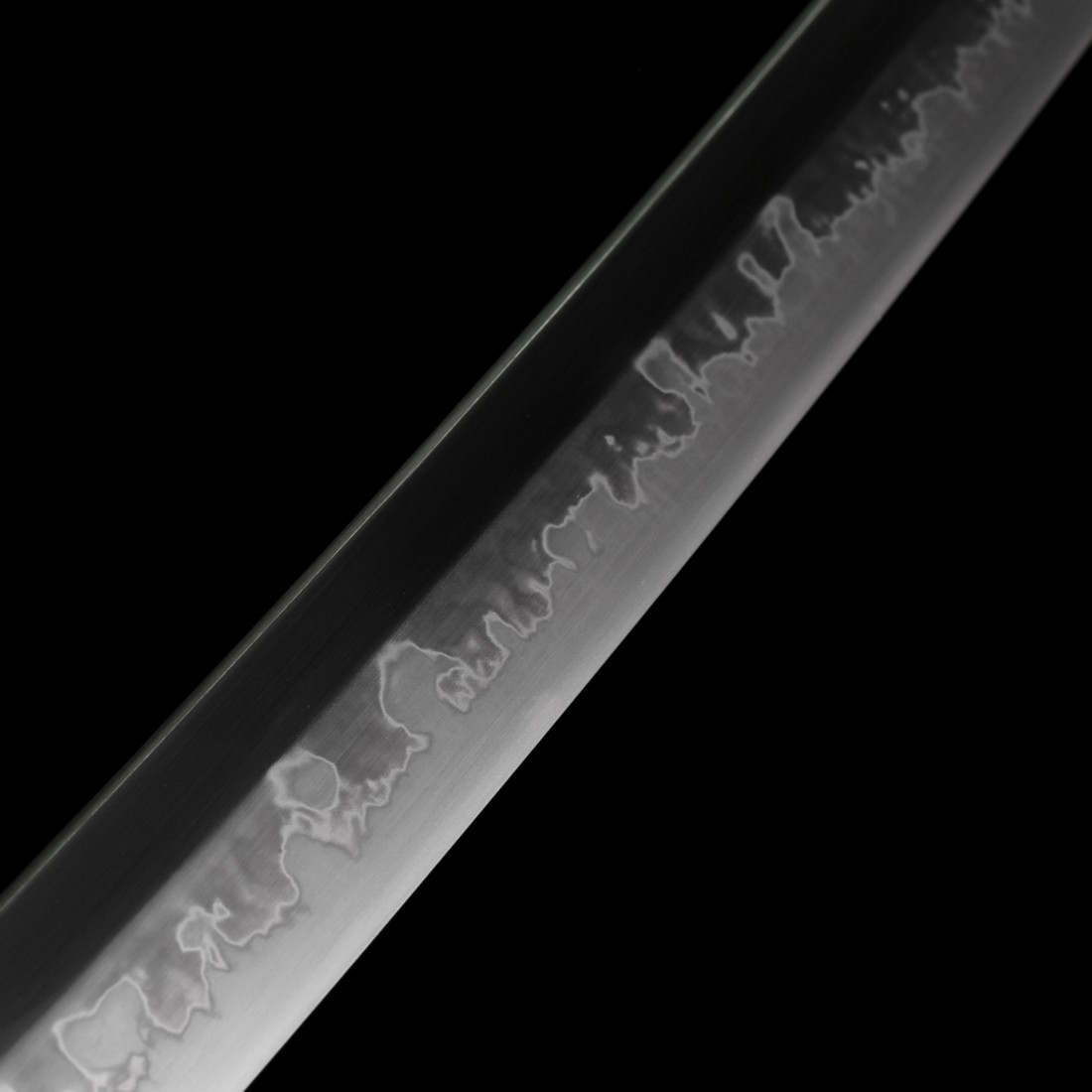
The resulting boundary and activity in the hardened region can produce the visible pattern known as the hamon (刃文).
Advantages of Clay Tempered Katana
- Genuine Hamon: The visible hardened-edge pattern reflects aspects of differential heat treatment rather than merely decorative surface finishing.
- Distinct Hardness Regions: The edge can be harder than the spine, providing different mechanical characteristics across the blade.
- Traditional Appearance: The process is closely associated with historic Japanese swordmaking.
- Individual Character: Differences in heat treatment and polishing can produce distinctive hamon features.
Limitations of Clay Tempered Katana
Differential hardening requires careful control and may involve greater manufacturing complexity. Improper quenching can introduce distortion, cracking, or other defects.
A hard cutting edge may also be susceptible to damage when it strikes an unsuitable target or experiences significant lateral loading.
A genuine hamon should therefore be viewed as evidence of a particular hardening process, not a guarantee that the sword will outperform every through-hardened blade.
For a detailed explanation, read our Japanese Sword Buyer Guides for more information about clay tempering and heat treatment.
4. Clay Tempered vs Through Hardened: Complete Comparison
The following chart summarizes the main differences between the two heat-treatment methods.
| Feature | Clay Tempered | Through Hardened |
|---|---|---|
| Heat Treatment | Differential hardening | Relatively uniform hardening |
| Edge Hardness | Usually higher than spine | More consistent across blade |
| Spine Hardness | Comparatively softer | Generally closer to edge hardness |
| Genuine Hamon | Characteristic feature | Normally absent |
| Toughness | Depends on steel and treatment | Can be excellent with suitable treatment |
| Edge Retention | Potentially high with suitable edge hardness | Depends on hardness, steel, and geometry |
| Visual Appearance | Traditional hamon-focused appearance | Usually more understated |
| Typical Pricing | Often higher for comparable models | Often more affordable |
| Beginner Suitability | Suitable with appropriate instruction | Often a practical starting point |
| Maintenance | Regular carbon-steel maintenance | Regular carbon-steel maintenance |
| Best Suited To | Collectors seeking a genuine hamon | Buyers prioritizing practicality and value |
5. Which Steel Is Best for Each Hardening Method?
Steel composition strongly influences how a blade responds to heat treatment. The same steel grade may produce different results depending on the thermal process, blade geometry, and manufacturing quality.
1060 Carbon Steel
1060 is a medium-carbon steel commonly used in functional Japanese-style swords. Its combination of carbon content, availability, and heat-treatment characteristics makes it a popular choice for affordable through-hardened katana.
When properly processed, 1060 can provide a useful balance of edge performance and toughness.
1095 High-Carbon Steel
1095 contains a relatively high proportion of carbon, allowing the steel to achieve substantial hardness under appropriate heat-treatment conditions.
It is commonly selected for differentially hardened blades with genuine hamon patterns.
However, higher hardness is not automatically better. Blade geometry, proper tempering, and intended cutting applications must be considered.
T10 Tool Steel
T10 is a high-carbon tool steel frequently used in modern handmade katana.
It can be differentially hardened to create a genuine hamon, making it popular among buyers seeking traditional-style blade aesthetics.
T10 can also be through hardened. Its performance depends on the actual manufacturing and heat-treatment specifications rather than the steel name alone.
9260 Spring Steel
9260 is a silicon-alloyed spring steel known for its potential to provide good toughness and elastic behavior when appropriately heat treated.
It is frequently used for through-hardened functional swords where resilience is an important design objective.
That does not mean every 9260 blade will automatically withstand greater loads than every 1095 or T10 blade. Finished hardness, tempering, geometry, and quality control remain essential.
Explore 9260 Spring Steel Katana.
6. Does Clay Tempered Mean Better Cutting Performance?
Not necessarily.
One common misconception is that a genuine hamon or a very hard cutting edge automatically makes a katana a better cutter.
In practice, effective cutting depends on several interacting factors:
- Edge Geometry: The shape and thickness of the cutting edge.
- Niku: The supporting convexity of the blade near and behind the edge.
- Blade Geometry: Width, thickness, curvature, and cross-sectional shape.
- Weight and Balance: The way mass is distributed along the sword.
- Distal Taper: Changes in blade thickness toward the tip.
- Heat Treatment: Hardness distribution and toughness.
- Cutting Technique: Edge alignment and controlled movement.
- Target Properties: Material hardness, density, and resistance.
A well-made through-hardened katana may outperform a poorly designed clay-tempered blade. Equally, a properly manufactured differentially hardened katana can be an excellent cutting sword.
What About Very Sharp and Sharp With Niku?
Edge sharpness and heat treatment are separate design choices.
At HanBon Forge, customers can select sharpening options for different intended applications, including a very sharp edge for light cutting and an edge with additional niku for appropriate heavier cutting applications.
Additional niku provides more supporting material behind the cutting edge, but it does not make the sword suitable for striking metal, stone, or other excessively hard targets.
7. Genuine Hamon, Artificial Hamon, and Folded Steel
Three frequently confused terms in Japanese sword listings are genuine hamon, decorative hamon, and folded-steel grain.
Genuine Hamon
A genuine hamon is associated with differential hardening and reflects the blade's heat-treatment characteristics.
Common patterns include Suguha, Notare, Gunome, Choji, and Midare.
Artificial Hamon
An artificial hamon is a decorative surface pattern produced by finishing, etching, abrasion, or another visual treatment.
It may resemble a hardened-edge pattern but does not by itself establish differential hardening.
Folded Steel Grain (Hada)
Hada refers to visible steel grain associated with forging and related steel-working processes.
A folded-steel blade can be through hardened or differentially hardened. Folding and clay tempering are not the same process.
For a detailed explanation, read our Katana Hamon vs Hada Guide.
8. Which Katana Should You Choose?
The most useful buying decision begins with the purpose of the sword rather than assuming that one heat-treatment method is always superior.
| Your Priority | Recommended Direction |
|---|---|
| First Functional Katana | Consider a properly made through-hardened 1060 or 9260 blade |
| Traditional Japanese Appearance | Clay-tempered T10 or 1095 with a genuine hamon |
| Practical Durability and Value | Well-tempered through-hardened blade |
| Genuine Hamon for Collecting | Differentially hardened blade with suitable polishing |
| Resilience-Oriented Steel Choice | Consider appropriately heat-treated 9260 steel |
| Visible Folded-Steel Grain | Consider folded steel while independently evaluating heat treatment |
| Personalized Craftsmanship | Custom katana with selected steel, blade geometry, and fittings |
For Beginners
A through-hardened 1060 or 9260 katana is often a practical starting point for buyers who value durability and an accessible price.
However, beginners who particularly appreciate traditional Japanese sword aesthetics can also choose a well-made clay-tempered blade.
For Collectors
Clay-tempered T10 and 1095 blades are attractive options for collectors interested in genuine hamon patterns and traditional-inspired heat-treatment methods.
Finishing and polishing techniques, including traditional-style Hazuya polishing where available, may help reveal fine surface activity.
For Martial Arts Practitioners
The choice should depend on the discipline, instructor recommendations, intended training activity, and sword specifications.
A live blade is not appropriate for every type of martial arts training. For many forms of practice, a purpose-built unsharpened iaito or other appropriate training sword is preferable.
Always confirm the suitability of a particular sword with a qualified instructor before using it for martial arts training.
9. HanBon Forge: Practical Swordmaking and Quality Considerations
HanBon Forge produces handmade Japanese-style swords with multiple blade steel options, heat-treatment methods, blade geometries, and customizable fittings.
From a manufacturing and inspection perspective, selecting the appropriate heat treatment is only one part of producing a reliable finished sword.
A katana must also be evaluated for:
- Appropriate blade geometry and edge finishing.
- Consistency of the finished blade's workmanship.
- Correct fitting and security of the tsuba, fuchi, and kashira.
- Secure tsuka construction and mekugi installation.
- Proper saya fit.
- Overall assembly, alignment, and finishing quality.
For example, a 1095 or T10 clay-tempered blade may display an attractive genuine hamon, but that visual feature does not eliminate the need to inspect the tip, cutting edge, handle, and other components.
Similarly, a through-hardened 1060 or 9260 blade should not be judged exclusively by its steel designation or claims of toughness.
For custom orders, HanBon Forge provides photographs of the finished sword for customer approval before shipment. Customers can review visible details and confirm their requested design options.
Photographs are useful for reviewing appearance and workmanship, but they cannot independently verify every metallurgical characteristic. Buyers should consider the complete specifications and intended use when choosing a sword.
10. Maintaining Your Katana
Most high-carbon-steel katana require similar basic maintenance regardless of whether they are clay tempered or through hardened.
- Wipe fingerprints and moisture from the blade after handling.
- Remove any residue after appropriate cutting practice.
- Apply a thin, even layer of suitable protective sword oil.
- Store the sword in a dry environment.
- Avoid unnecessary contact with the polished steel.
- Inspect the fittings, handle, and blade for damage before use.
A genuine hamon does not make a blade rustproof. Likewise, through hardening does not eliminate the need for regular cleaning and corrosion protection.
For more information, see our Japanese Sword Maintenance Guide.
Frequently Asked Questions
Find answers to common questions about differential hardening, through hardening, genuine hamon, and katana steel selection.
Is a clay tempered katana stronger than a through hardened katana?
Not necessarily. Differential hardening and through hardening produce different hardness distributions. Overall strength and durability depend on steel composition, heat treatment, geometry, and manufacturing quality.
Does every clay tempered katana have a genuine hamon?
Successfully differentially hardened blades generally develop a genuine hardened-edge boundary, although its visibility and appearance depend on the steel and polishing. Artificial decorative patterns should not be confused with genuine differential hardening.
Are through hardened katana good for cutting?
Yes. A properly constructed, appropriately sharpened, and correctly heat-treated through-hardened katana can provide excellent cutting performance when used with suitable targets and proper technique.
Can a through hardened katana bend or break?
Yes. Through hardening does not prevent permanent bending, edge damage, or fracture. These outcomes depend on material properties, blade geometry, heat treatment, loading conditions, and possible defects.
Is T10 better than 1095 steel?
Neither is automatically superior. Both are high-carbon steels capable of good performance. The correct comparison depends on heat-treatment quality, hardness, toughness, blade design, and intended use.
Is 9260 spring steel better for beginners?
A well-made 9260 katana can be a practical beginner option when toughness and resilience are priorities. However, correct training, safe handling, and sound assembly remain essential regardless of the steel.
Does a genuine hamon improve cutting performance?
A genuine hamon reflects differential hardening, which can produce a harder cutting edge. The hamon itself does not guarantee better cutting. Edge geometry, sharpness, steel, and technique are also critical.
Can folded steel be through hardened?
Yes. Folding is a forging process, while through hardening and differential hardening are heat-treatment methods. A folded-steel blade can undergo either process if its composition and construction are suitable.
Do clay tempered katana require more maintenance?
Both types generally require comparable carbon-steel care. Cleaning, drying, oiling, and careful storage are important regardless of heat-treatment method. Special polishing considerations may apply to finely finished hamon.
Which katana should I buy for my first sword?
For practical value, consider a well-made through-hardened 1060 or 9260 katana. If a genuine hamon and traditional appearance are particularly important, a clay-tempered 1095 or T10 blade may also be appropriate. Choose according to your intended use and experience.
Final Thoughts: Choose the Right Heat Treatment for Your Needs
Clay tempering and through hardening represent different approaches to achieving suitable mechanical properties in a Japanese-style sword.
A clay-tempered blade offers a traditional-style differential-hardening structure, a potentially harder edge relative to its spine, and the distinctive appearance of a genuine hamon.
A through-hardened blade offers a relatively uniform hardening approach and can provide excellent practical performance, depending on the steel, tempering, and blade design.
Neither process should be regarded as an automatic guarantee of superior quality.
When selecting a katana, evaluate the complete sword: steel composition, heat treatment, geometry, sharpness, fittings, construction, maintenance requirements, and intended purpose.
At HanBon Forge, we believe informed customers are better equipped to choose swords that meet their expectations for craftsmanship, appearance, and practical use.
Find the Right Katana at HanBon Forge
Explore handmade katana in different steels and heat-treatment configurations, or customize a sword with your preferred blade, fittings, and finishing options.
Explore Katana CollectionCustomize Your KatanaReferences & Further Reading
This article combines established metallurgical principles, Japanese swordmaking literature, and practical manufacturing considerations. It is intended as a general educational guide rather than a certification of any individual blade's mechanical properties.
- The Metropolitan Museum of Art. The Japanese Blade: Technology and Manufacture.
- Leon Kapp, Hiroko Kapp, and Yoshindo Yoshihara. The Craft of the Japanese Sword. Kodansha, 1987.
- George Krauss. Steels: Processing, Structure, and Performance. ASM International.
- HanBon Forge. Katana Hamon vs Hada: Differences Explained.
About This Article
Prepared by: HanBon Forge Team
Topic: Japanese Sword Heat Treatment, Differential Hardening, Through Hardening & Blade Materials
Content Focus: Technical explanations and practical guidance for buyers of modern handmade Japanese-style swords.
HanBon Forge produces handmade and custom Japanese-style swords, including katana, wakizashi, tanto, and other traditional-inspired blade designs.
This guide combines published technical references with practical considerations relevant to modern sword production, blade finishing, and quality inspection.