Chinese Hook Sword (Shuang Gou): History, Design and Martial Arts

Chinese Hook Sword (Shuang Gou): History, Design and Martial Arts
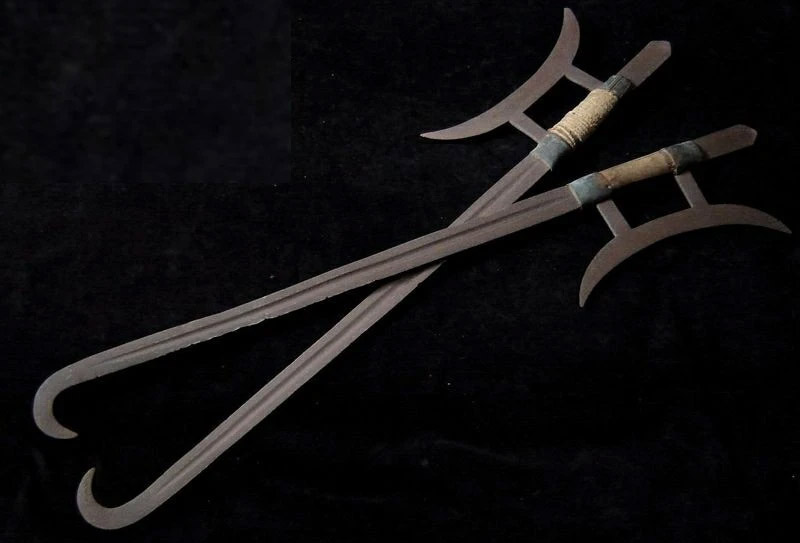
The Chinese hook sword, commonly known as Shuang Gou (双钩) or Shuang Gou Jian, is one of the most distinctive weapons associated with traditional Chinese martial arts. Unlike a conventional Chinese jian, the Shuang Gou has a long blade combined with a large crescent-shaped guard, a pointed pommel, and a distinctive hook at the tip.
Usually used as a pair, these unusual weapons allow practitioners to perform cutting, hooking, trapping, blocking, and linking movements that are difficult to perform with a conventional sword.
Because of its unusual shape and complex handling, the Chinese hook sword has become one of the most recognizable weapons in Chinese martial arts and modern Wushu.
What Is a Chinese Hook Sword?
The Shuang Gou is a type of traditional Chinese martial arts weapon designed around a straight, double-edged sword blade with additional hooked and pointed sections.
The Chinese name Shuang Gou (双钩) can be translated roughly as “double hooks” or “twin hooks.” The weapon is also associated with the name Hu Tou Gou (虎头钩), often translated as “tiger head hook.”
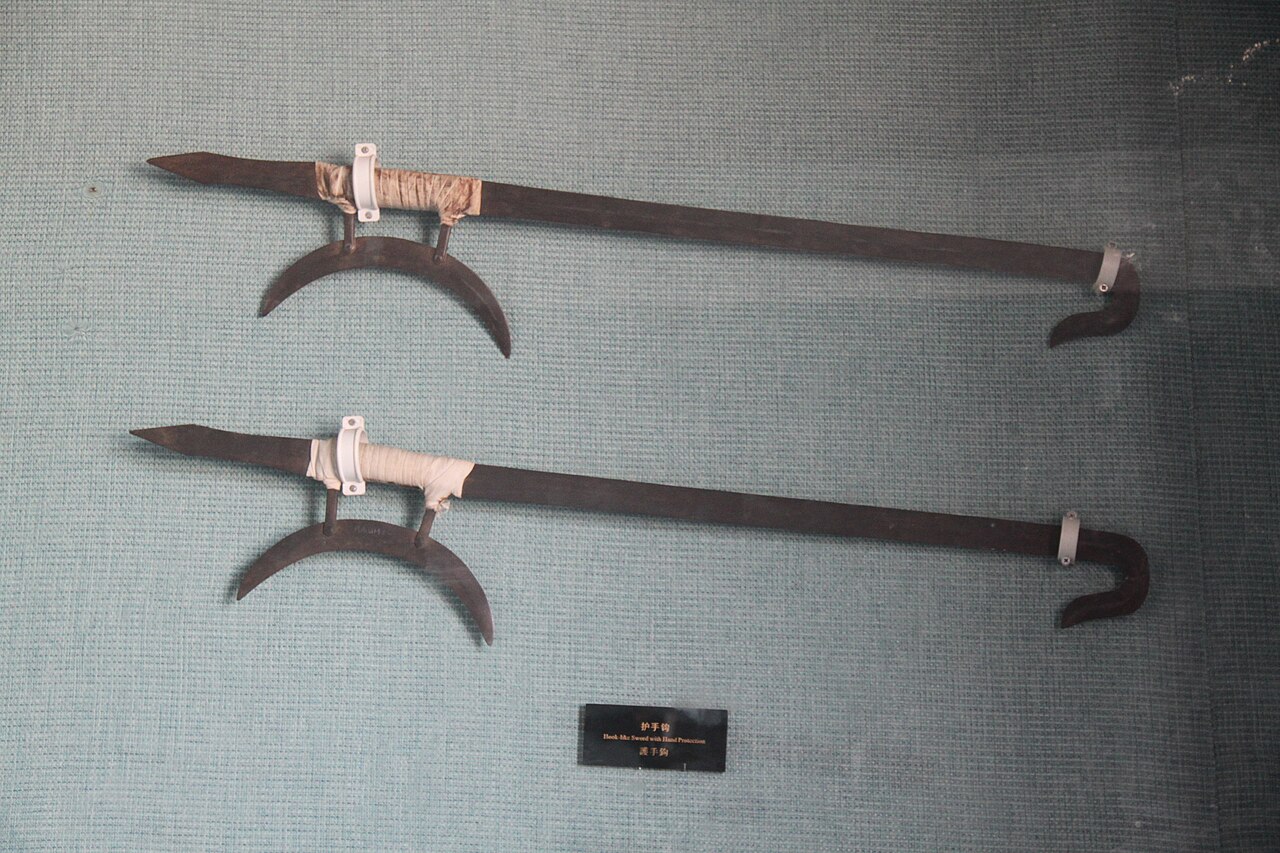
Unlike a standard jian, the Shuang Gou has several distinctive features:
A straight sword-like blade
A large crescent-shaped hand guard
A hooked tip at the end of the blade
A pointed pommel
A design intended to be used in pairs
Hooks that can sometimes be used to connect the two weapons
These features give the Chinese double hook sword a very different handling style from a traditional Chinese straight sword.
The Main Parts of a Shuang Gou Sword
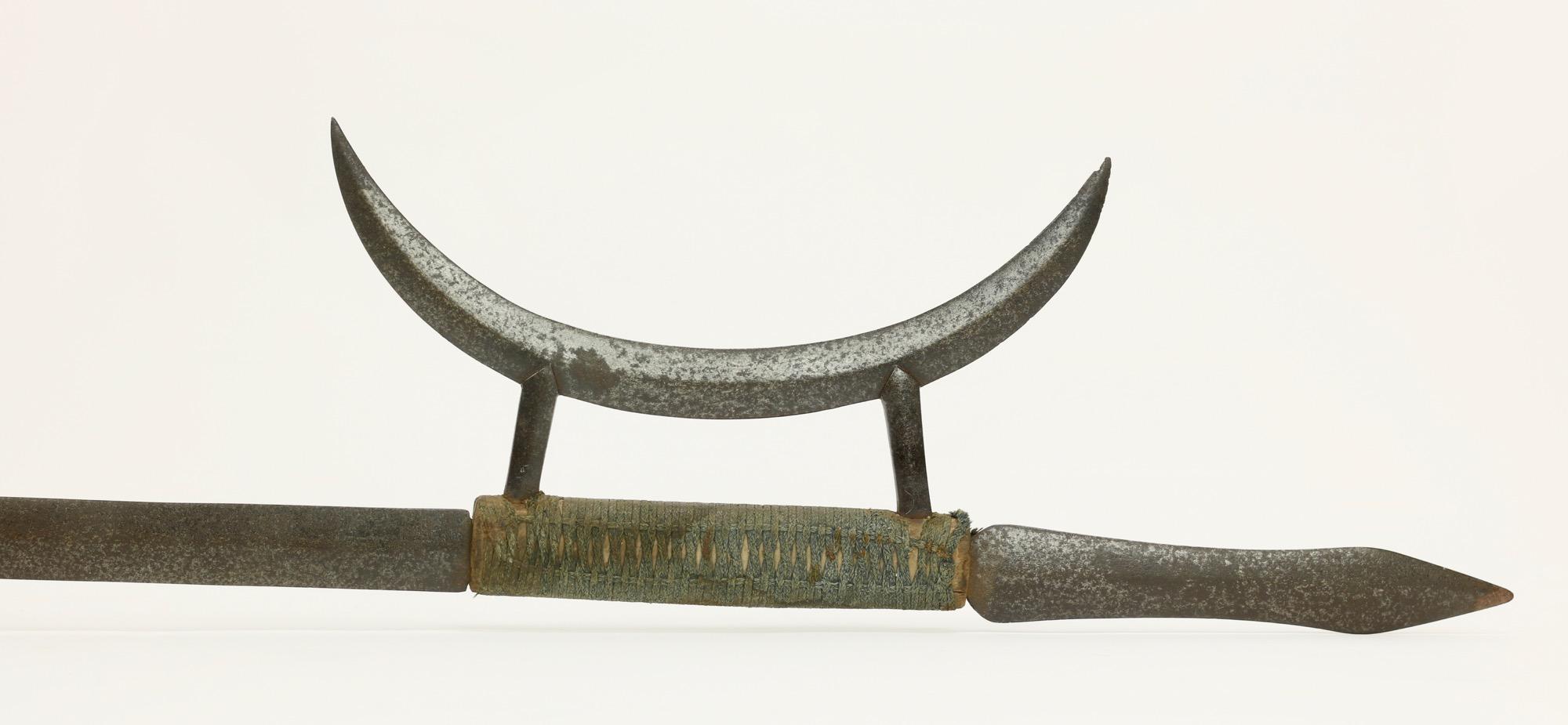
The unusual appearance of the Chinese hook sword comes from the combination of several functional elements.
1. Straight Blade
The main blade resembles a traditional Chinese straight sword.
It provides the familiar cutting and thrusting characteristics associated with a jian while giving the practitioner a central structure around which the other components are built.
2. Hooked Tip
The hook is the feature that immediately distinguishes a Shuang Gou from other Chinese swords.
In martial arts practice, the hook can be incorporated into techniques involving trapping, controlling, redirecting, or catching an opponent's weapon.
The hook can also be used as part of linking movements between a pair of Shuang Gou.
3. Crescent-Shaped Guard
The large curved guard protects the hand while also providing another surface that can be incorporated into martial arts movements.
Its size and shape are among the most recognizable visual features of traditional Chinese hook swords.
4. Pointed Pommel
The rear of the weapon usually ends in a pointed section.
This gives the Shuang Gou another functional element beyond the main blade and contributes to the weapon's distinctive four-part appearance.
How Are Shuang Gou Hook Swords Used?
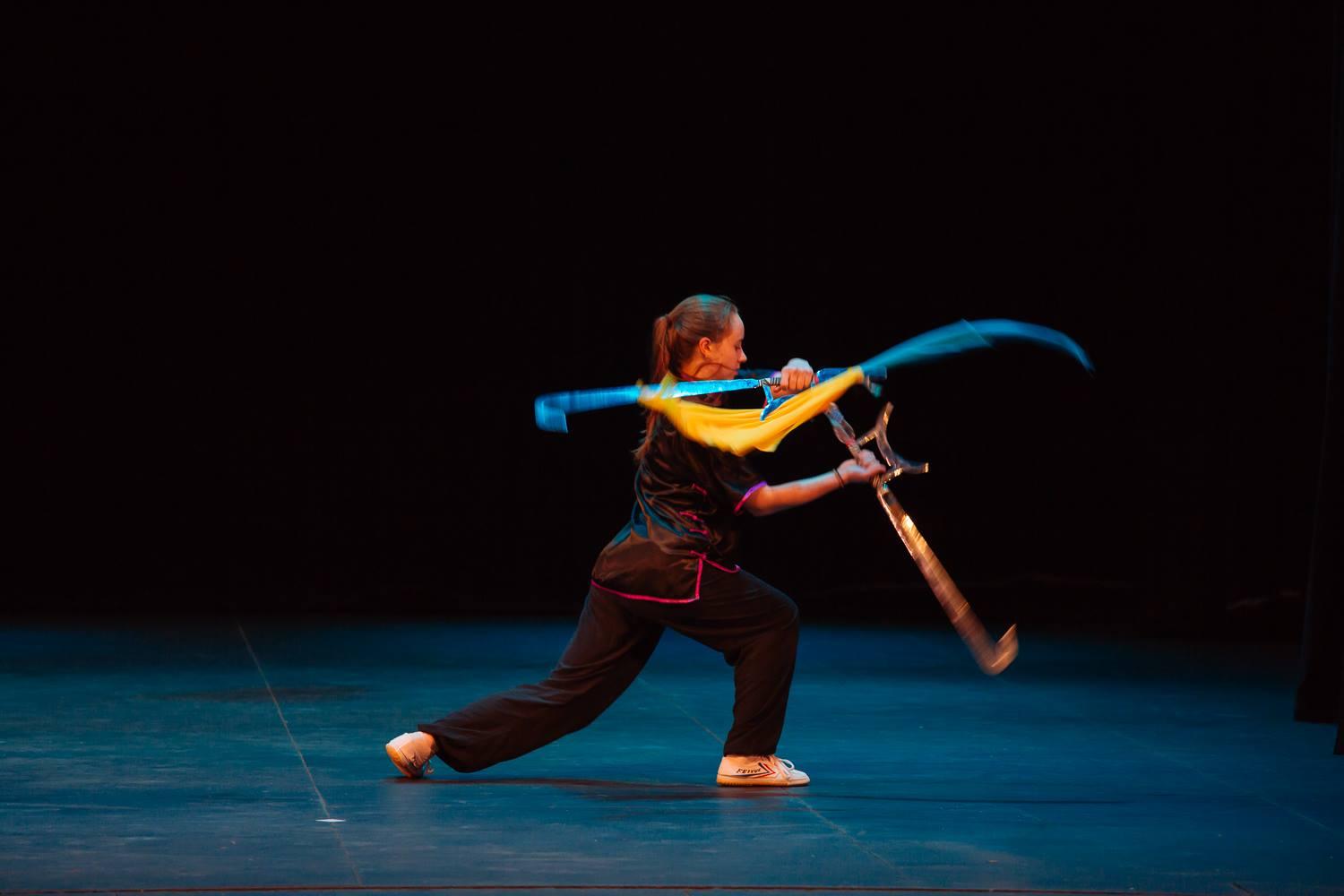
The Shuang Gou sword is best known today for its role in Chinese martial arts and Wushu.
Unlike a conventional jian, which has a relatively straightforward blade design, the Shuang Gou requires the practitioner to control several different parts of the weapon.
Common movements found in Shuang Gou training may include:
Cutting with the main blade
Thrusting movements
Hooking and trapping
Blocking and deflecting
Linking two weapons together
Switching between different parts of the weapon
Coordinated movements between both hands
The complexity of these movements means that Shuang Gou training requires considerable coordination and practice.
Modern demonstrations often emphasize speed, fluidity, precision, and visual control.
Shuang Gou vs. Traditional Chinese Jian
The Shuang Gou is sometimes confused with a conventional Chinese jian, but the two weapons are quite different.
A traditional jian is primarily a straight, double-edged sword with a relatively simple guard and pommel.
The Shuang Gou adds several additional features, including the large crescent guard and hooked blade.
| Feature | Chinese Jian | Shuang Gou |
|---|---|---|
| Blade | Straight | Straight with hooked tip |
| Guard | Usually compact | Large crescent-shaped guard |
| Pommel | Conventional pommel | Often pointed |
| Typical use | Martial arts, historical sword traditions | Primarily martial arts and Wushu |
| Use in pairs | Possible | Common |
| Hook | No | Yes |
| Linking mechanism | No | Hooked ends can be used to link weapons |
The Shuang Gou is therefore better understood as a specialized martial arts weapon rather than simply another style of Chinese jian.
Why Are Chinese Hook Swords So Difficult to Master?
The unusual shape of the Shuang Gou is also what makes it challenging.
With a normal sword, the practitioner mainly needs to control the blade, guard, and handle. A hook sword introduces additional surfaces and contact points that can interact with the practitioner's other weapon.
When using two Shuang Gou at the same time, the practitioner must coordinate both hands while maintaining control over the hooks, blades, guards, and pommels.
This is why Shuang Gou routines often look fast and complicated.
Good technique depends on timing, body coordination, balance, and precise control rather than simply moving the weapons quickly.
Are Shuang Gou Ancient Battlefield Weapons?
This is one of the most common questions about Chinese hook swords.
The answer requires some historical caution.
Although the Shuang Gou is often described online as an ancient Chinese battlefield weapon, reliable historical evidence for widespread military use is limited. Surviving examples and historical references suggest that the weapon was relatively uncommon compared with standard Chinese military weapons.
Its complicated construction and specialized handling also make it more closely associated with martial arts practice than with large-scale battlefield use.
For this reason, it is better to describe the Shuang Gou as a traditional Chinese martial arts weapon rather than automatically calling it a common ancient battlefield sword.
Shuang Gou in Chinese Martial Arts Today
Today, the Chinese double hook sword remains popular among martial arts practitioners, Wushu performers, collectors, and people interested in traditional Chinese weapons.
Its unusual design makes it particularly suitable for demonstrations and choreographed routines.
Shuang Gou routines can include rapid changes in direction, weapon linking, spinning movements, hooking actions, and coordinated movements between two weapons.
For beginners, however, the design can be considerably more difficult to control than a standard Chinese jian.
Training should therefore focus on learning the movements gradually and using appropriate practice equipment when necessary.
Why Is the Shuang Gou So Popular With Collectors?
The Chinese hook sword has a distinctive appearance that sets it apart from most traditional Chinese swords.
For collectors, its appeal comes from several factors:
Unique design:
The combination of a straight blade, large guard, hook, and pointed pommel gives the weapon an instantly recognizable appearance.
Martial arts connection:
The Shuang Gou has a strong association with traditional Chinese martial arts and Wushu.
Pair-based design:
Unlike many swords that are collected individually, Shuang Gou are commonly presented and practiced as a pair.
Historical interest:
The uncertain history of the weapon makes it an interesting subject for people researching Chinese martial arts weapons.
Display value:
A pair of Chinese hook swords can make a striking addition to a traditional weapons collection or martial arts display.
What Should You Look for When Buying a Chinese Hook Sword?
If you are considering buying a Shuang Gou sword, it is important to look beyond appearance.
Blade Construction
Check the blade material and construction method. If the sword is intended for practice, make sure the product is clearly described as suitable for its intended use.
Balance
Because Shuang Gou have several unusual components, balance is especially important.
A well-balanced pair should feel controllable rather than excessively heavy or awkward in the hand.
Handle and Guard
The handle should provide a secure grip, while the large guard should be firmly attached to the weapon.
Hook Construction
The hook is one of the most important parts of the weapon. Check how securely it is attached to the main blade and whether the construction is appropriate for the intended purpose.
Pair Matching
If you are purchasing Shuang Gou as a pair, check that both weapons are reasonably matched in size, weight, and overall construction.
For collectors, decorative details and traditional fittings may also be important.
Shuang Gou: A Unique Part of Chinese Sword Culture
The Chinese hook sword occupies a fascinating position within the world of traditional Chinese weapons.
It is not as common as the jian or dao, and its exact historical development remains difficult to document. However, its unusual design has allowed it to maintain a strong presence in Chinese martial arts.
The Shuang Gou combines several different functions into one weapon. The straight blade provides the characteristics of a sword, while the hook, crescent guard, and pointed pommel create additional possibilities for martial arts movements.
That combination is what makes the Shuang Gou sword so distinctive.
For anyone interested in Chinese swords, traditional martial arts, or unusual historical weapons, the Shuang Gou is well worth exploring.
Frequently Asked Questions About Chinese Hook Swords
What is a Shuang Gou sword?
A Shuang Gou is a traditional Chinese hook sword commonly used in pairs in Chinese martial arts. It features a straight blade, a large crescent-shaped guard, a hooked tip, and a pointed pommel.
What does Shuang Gou mean?
“Shuang Gou” (双钩) is commonly translated as “double hooks” or “twin hooks.” The name refers to the paired hook swords commonly used in martial arts.
What is a Hu Tou Gou?
Hu Tou Gou (虎头钩) is another name associated with the Chinese hook sword. It is commonly translated as “tiger head hook.”
Are Shuang Gou swords used in pairs?
Yes. Shuang Gou are most commonly practiced as a pair. Using two weapons allows practitioners to perform coordinated movements and techniques that are difficult with a single sword.
Are Chinese hook swords real swords?
They can be. Shuang Gou exist in both training and functional forms, depending on their construction. Buyers should always check the specifications of an individual sword rather than assuming that every Shuang Gou has the same purpose.
Are Shuang Gou used in Kung Fu?
Yes. Shuang Gou are associated with traditional Chinese martial arts and Wushu. Their complex design makes them particularly recognizable in martial arts weapons routines.
Are Shuang Gou ancient Chinese weapons?
Their exact origins are uncertain. Although they are sometimes described as ancient weapons, surviving examples and historical evidence are generally associated with the Qing period and later. Claims about much earlier origins should therefore be treated carefully.
What makes a Shuang Gou different from a Chinese jian?
A traditional jian is a straight, double-edged Chinese sword. A Shuang Gou adds a hooked blade tip, large crescent-shaped guard, and pointed pommel, giving it a much more complex design.
Are Shuang Gou difficult to learn?
Yes. Their unusual shape and paired use require good coordination, timing, balance, and weapon control. Beginners generally need to learn the movements progressively.
Can Shuang Gou be used for display?
Yes. Their distinctive shape makes them popular with collectors and martial arts enthusiasts. When purchasing a display sword, buyers should still check local laws and the product's construction and intended use.
Final Thoughts
The Shuang Gou, or Chinese hook sword, is one of the most unusual weapons in traditional Chinese martial arts.
Its combination of a straight blade, hooked tip, crescent guard, and pointed pommel gives it a design unlike the more familiar Chinese jian and dao. Although its early history remains uncertain, the weapon has developed a lasting place in Chinese martial arts and Wushu.
For collectors and martial arts enthusiasts, the appeal of the Shuang Gou lies not only in its appearance but also in the skill required to control it.
It is a fascinating example of how traditional Chinese martial arts weapons can combine practical design, specialized techniques, and distinctive cultural history.
Related Products