How to Choose a Katana Tsuba: A Guide to Styles, Materials & Meaning at HanBon Forge
Choosing the right katana tsuba involves more than selecting an attractive sword guard. Material, shape, size, weight, craftsmanship, symbolism, and compatibility with the other sword fittings all matter. This guide explains how to choose between alloy, iron, and brass tsuba, explores traditional Japanese designs, and shares practical customization advice from HanBon Forge.
How to Choose a Katana Tsuba: Styles, Materials & Customization Guide
A Japanese katana is admired for its blade, craftsmanship, and traditional aesthetics. Yet one of its most recognizable components is the tsuba (鍔), the guard positioned between the blade and the handle.
The tsuba is an essential element of Japanese sword mountings, known collectively as koshirae. It helps protect the hand, defines the transition between blade and handle, and contributes to the sword's overall weight distribution and appearance.
Traditional Japanese sword guards also developed into works of metalworking art. Their designs can feature dragons, waves, cherry blossoms, warriors, animals, geometric patterns, and many other cultural or artistic subjects.
At HanBon Forge, customers can choose from a wide selection of tsuba and matching Japanese sword fittings when ordering a custom katana.
In this guide, we explain the most important factors to consider, compare common tsuba materials and styles, and share practical advice for creating a coordinated sword design.
The best tsuba is one that fits the sword properly, has suitable strength and dimensions, and complements the overall koshirae.
Iron: A traditional-looking option often favored for restrained or functional designs.
Brass: Well suited to detailed decorative themes and coordinated premium-style fittings.
Alloy: A versatile and often affordable option with many different patterns.
Most important: Correct fitting, workmanship, and intended use matter more than the material name alone.
1. What Is a Katana Tsuba and Why Does It Matter?
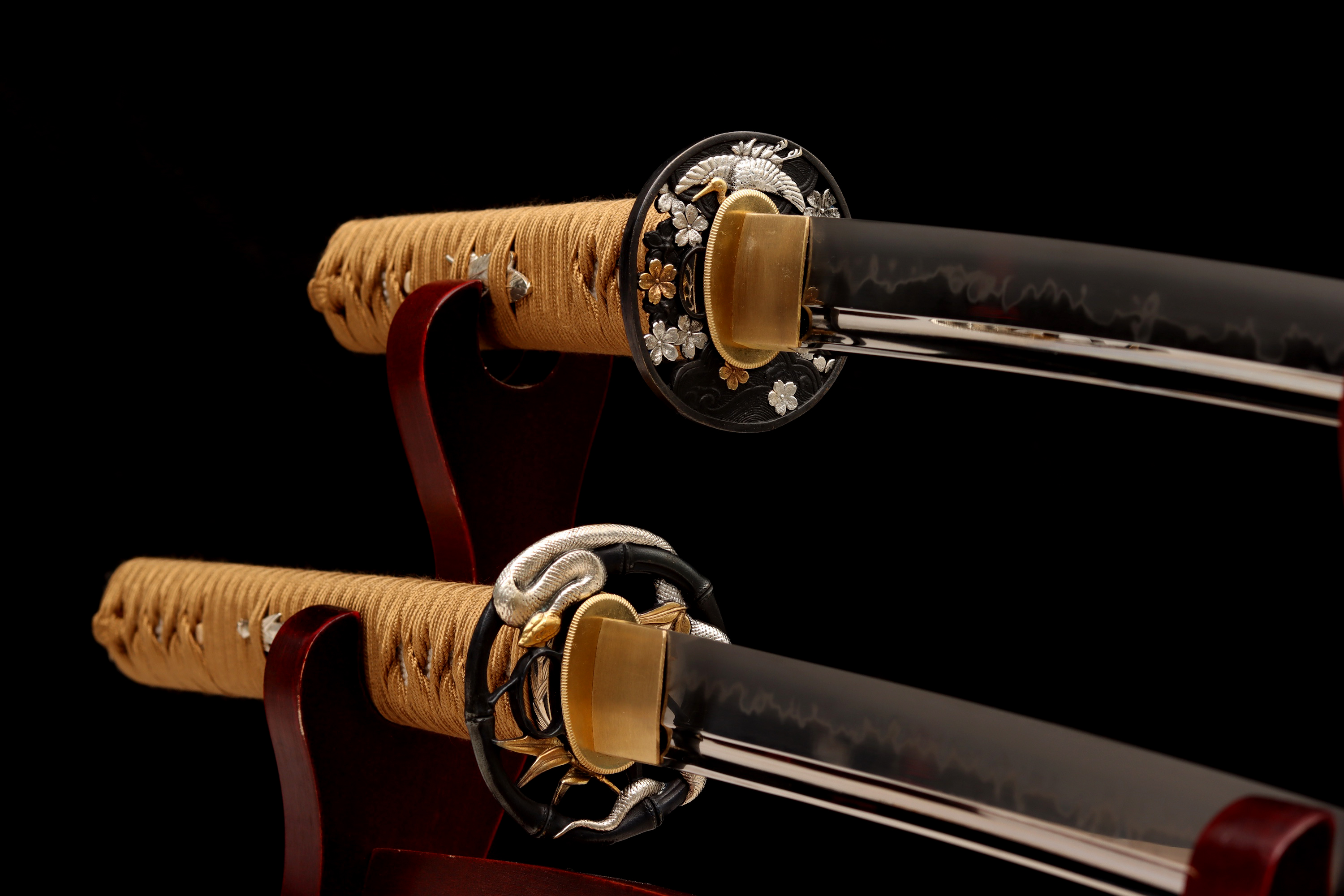
The tsuba is the sword guard installed near the base of the blade, directly in front of the tsuka, or handle.
On a conventionally mounted katana, the tsuba is positioned between the handle fittings and the habaki, with seppa washers commonly used as part of the assembly.
The guard performs several important roles.
Hand Protection
The tsuba helps provide a barrier between the hand and the blade or other external contact.
Its protective effectiveness depends on its dimensions, material, construction, and the specific circumstances of use.
Hand Position and Retention
The guard provides a physical boundary at the forward end of the handle and can help reduce the risk of the hand moving toward the cutting edge.
It is not a substitute for correct grip, safe handling, or sound sword construction.
Weight and Balance
The tsuba contributes to the total mass and distribution of weight around the handle.
Changing from a small, lightweight guard to a large, heavy one may influence the sword's handling and balance.
Artistic and Cultural Expression
Historically, tsuba developed into an important form of Japanese metalwork. Designs ranged from restrained iron guards to elaborate examples incorporating carving, openwork, inlay, and contrasting metals.
Today, these traditions inspire both historical reproductions and modern custom Japanese-style swords.
2. How to Choose a Katana Tsuba: The Main Factors
The most useful way to choose a tsuba is to evaluate material, shape, size, design, compatibility, and intended use together.
| Factor | What to Consider |
|---|---|
| Material | Iron, brass, alloy, and their quality of manufacture |
| Shape | Round, mokko, angular, or irregular outlines |
| Dimensions | Diameter, thickness, weight, and hand clearance |
| Design | Historical motifs, symbolism, and personal preference |
| Compatibility | Nakago opening, seppa fit, and complete mounting assembly |
| Intended Use | Display, collecting, or appropriate supervised sword practice |
| Budget | Material, finishing, complexity, and upgrade cost |
For most buyers, a balanced combination of proper construction and a design that complements the complete sword is preferable to selecting a guard based solely on appearance.
3. Katana Tsuba Materials: Alloy vs Iron vs Brass
Different tsuba materials create different visual effects and can influence the guard's weight, durability, and cost.
Alloy Tsuba: Versatile and Affordable
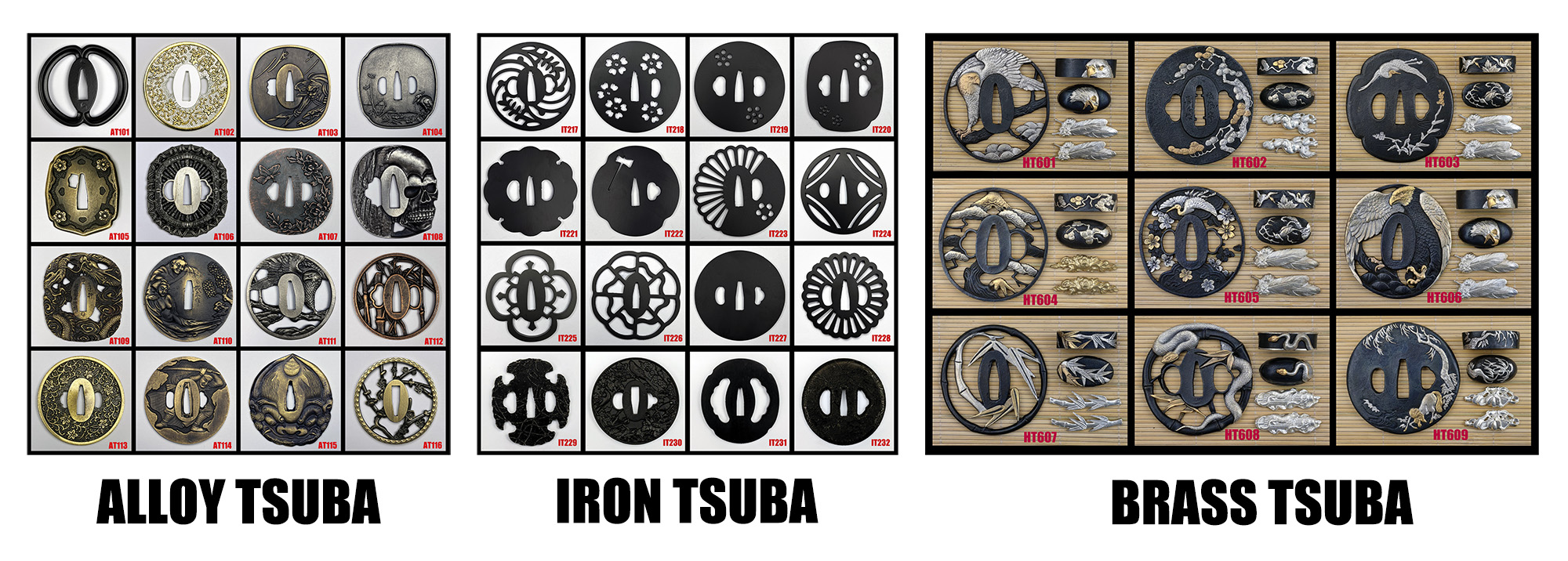
Alloy tsuba are common on modern production and custom Japanese-style swords because they can be manufactured in many different shapes and decorative patterns.
Many alloy designs are relatively affordable and provide a convenient way to personalize a sword.
However, the term "alloy" covers different metal compositions. Strength and durability depend on the specific material, casting or manufacturing method, and finished construction.
Best for: Decorative customization, affordable designs, and customers seeking a broad selection of themes.
Iron Tsuba: Traditional Character
Iron tsuba are strongly associated with historical Japanese sword fittings.
Their appearance can range from minimalist and understated to elaborate openwork and carved designs.
Popular styles include round iron guards, mokko shapes, and Musashi-inspired openwork designs.
Because iron can corrode, suitable surface finishing and maintenance are important.
Best for: Traditional-inspired katana, restrained aesthetics, and customers who appreciate iron sword fittings.
Brass Tsuba: Decorative Detail and Contrast
Brass is commonly used for decorative sword fittings because it can be cast, shaped, and finished with intricate designs.
A brass tsuba can create an elegant appearance, particularly when paired with matching fuchi, kashira, and menuki.
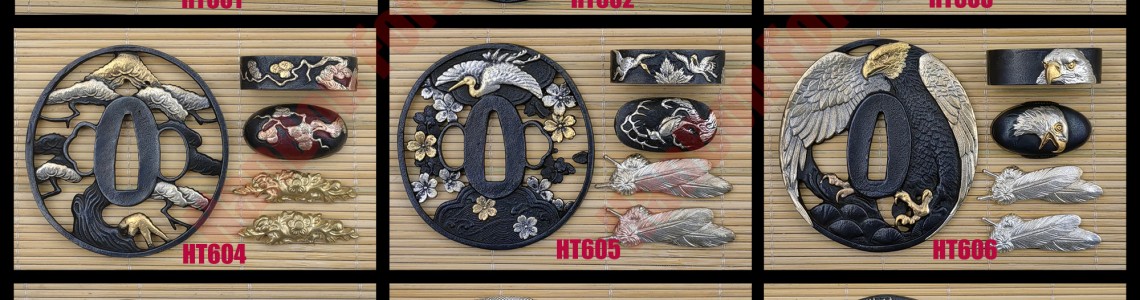
HanBon Forge offers brass fitting themes such as dragons, wolves, cherry blossoms, waves, cranes, and other traditional-inspired subjects.
Some brass guards are relatively heavy, although actual weight depends on the particular design and dimensions.
Best for: Decorative custom katana, coordinated fitting sets, and collectors who appreciate detailed metalwork.
| Material | Main Appeal | Considerations |
|---|---|---|
| Alloy | Many designs, often affordable | Properties vary with composition and quality |
| Iron | Traditional appearance, restrained styling | Corrosion protection and finishing matter |
| Brass | Detailed decorative themes, warm metal tones | Weight, surface finish, and fit vary |
4. Tsuba Designs and Their Symbolic Meanings
Japanese tsuba designs often draw inspiration from mythology, nature, animals, history, and artistic traditions.
However, a decorative motif does not always have one fixed meaning. Its interpretation can depend on the artistic tradition, historical period, and individual design.
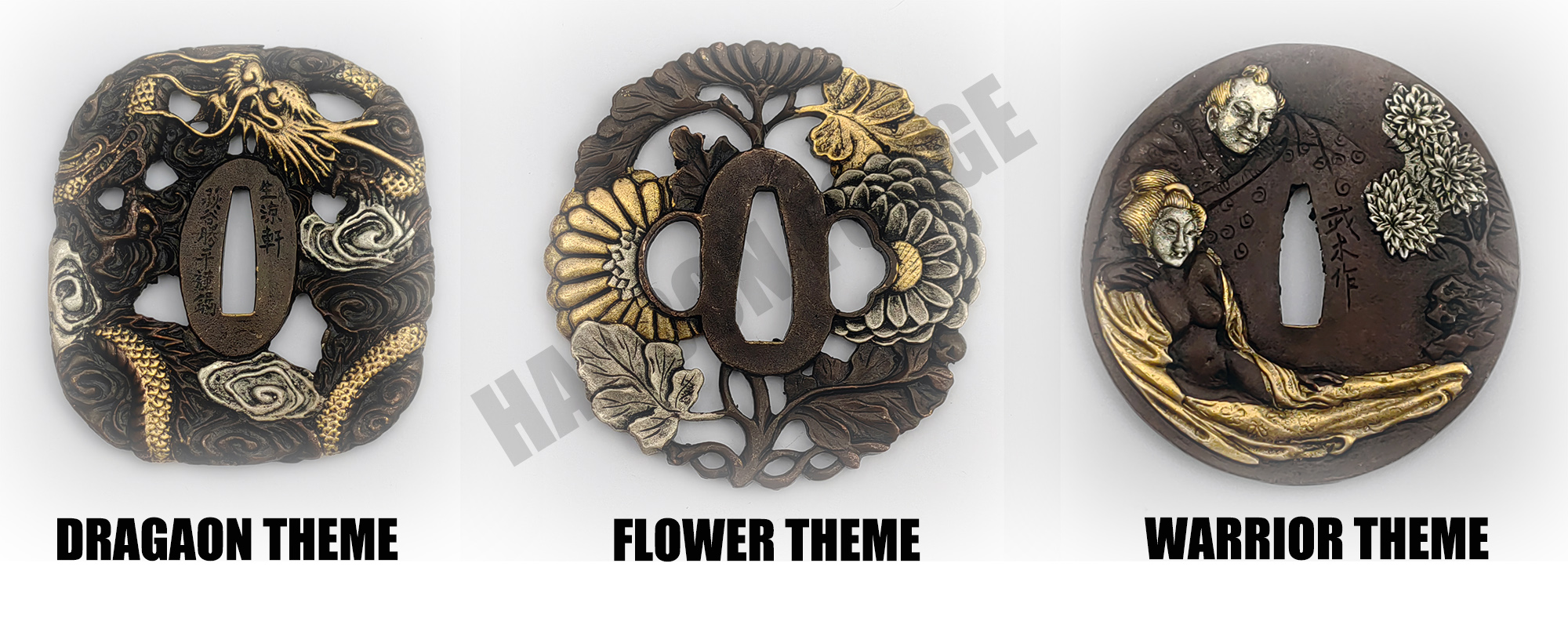
Dragon Tsuba
Dragons are prominent figures in East Asian art and mythology. Depending on context, they may be associated with water, strength, protection, power, or auspicious qualities.
Dragon designs are popular choices for decorative custom katana and matching fitting sets.
Cherry Blossom Tsuba
Cherry blossoms are widely associated with spring, beauty, and the fleeting nature of life in Japanese cultural traditions.
A cherry blossom tsuba can create a refined and understated sword design when paired with complementary fittings.
Wave Tsuba
Wave motifs are common in Japanese decorative art and can evoke water, movement, energy, or natural forces.
They work especially well with blue, black, or natural-colored sword mountings.
Animal Motifs
Wolves, tigers, cranes, eagles, and other animals are used in decorative sword fittings.
These motifs can reflect personal taste, artistic inspiration, or symbolic associations that vary by context.
Warriors and Historical Subjects
Some sword guards depict historical figures, legendary warriors, deities, or scenes inspired by Japanese literature and history.
For historically focused reproductions, it is worth checking whether the chosen motif is appropriate to the intended period and mounting style.
Minimalist and Geometric Patterns
Simple circular, openwork, or geometric designs can produce a restrained appearance while highlighting the sword's blade and handle.
These are good options for customers who prefer a traditional-inspired aesthetic without extensive decoration.
5. Katana Tsuba Shapes: Round, Mokko, Square and More
Beyond material and decoration, the outline of the guard contributes strongly to the overall appearance of a Japanese sword.
Maru-Gata: Round Tsuba
Round tsuba are among the most recognizable shapes and work with a broad variety of katana mounting styles.
Mokko-Gata: Lobed Tsuba
Mokko-gata tsuba have a lobed outline, often resembling a four-lobed or floral form.
They are frequently seen in traditional-inspired Japanese sword designs.
Kaku-Gata: Angular Tsuba
Angular guards can create a distinctive visual contrast with the curved blade and rounded handle contours.
Openwork and Musashi-Inspired Designs
Some tsuba feature large openings or a distinctive openwork structure.
Musashi-inspired styles are particularly popular on modern Japanese-style swords, though not every guard marketed using that name represents a documented historical example.
6. How Tsuba Size and Weight Affect a Katana
Tsuba dimensions influence the visual proportions and handling characteristics of a Japanese sword.
A large, thick guard may add noticeable weight near the handle, while a lightweight openwork design may have less influence on the overall mass distribution.
However, the exact effect depends on the entire sword, including blade length, blade thickness, distal taper, handle dimensions, and other fittings.
Does a Heavier Tsuba Improve Balance?
Not automatically. Adding weight close to the handle can change the perceived balance, but an excessively heavy guard is not necessarily beneficial.
Is a Larger Tsuba Safer?
A larger guard may provide more hand coverage, but protection also depends on material, construction, attachment, and handling conditions.
What About Martial Arts Practice?
For martial arts training, follow the requirements of your instructor and discipline. The appropriate tsuba may differ depending on the sword and its intended use.
7. Matching the Tsuba with Other Japanese Sword Fittings
A tsuba should be considered as part of the sword's complete koshirae, not as an isolated decorative component.
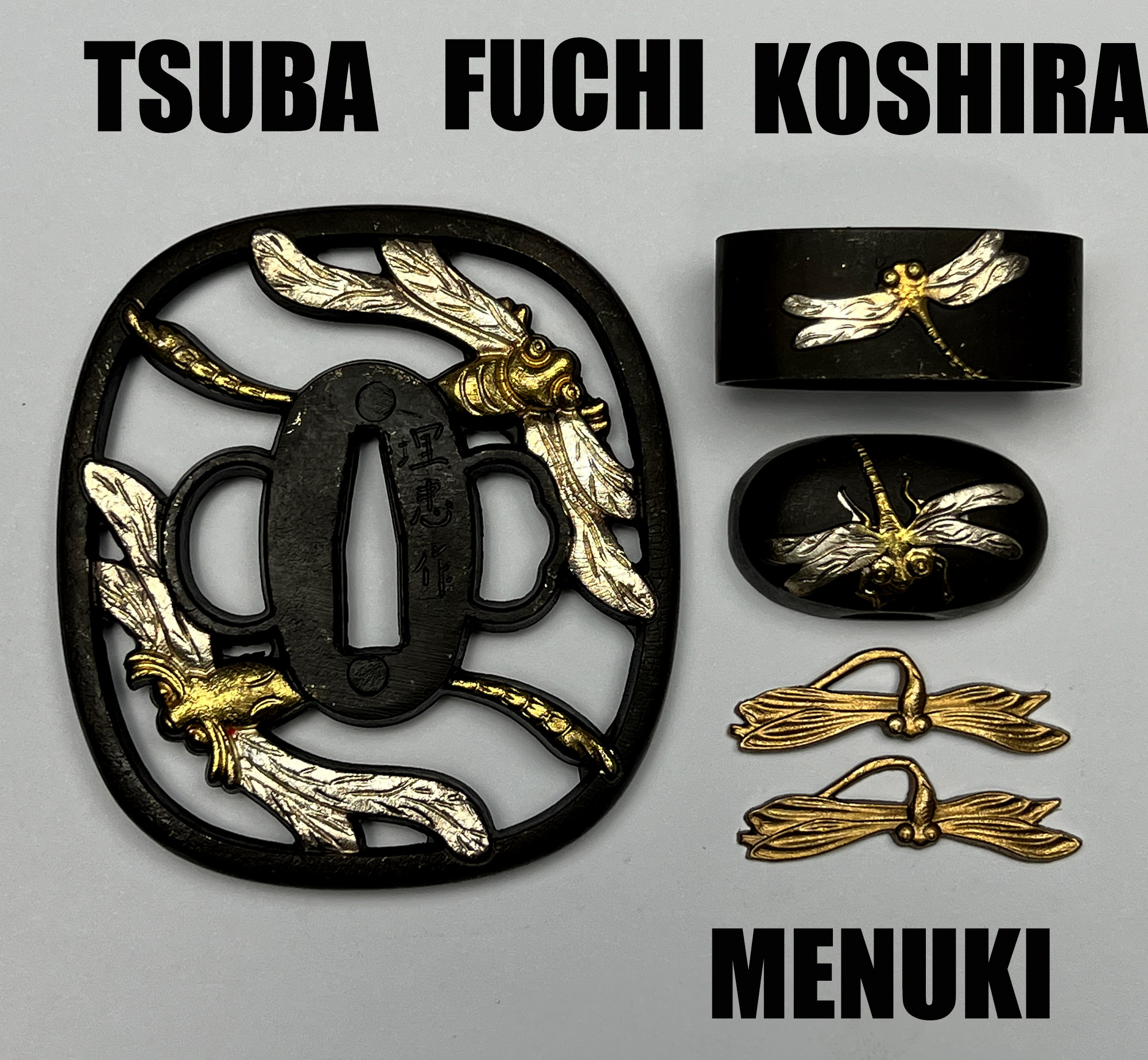
Fuchi and Kashira
The fuchi is the metal collar near the guard, while the kashira is the end fitting of the handle.
Matching materials or decorative motifs can create a coordinated look.
Menuki
Menuki are decorative ornaments associated with the sword handle and typically positioned beneath or among the wrapping.
They can complement the motif or material of the guard.
Tsuka-Ito and Samegawa
Handle wrapping color and rayskin selection influence how the metal fittings appear as a complete set.
For example, black silk wrapping with dark iron fittings creates a different impression from brown leather wrapping with gold-colored brass details.
Saya and Sageo
The saya and sageo are also important parts of the overall visual composition.
A consistent color palette often produces a more coherent sword than combining too many unrelated decorative elements.
Learn more in our Katana Saya Selection Guide.
8. How to Check Whether a Tsuba Fits Your Katana
One of the most important considerations in selecting a tsuba is compatibility with the sword's existing construction.
Nakago-Ana: The Tang Opening
The central opening in a Japanese tsuba is called the nakago-ana.
Its shape and dimensions must accommodate the blade tang appropriately.
Seppa and Assembly Thickness
The tsuba is normally installed as part of an assembly containing seppa washers and other fitted components.
Changing the thickness of the guard may affect the fit of the complete mounting.
Avoid Assuming Universal Compatibility
Japanese swords do not all have identical tang geometry or fitting dimensions.
A tsuba that fits one katana may require specialist fitting work for another.
9. Choosing Your Tsuba at HanBon Forge
HanBon Forge offers a broad selection of Japanese-style sword guards, including alloy, iron, and brass options for compatible custom katana.
Our selection includes traditional-inspired round and mokko guards, Musashi-style iron designs, and decorative brass sets featuring dragons, wolves, birds, flowers, and other themes.
How to Select Your Tsuba
- Choose Your Sword: Select the desired blade and main specifications.
- Review Tsuba Options: Compare materials, shapes, design codes, and available images.
- Coordinate the Fittings: Select compatible fuchi, kashira, menuki, handle wrapping, and saya details.
- Confirm Your Order: Review any upgrade costs or unusual requests before completing your purchase.
Material and Design Availability
Many alloy tsuba are included among our standard configuration choices, while selected iron, brass, and specialized fitting options may involve additional charges.
We periodically update our sword fitting selection and pricing. Customers should refer to current product options or contact our team to confirm availability and upgrade costs.
Workshop and Quality Considerations
When assembling a custom katana, the tsuba should be assessed alongside the habaki, seppa, handle, and other fitting components.
We also review visible fitting alignment and the requested decorative configuration before shipment.
For custom orders, HanBon Forge provides finished-sword photographs for customer approval before shipment, allowing customers to review visible design details.
Explore the HanBon Forge Tsuba Collection, or use our Custom Katana Builder to choose compatible sword fittings.
10. How to Care for a Katana Tsuba
Proper maintenance helps preserve the finish and appearance of your sword fittings.
Iron Tsuba
Keep iron fittings dry and avoid unnecessary handling with moist hands. Periodically inspect for active corrosion.
Some finishes or traditional patinas require specialized care, so do not automatically polish, oil, or chemically clean every iron guard.
Brass Tsuba
Brass can develop surface patina over time. Avoid aggressive polishing or chemical cleaners that may remove decorative finishes or damage contrasting metal details.
Alloy Tsuba
Use a soft, dry cloth for ordinary cleaning, taking care not to damage coatings, plated surfaces, or decorative details.
Inspect the Fit
If the tsuba begins to move, rattle, or feel insecure, stop using the sword until the mounting is inspected.
Avoid improvised modifications that could damage the tang, guard, or other assembly components.
For broader guidance, visit our Katana Maintenance Guide.
11. Common Misconceptions About Katana Tsuba
Click a question to expand the answer.
Frequently Asked Questions About Katana Tsuba
Answers to common questions about Japanese sword guards, materials, fit, and customization.
Final Thoughts: Choosing the Right Katana Tsuba
The katana tsuba is both a functional sword component and an important form of Japanese decorative metalwork.
Whether you prefer the understated appearance of an iron guard, the elaborate details of a brass fitting set, or an affordable alloy design, your choice should reflect the complete sword.
Material, shape, size, weight, fitting security, and decorative harmony all contribute to a successful design.
For a custom Japanese sword, selecting the tsuba together with the handle and other fittings is often the most practical approach.
At HanBon Forge, we encourage customers to combine personal preferences with appropriate construction and compatibility when creating their ideal katana.
Choose Your Katana Tsuba at HanBon Forge
Explore Japanese sword guards in different materials, shapes, and designs, or customize a handmade katana with matching fittings.
Explore Tsuba Collection Customize Your KatanaReferences & Further Reading
- The Metropolitan Museum of Art — Japanese Arms and Armor Collection. Historical examples of Japanese swords and decorative metalwork. Explore the Collection.
- Helen C. Gunsaulus — Japanese Sword-Mounts. An early reference on Japanese decorative sword fittings and their artistic traditions.
- Leon Kapp, Hiroko Kapp, and Yoshindo Yoshihara — The Craft of the Japanese Sword. A reference on Japanese sword construction and related craftsmanship.
- HanBon Forge — How to Choose the Right Katana Saya. Additional guidance on matching sword scabbards and other fittings. Read the Saya Guide.
- HanBon Forge — The Ultimate Guide to Choosing Your First Katana. Practical advice for selecting a blade and matching sword components. Read the Beginner Guide.
Editorial Note: Historical Japanese sword fittings vary by period, workshop, and intended use. Modern designs may be historically inspired without representing exact reproductions.
About This Guide & Editorial Experience
Prepared by: HanBon Forge Team
Topic: Katana Tsuba, Japanese Sword Fittings, Decorative Metalwork, and Customization.
Practical Experience: Selecting, coordinating, fitting, and inspecting sword guards as part of modern custom Japanese-style sword production.
HanBon Forge offers handmade and custom Japanese-style swords, including katana, wakizashi, tanto, and traditional-inspired designs.
Our team works with alloy, iron, and brass fittings, coordinated handle components, and custom mounting requirements.
For custom orders, completed swords are photographed for customer review before shipment.
Last Reviewed: October 2026
Related Products