
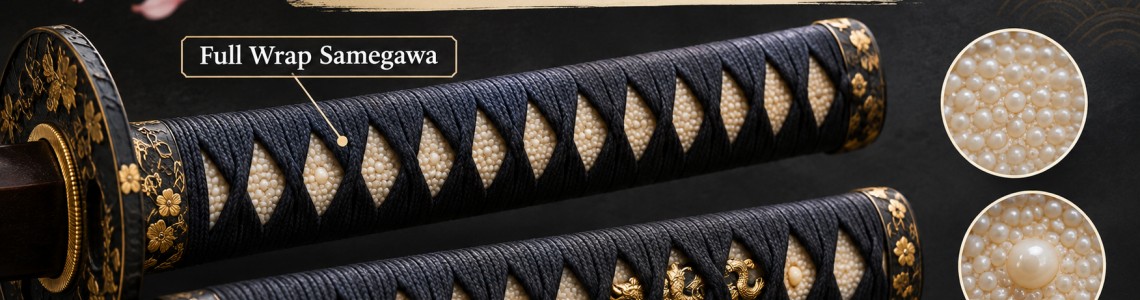
Full wrap and panel samegawa are two common methods of covering a Japanese katana handle with rayskin. While both can provide a traditional appearance, they differ in material coverage, craftsmanship, construction, and cost. Understanding these differences can help collectors better appreciate Japanese sword handle craftsmanship.
When choosing a Japanese-style sword, many collectors focus on blade steel, hamon patterns, blade geometry, and decorative fittings. However, the construction of the handle, known as the tsuka (柄), is another important aspect of Japanese sword craftsmanship.
One of the most distinctive materials used in traditional Japanese sword handles is samegawa (鮫皮), commonly known as rayskin or stingray skin.
In this guide, HanBon Forge explores the differences between full wrap and panel samegawa, their historical characteristics, material requirements, appearance, and overall craftsmanship.
Quick Answer: What Is the Difference Between Full Wrap and Panel Samegawa?
Full wrap samegawa surrounds the circumference of the wooden katana handle core, while panel samegawa covers selected areas on its sides. Full wrap construction generally requires more natural rayskin and additional craftsmanship, resulting in a higher cost. However, both methods can produce a similar finished appearance, and rayskin coverage alone does not determine overall sword quality.
1. What Is Samegawa on a Japanese Katana?
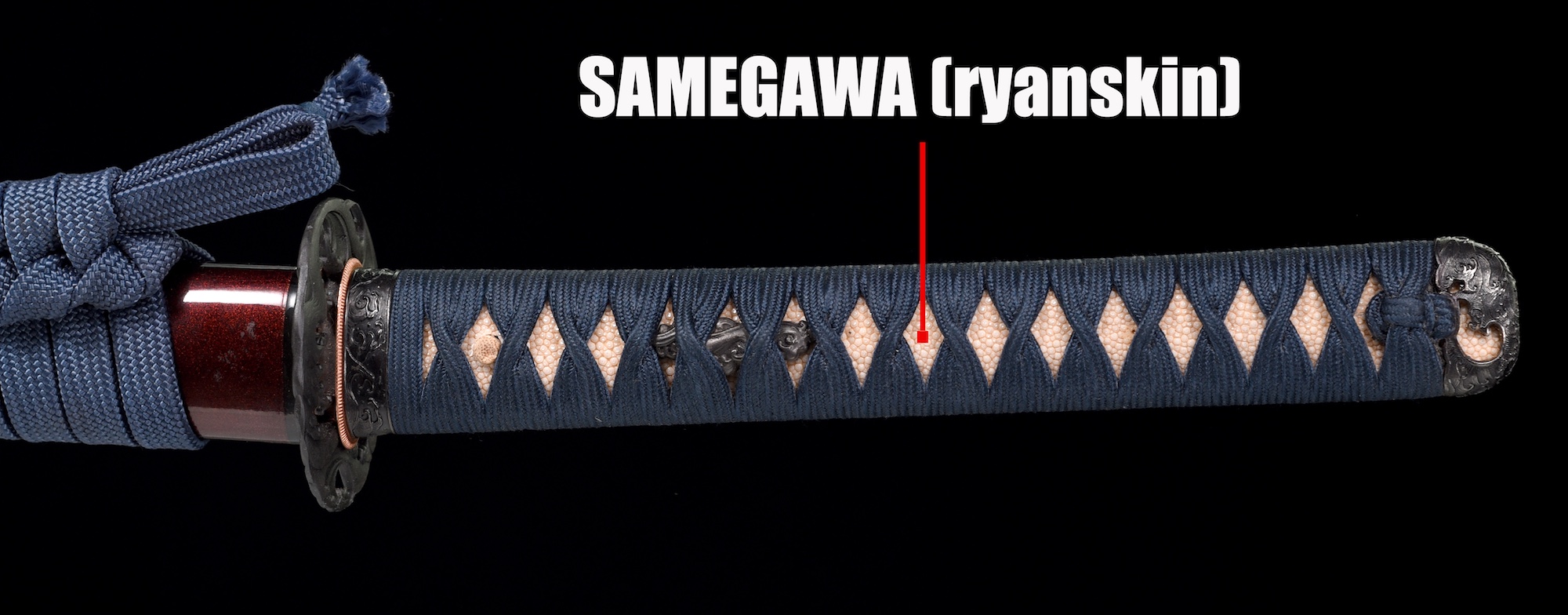
Samegawa is the traditional textured skin used in Japanese sword mountings. Although the Japanese term historically refers to shark or ray skin, stingray skin is commonly associated with Japanese sword handles.
Genuine samegawa is recognized by its distinctive surface, consisting of numerous hard, rounded, naturally occurring nodules. These nodules create the pearl-like texture frequently seen through the diamond-shaped openings of traditional handle wrapping.
Samegawa contributes to several aspects of Japanese sword mounting, including traditional aesthetics, material texture, decorative contrast, and the overall character of the tsuka.
Samegawa, Tsuka-Ito, and Tsuka: What Is the Difference?
- Samegawa: The textured material covering selected areas or the circumference of the wooden handle core.
- Tsuka-Ito: The outer handle wrapping, commonly made from silk, cotton, leather, or other materials.
- Tsuka: The complete Japanese sword handle assembly.
Natural white samegawa is one of the most recognizable choices for traditional Japanese sword mountings. Black and other colored rayskin finishes are also found on contemporary Japanese-style swords.
Importantly, the terms full wrap and panel describe the coverage of the material rather than whether the rayskin is genuine or synthetic.
Related reading: Making a Tsuka: How Traditional Katana Handles Are Crafted.
2. What Is Panel Samegawa?
Panel samegawa is a type of handle covering in which individual sections of rayskin occupy selected areas on the sides of the wooden tsuka core.
These areas generally correspond to the visible openings of the finished handle wrapping. Other portions of the wooden core remain concealed beneath the outer mounting.
A historically documented form of partial rayskin coverage is known as Tanzaku, sometimes described as strip-style or panel-style samegawa coverage.

Characteristics of Panel Samegawa
- Partial coverage of the wooden handle core.
- Lower natural-material consumption.
- Traditional textured appearance beneath the handle wrapping.
- Available in different colors and surface textures.
- Generally more economical than full wrap construction.
Panel samegawa is widely encountered on contemporary Japanese-style swords. It provides the recognizable appearance of traditional rayskin without requiring complete circumference coverage.
Panel construction should not automatically be regarded as imitation rayskin or inferior craftsmanship. Genuine natural rayskin can be used in both panel and full wrap configurations.
3. What Is Full Wrap Samegawa?
Full wrap samegawa refers to a covering that surrounds the circumference of the wooden tsuka core rather than occupying only selected areas on its sides.
A traditional form of full circumference coverage is known as Maru-gise. This is one of several documented samegawa covering styles associated with historical Japanese sword mountings.

Characteristics of Full Wrap Samegawa
- More extensive natural rayskin coverage.
- Greater material requirements.
- Additional preparation and craftsmanship.
- Association with traditional Japanese mounting styles.
- Generally higher material and labor costs.
Much of the additional rayskin becomes concealed once the tsuka-ito wrapping is completed. Consequently, the appeal of full wrap samegawa often lies in the underlying craftsmanship rather than an immediately noticeable external difference.
Full circumference coverage is one of several historical approaches to Japanese sword handle construction. Traditional Japanese mountings were not limited to a single universal samegawa configuration.
Related reading: Several Styles of Ray Skin (Samegawa) Wrapping on Handle.
4. Full Wrap vs. Panel Samegawa: Comparison Table
The following table summarizes the principal differences between these two types of Japanese sword handle covering.
| Feature | Panel Samegawa | Full Wrap Samegawa |
|---|---|---|
| Material Coverage | Selected areas on the sides | Surrounds the circumference |
| Natural Material Usage | Lower | Higher |
| Craftsmanship Requirements | Generally less extensive | Generally more extensive |
| Visible Texture | Traditional rayskin appearance | Traditional rayskin appearance |
| Historical Character | Partial covering styles | Full circumference covering styles |
| Material Authenticity | Can use genuine rayskin | Can use genuine rayskin |
| Typical Cost | Generally lower | Generally higher |
| Finished Appearance | May look similar to full wrap | May look similar to panels |
| Overall Quality | Depends on complete workmanship | Depends on complete workmanship |
Key takeaway: The defining difference between full wrap and panel samegawa is the extent of material coverage beneath the handle wrapping, not necessarily the visible appearance of the completed sword.
5. Can You See the Difference on a Finished Katana?
One of the most common misconceptions about full wrap samegawa is that it always creates a noticeably different external appearance.
In reality, much of the rayskin is hidden underneath the outer handle wrapping. Two completed handles with different samegawa constructions may therefore look remarkably similar.

The visible appearance of a finished tsuka is influenced by several factors:
- The size and distribution of natural rayskin nodules.
- The color of the samegawa.
- The color and texture of the tsuka-ito.
- The symmetry of the wrapping pattern.
- The decorative menuki and other fittings.
- The overall proportions of the handle.
Photographs of a completed sword may not provide enough information to distinguish full wrap construction from panel construction.
Documentation from the maker or photographs taken before the outer wrapping is completed can provide clearer evidence of the underlying samegawa coverage.
6. Is Full Wrap Samegawa Always Better?
Full wrap samegawa is frequently regarded as a premium feature because it involves more extensive natural-material coverage and additional craftsmanship.
However, it is only one element of the complete Japanese sword mounting.
A traditional tsuka consists of multiple components, including the wooden core, samegawa, tsuka-ito, mekugi, fuchi, kashira, and decorative menuki.
The quality of a completed mounting cannot be determined by the amount of rayskin alone. A carefully finished panel samegawa handle may have a more refined appearance than a poorly executed full wrap handle.
Although full wrap construction uses more material, material coverage alone does not establish a measurable improvement in durability or guarantee the safety of a sword.
Historical character, decorative appearance, material authenticity, and overall workmanship should therefore be considered separately when evaluating Japanese sword craftsmanship.
7. Understanding Genuine Rayskin and the Emperor Node
Genuine rayskin is a natural material, meaning that every individual piece has its own surface characteristics.
Some sections feature small, relatively uniform nodules, while others contain larger and more prominent formations.
One of the best-known decorative features of natural samegawa is the Emperor Node, also referred to as the King Pearl or oyatsubu.
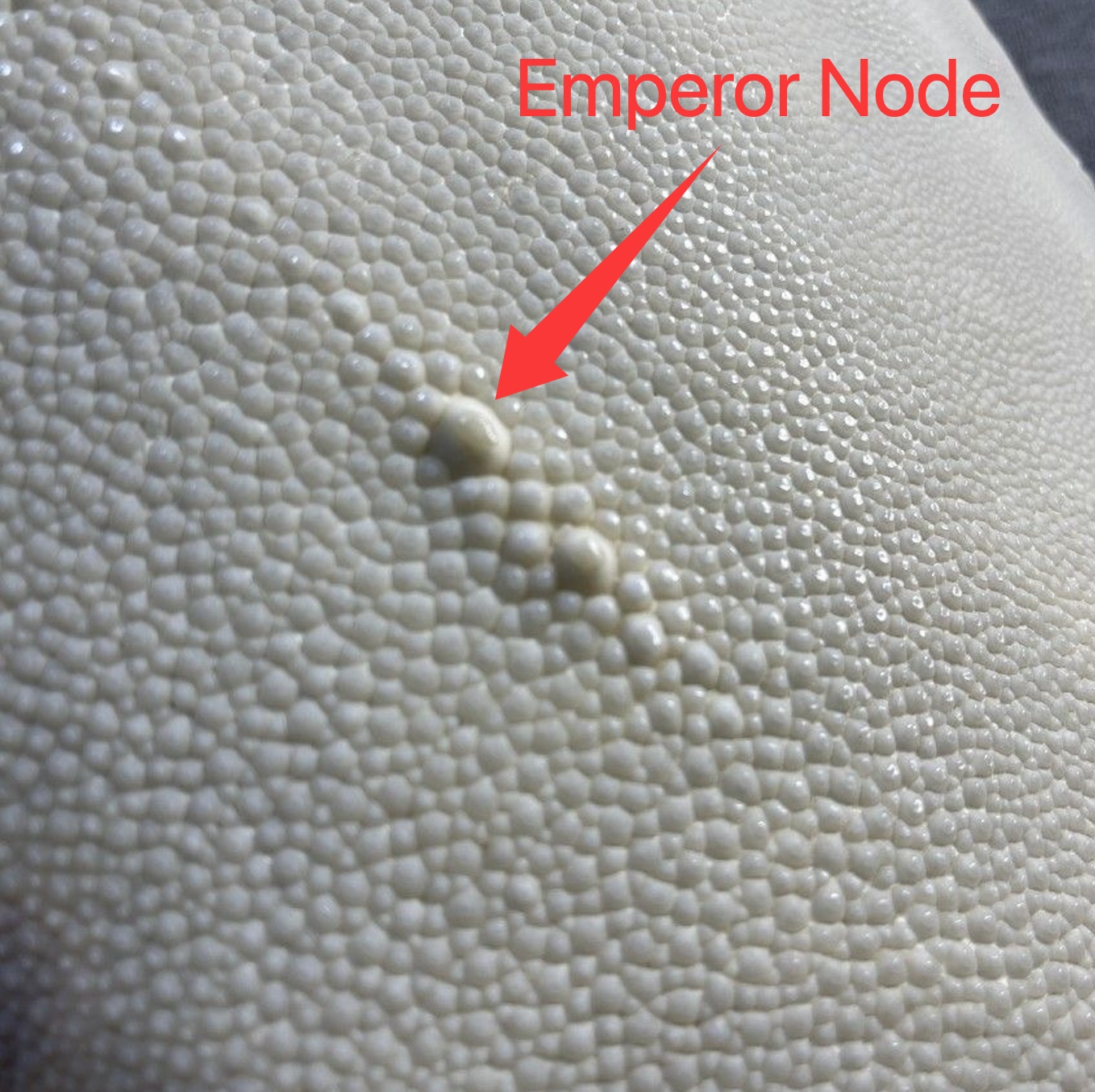
Large nodules are appreciated for their distinctive appearance and decorative character. They can add visual interest to traditional Japanese sword mountings.
However, the presence of a large node does not independently prove material authenticity, superior workmanship, or overall structural quality.
Natural Characteristics of Genuine Samegawa
- Different nodule sizes and shapes.
- Irregular surface patterns.
- Subtle differences in natural coloration.
- Variations in thickness and texture.
- Unique patterns between individual pieces of rayskin.
These characteristics contribute to the individuality of genuine samegawa and distinguish its natural appearance from many molded synthetic alternatives.
Related reading: How to Tell Genuine Ray Skin from Fake Samegawa on a Katana Handle.
8. Natural White vs. Black Samegawa
The color of samegawa has a significant influence on the overall artistic character of a Japanese sword mounting.
Natural White Samegawa
Natural white rayskin is one of the most recognizable materials associated with traditional Japanese sword handles. Its light surface creates a distinctive contrast with darker wrapping materials such as black, navy blue, brown, and dark green.
White samegawa also makes its naturally occurring surface nodules particularly easy to appreciate.
Black Samegawa
Black rayskin creates a darker and more understated appearance. It is commonly seen in monochromatic Japanese-style mountings and designs featuring dark metal fittings.
When combined with lighter wrapping materials, black samegawa can also provide a strong decorative contrast.
Color and material coverage are separate characteristics. Genuine rayskin can be colored black, and white samegawa is not necessarily genuine.
Material authenticity should be established through reliable product information and appropriate inspection rather than color alone.
9. Why Does Full Wrap Samegawa Cost More?
The price difference between panel samegawa and full wrap samegawa is primarily associated with natural-material consumption, material selection, and additional craftsmanship.
Additional Natural Material
Full circumference coverage requires a larger amount of rayskin than separate side panels. Natural variations in skin size, texture, and thickness also influence the amount of suitable material available.
Material Selection
Genuine rayskin varies naturally between individual pieces. Larger sections with attractive textures and suitable dimensions may require more selective material sourcing.
Additional Craftsmanship
More extensive material coverage generally involves additional preparation and workmanship compared with conventional side panels.
Traditional Craftsmanship Value
For collectors who appreciate traditional Japanese mounting details, the additional cost may represent an appreciation of underlying construction and natural materials, even when these features are largely concealed on a finished sword.
10. Historical Samegawa Covering Styles
Japanese sword mountings have evolved across different historical periods, regional traditions, artistic preferences, and available materials.
Traditional samegawa coverage was not limited to a single configuration. Several historical terms describe different approaches to rayskin covering.
| Japanese Term | General Description |
|---|---|
| Tanzaku | Partial or strip-style rayskin coverage. |
| Maru-gise | Full circumference rayskin covering. |
| Maedare-gise | A traditional covering style incorporating overlapping material. |
These historical terms reflect the diversity of Japanese sword mounting traditions. Modern commercial descriptions such as panel samegawa and full wrap samegawa provide a simplified way of discussing material coverage.
They should not be interpreted as exact classifications of every historical Japanese sword mounting.
11. Common Misconceptions About Samegawa
Myth 1: Panel Samegawa Is Always Fake Rayskin
Incorrect. Panel samegawa describes the coverage of the material rather than its authenticity. Genuine rayskin can be used in both partial and full circumference coverings.
Myth 2: Full Wrap Samegawa Is Always Visible
Incorrect. Much of the additional material remains hidden underneath the outer wrapping, so completed handles may appear similar.
Myth 3: Black Samegawa Is Always Synthetic
Incorrect. Genuine natural rayskin can be colored black or finished in other colors.
Myth 4: Full Wrap Samegawa Guarantees Superior Sword Quality
Incorrect. The quality of a complete sword mounting depends on multiple materials, components, and aspects of workmanship.
Myth 5: Every Traditional Japanese Sword Used Full Wrap Samegawa
Incorrect. Historical Japanese sword mountings featured different covering styles according to their period, artistic character, and individual circumstances.
12. Samegawa and Japanese Sword Craftsmanship at HanBon Forge
At HanBon Forge, samegawa is an important part of the traditional-inspired appearance of our Japanese-style sword mountings.
Through our experience with handcrafted sword mountings and customer customization requests, we recognize that collectors have different preferences regarding rayskin texture, color, decorative character, and traditional construction details.
Every piece of genuine natural rayskin has its own surface characteristics. Differences in nodule size, texture, and coloration are normal features of natural materials.
Our approach to Japanese sword craftsmanship considers the handle, decorative fittings, blade finish, and saya as parts of a complete artistic design rather than evaluating any individual component in isolation.
Through our educational guides, we aim to help collectors understand the terminology, materials, historical traditions, and craftsmanship behind Japanese-style swords.
Frequently Asked Questions
What is the difference between full wrap and panel samegawa?
Full wrap samegawa surrounds the circumference of the wooden handle core, while panel samegawa covers selected areas on its sides. The primary differences involve material coverage, craftsmanship, and cost.
Is panel samegawa genuine rayskin?
It can be. The term panel describes how much of the handle is covered rather than whether the material is genuine or synthetic. Genuine natural rayskin can be used in both panel and full wrap configurations.
Is full wrap samegawa always better than panel samegawa?
Not necessarily. Full wrap samegawa provides more extensive material coverage, but overall quality depends on the workmanship, materials, and condition of the complete sword mounting.
Why is full wrap samegawa more expensive?
Full wrap construction generally requires more natural rayskin, additional material preparation, and more extensive craftsmanship. These factors contribute to its higher cost.
Can you see the difference between full wrap and panel samegawa on a finished katana?
Not always. Much of the rayskin is concealed beneath the tsuka-ito. Construction photographs and documentation from the maker can provide clearer information about the underlying coverage.
Is black samegawa genuine stingray skin?
Black samegawa can be genuine stingray skin that has been colored black. Color alone does not establish whether the material is natural or synthetic.
What is an Emperor Node on samegawa?
An Emperor Node, also known as oyatsubu, is a prominent natural nodule found on certain sections of genuine rayskin. It is appreciated primarily for its distinctive decorative appearance.
Are samegawa and tsuka-ito the same thing?
No. Samegawa is the textured material beneath the outer handle wrapping. Tsuka-ito is the cord or other wrapping material visible on the exterior of the handle.
Does every genuine samegawa handle look the same?
No. Genuine rayskin naturally varies in texture, nodule size, distribution, and coloration. Each piece has its own individual surface characteristics.
Does full wrap samegawa guarantee a safer sword?
No. Rayskin coverage alone cannot establish sword safety. The condition and workmanship of the complete sword must be considered, and damaged or loose components should be assessed by a qualified specialist.
Conclusion
Full wrap and panel samegawa represent two different approaches to Japanese-style sword handle construction.
Panel samegawa provides the familiar textured appearance of genuine rayskin while using less material. Full wrap samegawa offers more extensive coverage and reflects an additional investment in traditional mounting craftsmanship.
Both methods have their own characteristics, and neither should be used as the sole indicator of overall Japanese sword quality.
Understanding these differences allows collectors and Japanese sword enthusiasts to develop a deeper appreciation of the natural materials, historical traditions, and craftsmanship behind the Japanese sword handle.
Related Japanese Sword Guides
- Making a Tsuka: How Traditional Katana Handles Are Crafted
- How to Tell Genuine Ray Skin from Fake Samegawa on a Katana Handle
- Several Styles of Ray Skin (Samegawa) Wrapping on Handle
- Katana vs. Wakizashi vs. Tanto: Differences Between Japanese Swords Explained
- Explore More Japanese Sword Buyer Guides
References and Further Reading
- Japanese Sword Mounting: Traditional Samegawa Covering Styles.
- HanBon Forge educational resources on genuine rayskin, traditional-inspired sword mountings, and Japanese sword handle craftsmanship.
About This Guide & Editorial Experience
This guide was prepared by the HanBon Forge Editorial Team, drawing on our practical experience with Japanese-style sword manufacturing, traditional-inspired sword mountings, genuine rayskin materials, handle assembly, and customer customization inquiries.
Based in Longquan, China, a region known for its longstanding swordmaking heritage, HanBon Forge works with a variety of natural materials, wooden handle cores, traditional wrapping materials, and decorative Japanese-style sword fittings.
Our editorial approach combines practical manufacturing experience with research into Japanese sword terminology, historical mounting traditions, and material characteristics. We aim to distinguish historical Japanese swordmaking practices from modern manufacturing methods and commercial terminology.
We recognize that natural materials and handcrafted products vary between individual examples. Our educational content therefore avoids unsupported performance claims and emphasizes the importance of evaluating materials and craftsmanship in their proper context.
The purpose of this guide is to provide accurate, transparent, and accessible educational information for sword collectors, Japanese sword enthusiasts, and readers interested in traditional sword craftsmanship.
Written by: HanBon Forge Editorial Team
Editorial focus: Japanese Sword Craftsmanship, Materials, and Traditional Mountings
Published by: HanBon Forge
Published:
Category: Swords Buyer Guide