
Double Edged Sword vs Single Edged Sword: Key Differences Explained
Double Edged Sword vs Single Edged Sword: What Is the Difference?
One of the most basic differences between swords is the number of sharpened edges on the blade. Some swords have two cutting edges, while others are designed with only one sharp edge and an unsharpened spine.
This difference may seem simple, but it affects the shape of the blade, the way the sword is used, and the historical development of different sword traditions.
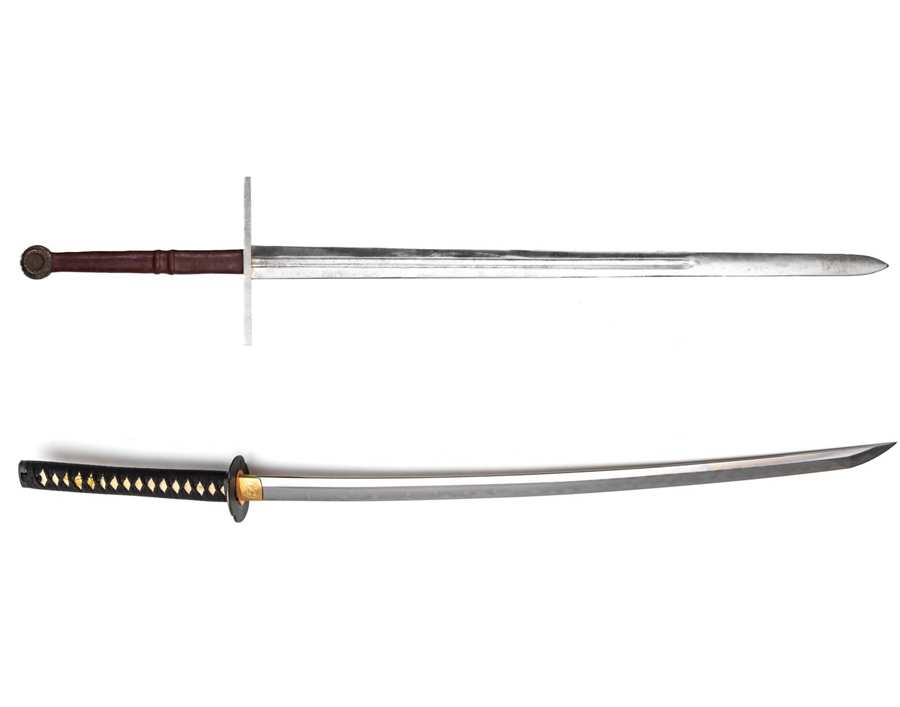
A double edged sword has two sharpened edges running along the blade. Many traditional European swords, including various medieval arming swords and longswords, used this design. A single edged sword, on the other hand, has one primary cutting edge and an unsharpened back, often called the spine.
The Japanese katana is one of the world's best-known single-edged swords. Its curved blade and single cutting edge were developed within a swordmaking tradition that placed great importance on cutting efficiency, blade geometry, and the practical needs of Japanese warriors.
So, which design is better? The answer depends on the purpose of the sword. A double edged sword and a single edged sword offer different advantages, and neither design is automatically superior in every situation.
What Is a Double Edged Sword?
A double edged sword has two sharpened edges. Both sides of the blade are designed to cut, allowing the sword to be used without relying on a single cutting edge.
Many straight European swords were double edged. Depending on the design, these weapons could combine cutting and thrusting capabilities. The exact performance of a double-edged blade depended on factors such as blade width, thickness, cross-section, weight, balance, and tip design.
A double edged blade does not necessarily mean that both edges are used equally in every movement. However, having two sharpened edges allows the blade to cut from either side without needing to reposition the weapon to bring a single cutting edge into alignment.
Double edged swords appeared in many parts of the world and were developed in a wide variety of forms, from relatively short straight swords to large two-handed weapons.
What Is a Single Edged Sword?
A single edged sword has one primary sharpened cutting edge. The opposite side of the blade is generally left unsharpened and forms the spine of the sword.
This design is common in many sword traditions. The Japanese katana is perhaps the most famous example, but single-edged swords also developed in Chinese, Middle Eastern, Southeast Asian, and other martial traditions.
A single-edged blade allows the swordsmith to concentrate the blade geometry around one primary cutting edge. The unsharpened spine can also contribute to the overall structure of the blade.
Single-edged swords may be straight or curved. The shape of the blade depends on the intended use and the historical development of the weapon.
Double Edged Sword vs Single Edged Sword: The Main Difference
The most obvious difference is simple: a double edged sword has two sharpened edges, while a single edged sword has one.
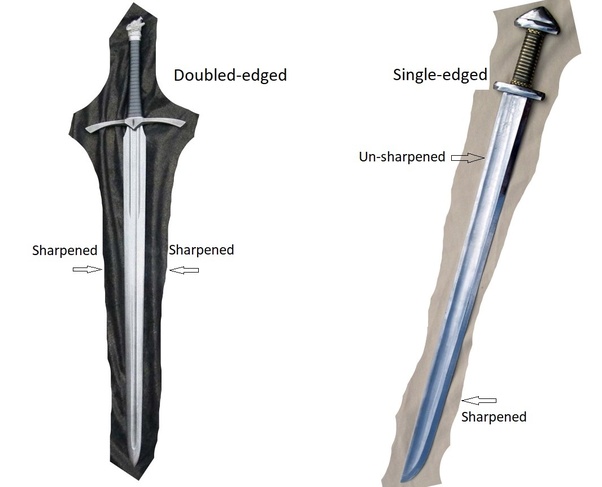
However, the difference goes beyond the number of cutting edges. Blade design affects how the swordmaker distributes material throughout the blade and how the weapon performs in cutting, slicing, thrusting, and defensive movements.
| Feature | Double Edged Sword | Single Edged Sword |
|---|---|---|
| Cutting Edges | Two sharpened edges | One primary sharpened edge |
| Blade Spine | Both sides are generally sharpened | One side remains unsharpened |
| Cutting Direction | Can cut with either edge | Designed around one primary cutting edge |
| Common Examples | European arming swords, longswords and many straight swords | Katana, dao and many sabers |
| Blade Design | Often designed to use both sides of the blade | Geometry focused around one cutting edge and a spine |
It is important to remember that these are general differences. Individual swords can vary greatly. A sword's performance depends on the complete design rather than on the number of sharpened edges alone.
Are Double Edged Swords Better for Cutting?
Not necessarily. Having two sharp edges does not automatically make a sword better at cutting.
The cutting ability of a sword depends heavily on blade geometry. Factors such as edge angle, blade thickness, cross-section, curvature, weight, and the quality of the edge all influence cutting performance.
A double edged sword offers the advantage of having a cutting edge on both sides of the blade. After completing one movement, the opposite edge may also be available for the next cutting motion without requiring the sword to be completely repositioned.
This can make alternating cutting actions possible from different directions.
However, a single edged blade can be designed with a highly effective primary cutting edge. Since the sword is built around one main edge, the blade geometry can be optimized for the cutting characteristics intended by the swordmaker.
For this reason, both double edged and single edged swords can be effective cutting weapons.
Why Are Single Edged Swords Often Curved?
Many famous single-edged swords feature curved blades. The katana, Chinese dao, and many types of saber are well-known examples.
A curved blade can influence how the edge moves through a target during a cutting motion. Instead of making contact with the target at only one point, the blade may produce a slicing action as the sword continues through the cut.
However, not all single edged swords are curved, and not all curved swords are designed in the same way. Blade curvature varies significantly depending on the sword tradition and intended use.
The katana, for example, has a characteristic curvature that developed within the Japanese swordmaking tradition. Other single-edged swords may have a much stronger curve, a very slight curve, or a completely straight blade.
The presence of one cutting edge does not automatically determine whether a sword will be curved. Blade shape is influenced by many historical and practical factors.
Are Double Edged Swords Better for Thrusting?
Another common assumption is that double edged swords are always better for thrusting. In reality, the number of sharpened edges is only one small part of blade design.
The effectiveness of a thrust depends more directly on factors such as:
- The shape and strength of the tip
- The alignment between the point and the handle
- The stiffness of the blade
- The overall blade geometry
- The distribution of weight
A well-designed single edged sword can be highly effective for thrusting. Likewise, not every double edged sword is designed primarily as a thrusting weapon.
The shape of the point is particularly important. A sword with a narrow and well-supported tip may be optimized differently from a blade with a broader point designed primarily for cutting.
For this reason, it is more accurate to evaluate the entire sword rather than simply asking whether it has one edge or two.
The Katana as a Single Edged Sword
The katana is one of the most recognizable examples of a single edged sword. Its curved blade, long handle, and distinctive Japanese construction have made it famous around the world.
A traditional katana has one primary sharpened edge called the ha. The opposite side of the blade is known as the mune, or back of the blade.
The katana was developed within a long tradition of Japanese swordmaking. Its design was influenced by changes in warfare, armor, fighting methods, and the evolution of earlier Japanese swords.
The katana is often associated with cutting, but it is not limited to cutting alone. The blade and point can also be used in thrusting techniques.
The effectiveness of the katana comes from the combination of its blade geometry, curvature, construction, balance, and intended method of use—not simply because it has one sharp edge.
Why Does a Katana Have Only One Sharp Edge?
The single-edged design of the katana is part of a broader Japanese swordmaking tradition.
With one primary cutting edge, the blade has a distinct edge and an unsharpened back. The overall blade geometry is designed around this structure.
The mune, or spine of the katana, is an important part of the blade's construction. Because it is not sharpened like the cutting edge, it can serve as the back of the blade during handling and certain defensive movements.
The single-edge design also clearly establishes the orientation of the blade. When the katana is handled, drawn, and returned to the saya, the position of the cutting edge remains an important part of traditional sword handling.
Rather than being a disadvantage, the single-edged design is one of the characteristics that defines the traditional Japanese sword.
Advantages of a Double Edged Sword
A double edged sword offers several potential advantages depending on its design.
- Two cutting edges: Both sides of the blade can be sharpened and used for cutting.
- Flexible edge orientation: The sword may cut from either side of the blade.
- Versatile blade design: Double edged blades can be designed for different combinations of cutting and thrusting.
- Wide historical use: Double edged swords were developed in many cultures and in many different forms.
The exact advantages depend on the individual sword. A narrow thrusting sword and a broad cutting sword may both have two edges but perform very differently.
Advantages of a Single Edged Sword
Single edged swords also offer important advantages.
- Focused cutting edge: The blade is built around one primary cutting edge.
- Strong blade spine: The unsharpened side forms the back of the blade.
- Variety of blade shapes: Single edged swords can be straight, slightly curved, or strongly curved.
- Efficient cutting designs: Many famous cutting swords, including the katana and dao, use a single edge.
A single edged sword should not be considered a simplified version of a double edged sword. It is a different approach to blade design that developed successfully across many swordmaking traditions.
Double Edge vs Single Edge: Which Sword Is Better?
There is no universal answer to this question.
A double edged sword may be better suited to a blade design that benefits from having two sharpened edges. A single edged sword may be designed around a strong primary cutting edge and a distinctive blade profile.
The historical purpose of the sword is also important. Swords were developed for different environments, fighting traditions, and military requirements.
For example, a straight double-edged sword and a curved single-edged katana were not created to solve exactly the same design problems. Comparing them requires an understanding of their individual construction and historical context.
The best sword design depends on what the weapon was intended to do.
When comparing swords, it is more useful to consider:
- Blade geometry
- Blade length
- Blade curvature
- Tip design
- Weight and balance
- Historical purpose
- Construction method
The number of sharpened edges is only one part of the overall design.
Double Edged Swords and Single Edged Swords in History
Both blade designs have a long history.
Double edged swords appeared in many ancient and medieval cultures. Straight double-edged blades became particularly well known through European sword traditions, although double-edged swords were also used in other parts of the world.
Single edged swords were equally important. The Japanese katana, Chinese dao, and numerous types of sabers demonstrate the wide variety of single-edge blade designs developed throughout history.
Different sword designs were shaped by local materials, forging traditions, military requirements, armor, and fighting methods.
For this reason, sword history is not a simple story of one blade type replacing another. Double edged and single edged swords often existed at the same time and continued to develop in different directions.
Choosing Between a Double Edged and Single Edged Sword
For modern collectors, sword enthusiasts, and martial arts students, choosing between a double edged sword and a single edged sword often depends on personal interest.
If you are interested in Japanese sword history and craftsmanship, a katana or other traditional Japanese single-edged blade may be the most appealing choice.
If you are interested in European sword history, a double edged sword may better represent the historical period or style you want to explore.
Collectors should also consider the quality of construction, materials, heat treatment, balance, fittings, and intended purpose of the sword.
A well-made sword should be evaluated as a complete object. The number of cutting edges alone does not determine overall quality.
Final Thoughts
The comparison between a double edged sword and a single edged sword is ultimately a comparison between two different approaches to blade design.
A double edged blade provides two sharpened edges and can be used from either side. A single edged blade concentrates its design around one primary cutting edge and an unsharpened spine.
Neither design is automatically better. Cutting ability, thrusting performance, durability, and handling depend on the complete construction of the sword.
The katana demonstrates how effective a single-edged sword can be, while the long history of double-edged swords shows the versatility of blades with two sharpened edges.
Understanding these differences helps collectors and sword enthusiasts appreciate why swords developed into so many different forms throughout history.
Frequently Asked Questions About Double Edged and Single Edged Swords
What is the difference between a double edged sword and a single edged sword?
A double edged sword has two sharpened cutting edges, while a single edged sword has one primary sharpened edge and an unsharpened spine on the opposite side of the blade.
Are double edged swords better than single edged swords?
Not necessarily. Each design has different advantages. The overall performance of a sword depends on blade geometry, tip design, weight, balance, construction, and intended use.
Is a katana single edged?
Yes. A traditional katana has one primary sharpened cutting edge called the ha. The opposite side is the mune, or back of the blade.
Can a single edged sword thrust?
Yes. A sword's thrusting ability depends mainly on the design of its point, blade stiffness, and alignment. A single edged sword can be highly effective for thrusting if it has the appropriate blade geometry.
Are double edged swords better for cutting?
Having two sharp edges does not automatically make a sword better at cutting. Cutting performance depends on factors such as edge geometry, blade thickness, curvature, weight, and the overall design of the sword.
Why does a katana have only one sharp edge?
The katana developed within the Japanese swordmaking tradition as a single-edged blade. Its construction combines one primary cutting edge with an unsharpened spine, creating the distinctive blade profile associated with traditional Japanese swords.
Are all European swords double edged?
No. Although many famous European swords were double edged, European sword traditions also included single-edged weapons and many different blade designs.
What are examples of single edged swords?
Examples include the Japanese katana, many Chinese dao, and numerous types of sabers. Single-edged swords exist in many cultures and historical periods.