
Clay Tempered vs. Through Hardened Katana: Differences & Guide
Clay Tempered vs. Through Hardened Katana: What's the Difference?
When choosing a Japanese katana, blade heat treatment is one of the most important factors to understand. Two common approaches are clay tempering, also known as clay-assisted differential hardening, and through hardening. Both methods are used to produce functional sword blades, but they create different hardness profiles and visual characteristics.
In this guide, we'll explain how clay-tempered and through-hardened katana blades are made, how they differ, and what to consider when choosing between them.
1. What Is a Clay Tempered Katana?
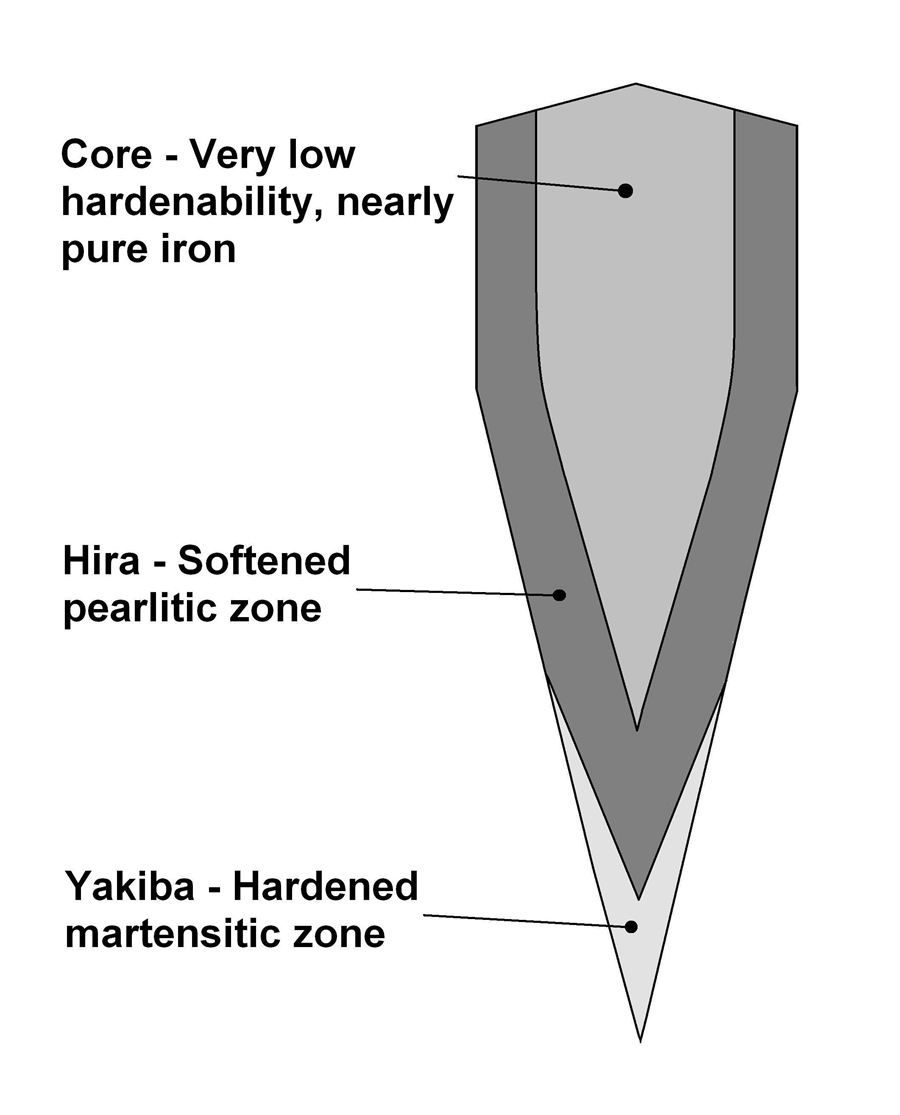
A clay-tempered katana is made using a traditional heat-treatment technique in which a layer of clay is applied to selected areas of the blade before heating and quenching. The clay coating helps control how quickly different parts of the blade cool.
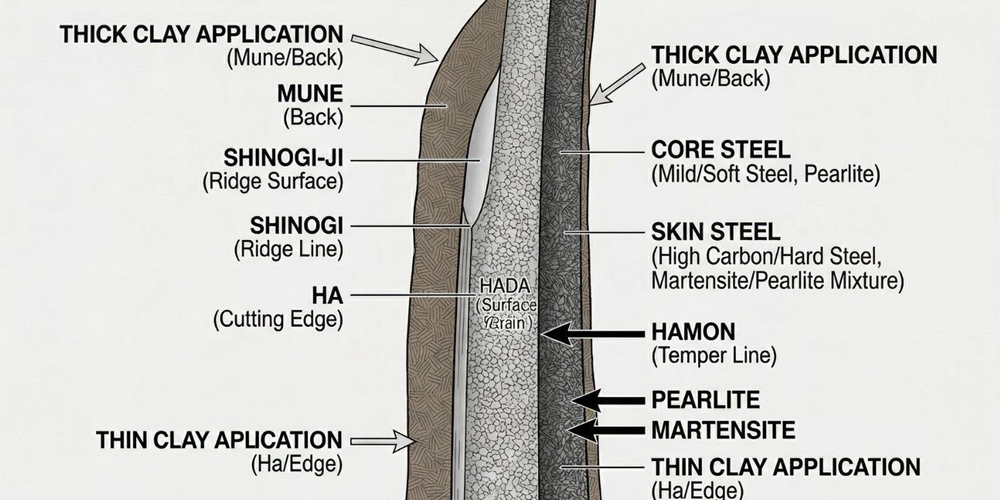
Typically, the cutting edge is left exposed or covered with a thinner layer of clay, allowing it to cool more rapidly. The spine and other areas receive a thicker coating, which slows their cooling. This creates different metallurgical structures and hardness levels within the same blade.
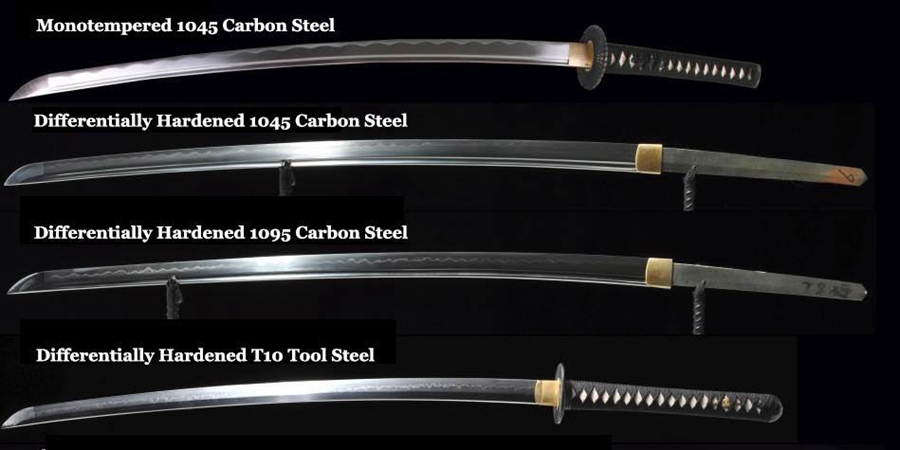
One of the most recognizable results is the hamon, the visible temper line that forms along the blade. Its appearance can vary depending on the clay application, steel, heating temperature, quenching process, and polishing.
2. What Is a Through Hardened Katana?
A through-hardened katana is heat-treated so that the blade develops a more uniform hardness throughout its cross-section. Unlike clay-assisted differential hardening, this process does not intentionally create a hard cutting edge and a significantly softer spine through selective clay insulation.
The blade is heated and quenched under controlled conditions to achieve the desired hardness. The final result depends on the steel composition, blade thickness, heating temperature, quenching medium, and heat-treatment procedure.
Through-hardened blades generally do not develop a traditional differential-hardening hamon. Any visible decorative line should not automatically be considered evidence of a genuine hamon produced by heat treatment.
3. Clay Tempering: How Does the Process Work?
The clay-tempering process involves several important stages:
Step 1: Preparing the blade
The blade is forged and shaped before the heat-treatment process. Its geometry and surface condition must be prepared for controlled heating and quenching.
Step 2: Applying the clay
A clay mixture is applied to selected areas of the blade. The thickness and pattern of the coating influence the cooling rate during quenching.
Step 3: Heating the blade
The blade is heated to a suitable temperature so that the steel can undergo the intended transformation during quenching.
Step 4: Quenching
The heated blade is rapidly cooled. Areas with less clay generally cool faster, while thicker clay-covered areas cool more slowly. This can produce a harder cutting edge and a tougher, less hard spine.
Step 5: Polishing
After heat treatment and any necessary finishing operations, polishing reveals the hamon and other blade details.
4. Key Differences Between Clay Tempered and Through Hardened Katana
The main difference is how hardness is distributed through the blade. Clay-assisted differential hardening creates distinct zones, while through hardening aims for a more uniform hardness profile.
| Feature | Clay Tempered | Through Hardened |
|---|---|---|
| Hardness profile | Differential hardness | More uniform hardness |
| Hamon | Can produce a genuine hamon | Typically no traditional differential-hardening hamon |
| Blade structure | Harder edge and relatively softer spine | More consistent hardness across the blade |
| Appearance | Often features a visible hamon | Usually a more uniform blade appearance |
| Manufacturing | Requires controlled clay application and differential cooling | Requires controlled and consistent heat treatment |
5. Advantages of a Clay Tempered Katana
Traditional appearance: A genuine hamon gives the blade a distinctive Japanese sword aesthetic. Patterns such as Suguha, Gunome, Choji, and Notare are popular among collectors.
Differential hardness: The process creates a harder cutting edge and a relatively softer spine, combining different mechanical characteristics in one blade.
Craftsmanship: Clay application, heating, quenching, and polishing require careful control. The final hamon reflects several aspects of the maker's process.
6. Advantages of a Through Hardened Katana
More uniform hardness: The blade is designed to have a more consistent hardness profile, rather than a deliberately differentiated edge and spine.
Practical construction: Through hardening is a common approach in modern sword manufacturing and can provide reliable performance when the steel and heat treatment are properly selected.
Simpler visual appearance: Buyers who prefer a clean blade without a prominent traditional hamon may appreciate this style.
7. Which Katana Should You Choose?
The right choice depends on your priorities, intended use, and personal preferences.
Choose a clay-tempered katana if you appreciate traditional Japanese sword aesthetics, genuine hamon patterns, and differential hardening. It can be an appealing option for collectors and enthusiasts who value the appearance and craftsmanship of traditionally inspired blades.
Choose a through-hardened katana if you prefer a more uniform hardness profile and a straightforward blade appearance. As with any sword, the quality of the steel, heat treatment, blade geometry, and overall construction matters more than the process name alone.
8. Final Thoughts
Clay-tempered and through-hardened katana blades are produced using different heat-treatment approaches. Clay-assisted differential hardening creates distinct hardness zones and can produce a genuine hamon, while through hardening aims for a more uniform hardness throughout the blade.
Neither method is automatically better in every situation. The best katana is one that combines suitable steel, proper heat treatment, sound construction, and craftsmanship that matches your expectations.
At HanBon Forge, we offer different katana styles and blade options for collectors and sword enthusiasts. Explore our selection to find a Japanese sword that suits your preferences.
Frequently Asked Questions
1. Is a clay-tempered katana stronger than a through-hardened katana?
Not necessarily. Each method creates a different hardness profile. Overall strength and durability also depend on steel quality, heat treatment, blade geometry, and workmanship.
2. Does every clay-tempered katana have a real hamon?
A properly executed clay-assisted differential hardening process can produce a genuine hamon. However, decorative or etched lines can imitate its appearance, so a visible line alone does not prove how a blade was heat-treated.
3. Can a through-hardened katana bend?
Yes. A through-hardened blade can still bend under excessive force. Its response depends on the steel, hardness, geometry, and heat treatment.
4. Which type is better for beginners?
Neither type is automatically better for beginners. Consider the sword's construction, intended purpose, maintenance requirements, and the maker's quality control before choosing.
5. Does a visible hamon mean the katana is sharper?
No. A hamon is a visible result of differential heat treatment, not a measurement of sharpness. Sharpness depends on the blade's edge geometry and finishing.