
Shapes of Katana Tang Tips (Nakago-jiri): A Complete Guide
/Shape_Tang_tip_2-1140x300w.jpg "Shapes of Katana Tang Tips (Nakago-jiri): A Complete Guide")
Shapes of Katana Tang Tips (Nakago-jiri): A Guide to Japanese Sword Tang Shapes
When studying a Japanese sword, collectors often focus on the blade, hamon, kissaki, or fittings. However, the nakago, or tang, is also an important part of a sword's identity. One detail that can provide useful information is the shape of the tang tip, known in Japanese as Nakago-jiri.
The different Katana tang tip shapes have long been used in Japanese sword terminology to describe the finishing shape of the end of the nakago. While the shape of the tang tip alone cannot identify the exact age, school, or maker of a sword, it is one of several characteristics examined when studying traditional Japanese swords.
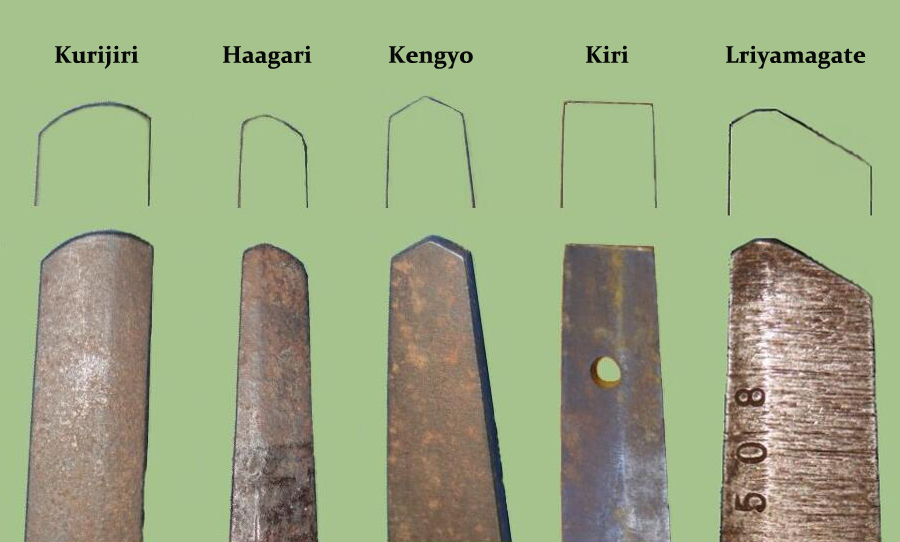
In this guide, we will look at the most common types of Nakago-jiri, including Kurijiri, Haagari, Kiri, Kengyo, and Iriyamagata, and explain how each shape is recognized.
What Is Nakago-jiri?
Nakago-jiri refers to the shape of the end of the nakago, the tang of a Japanese sword. The nakago is the portion of the blade that extends into the handle, or tsuka.
Unlike the polished portion of the blade, the tang of a traditional Japanese sword is generally left unpolished. It may contain important features such as the maker's signature, known as mei, file marks called yasurime, and one or more holes known as mekugi-ana.
The shape of the tang tip is another feature used when describing the overall form of the nakago. Japanese sword scholars examine multiple characteristics together when studying a blade, and Nakago-jiri is one part of this larger process.
There are several recognized Katana tang shapes. Some are rounded, while others are pointed, asymmetrical, or cut straight across.
Why Is the Shape of a Katana Tang Tip Important?
The Japanese sword tang contains valuable information about the construction and history of a sword. Although the tang tip shape should never be used as the only method of identification, it can contribute to a broader examination of the blade.
When evaluating a Japanese sword, collectors and researchers may consider several characteristics, including:
- The overall shape of the nakago
- The shape of the Nakago-jiri
- The yasurime, or file marks
- The placement and number of mekugi-ana
- The presence of a signature or mei
- Whether the tang has been shortened
For example, a sword that has been significantly shortened may have a tang that no longer retains its original shape. In many shortened Japanese swords, the tang tip may be finished with a relatively straight cut.
For this reason, the Nakago-jiri must always be examined together with the rest of the sword.
The Main Types of Nakago-jiri
Below are several common shapes used to describe the tips of Japanese sword tangs.
1. Kurijiri – Rounded Tang Tip
Kurijiri is one of the most recognizable Nakago-jiri shapes. The word generally describes a rounded tang tip.
A Kurijiri tang tip has a smooth, curved end rather than a sharp point or straight edge. Its outline is usually formed by a continuous rounded curve.
Because of its simple and rounded appearance, Kurijiri is relatively easy to recognize when comparing different Katana tang tips.
Key characteristics:
- Rounded end
- Smooth curved profile
- No sharp point
- Commonly recognized Japanese sword tang shape
2. Haagari – Asymmetrical Rounded Tang Tip
Haagari is an asymmetrical form of Nakago-jiri. Unlike the evenly rounded appearance of Kurijiri, the two sides of the tang tip do not form a perfectly balanced curve.
The shape is created by two curved lines that meet toward one point, with one side generally appearing shorter or differently shaped than the other.
This asymmetry gives Haagari a distinctive appearance and makes it different from the more evenly rounded Kurijiri.
Key characteristics:
- Rounded overall appearance
- Asymmetrical shape
- Two curved lines meet toward the end
- One side may appear shorter than the other
3. Kiri – Straight-Cut Tang Tip
Kiri refers to a tang tip that has been cut relatively straight across. It is one of the easiest Nakago-jiri shapes to identify because the end of the tang appears flat rather than rounded or pointed.
The term Kiri is often associated with a tang that has been shortened or modified. A Japanese sword may be shortened through a process known as suriage, in which part of the original tang is removed.
When a tang is shortened, the original Nakago-jiri may no longer remain. The newly finished end may therefore have a straight-cut appearance.
However, it is important not to assume that every Kiri tang tip automatically indicates a shortened sword. The overall condition and structure of the nakago must also be examined.
Key characteristics:
- Flat or straight-cut end
- Simple geometric appearance
- May be seen on shortened tangs
- Often associated with suriage
4. Kengyo – Symmetrical Pointed Tang Tip
Kengyo is a pointed form of Nakago-jiri. The tip is formed by straight lines that come together to create a distinct point.
Compared with rounded tang tips such as Kurijiri, Kengyo has a sharper and more angular appearance.
The two sides generally create a balanced, pointed profile, although the exact proportions may vary depending on the sword.
Key characteristics:
- Pointed tang tip
- Angular appearance
- Straight lines meet toward the end
- More symmetrical than asymmetrical pointed forms
5. Iriyamagata (Katayama) – Asymmetrical Pointed Tang Tip
Iriyamagata, sometimes associated with the term Katayama, is an asymmetrical pointed Nakago-jiri shape.
Unlike the balanced appearance of Kengyo, this type of tang tip has an uneven or asymmetrical profile. The lines forming the end of the tang create a pointed shape with a distinctive variation between the two sides.
In some examples, the upper portion may include a small flat section before the lines form the final shape of the tang.
Key characteristics:
- Pointed overall form
- Asymmetrical profile
- More complex outline than Kengyo
- Distinctive Japanese sword tang shape
Nakago-jiri and Suriage: What Happens When a Sword Is Shortened?
One important factor when examining a Katana tang is whether the sword has been shortened.
The process of shortening a Japanese sword is known as suriage. This process may alter the original shape and length of the nakago. In some cases, the original Nakago-jiri is removed completely.
Once the tang has been shortened, a new tang tip must be created. This can change the original appearance of the nakago and make it more difficult to determine the sword's original proportions.
A straight-cut Kiri Nakago-jiri may sometimes be seen on shortened tangs. However, the tang tip alone is not enough to determine whether a sword has been altered.
Other features should also be considered, including:
- The position of the mekugi-ana
- The overall length of the nakago
- The placement of the signature
- The yasurime
- The relationship between the tang and the blade
How to Identify Different Katana Tang Tip Shapes
If you are learning about Japanese sword anatomy, the easiest way to understand Nakago-jiri is to compare the basic outlines of the different shapes.
Start by looking at the end of the tang and ask a few simple questions.
- Is the tang tip rounded?
- Is it pointed?
- Is the point symmetrical or asymmetrical?
- Does the end appear to be cut straight across?
- Does the tang appear to have been shortened?
A rounded tip may indicate a form such as Kurijiri, while a straight-cut end may be described as Kiri. A pointed tang may fall into a category such as Kengyo or an asymmetrical pointed form such as Iriyamagata.
For beginners, studying diagrams and comparing multiple examples is often the best way to become familiar with the differences between Katana tang shapes.
Nakago-jiri Is Only One Part of Japanese Sword Identification
Although the shape of the tang tip is useful, a Japanese sword should never be identified based on Nakago-jiri alone.
Traditional Japanese sword study involves examining many characteristics together. These may include the blade shape, curvature, kissaki, hamon, jihada, nakago shape, file marks, signature, and other details.
The Nakago-jiri is simply one piece of a much larger picture.
For collectors and enthusiasts, learning the names of different tang shapes is still valuable. Understanding these terms can make it easier to read sword descriptions, compare blades, and recognize the vocabulary used in Japanese sword collecting.
Summary: The Different Shapes of Katana Tang Tips
The Nakago-jiri is the shape of the end of a Japanese sword tang. Several different forms are commonly used to describe Katana tang tips.
- Kurijiri: A rounded tang tip.
- Haagari: An asymmetrical rounded tang tip.
- Kiri: A straight-cut or flat tang tip.
- Kengyo: A symmetrical pointed tang tip.
- Iriyamagata (Katayama): An asymmetrical pointed tang tip.
Understanding these Katana tang shapes is useful for anyone interested in Japanese sword anatomy and traditional sword terminology.
Whether you are a collector, a beginner studying Japanese swords, or simply interested in the construction of a Katana, learning about the nakago and its different features can provide a deeper appreciation of how Japanese swords are studied and described.
Frequently Asked Questions About Katana Tang Tips (Nakago-jiri)
What is Nakago-jiri?
Nakago-jiri is the Japanese term used to describe the shape of the end of a sword's tang, known as the nakago. Different Nakago-jiri shapes include rounded, pointed, asymmetrical, and straight-cut forms.
What is the tang of a Katana?
The tang of a Katana is called the nakago. It is the portion of the blade that extends inside the handle, or tsuka, and helps secure the blade to the sword's handle.
What are the main types of Nakago-jiri?
Common Nakago-jiri shapes include Kurijiri, Haagari, Kiri, Kengyo, and Iriyamagata. These terms describe the overall shape of the tip of the Japanese sword tang.
What is Kurijiri?
Kurijiri is a rounded Nakago-jiri shape. The end of the tang has a smooth, curved appearance rather than a point or straight edge.
What does Kiri Nakago-jiri mean?
Kiri describes a tang tip that is cut relatively straight across. This type of tang tip may be seen on shortened swords, although the shape alone cannot confirm that a sword has been shortened.
Can Nakago-jiri identify the age of a Japanese sword?
No. Nakago-jiri alone cannot accurately determine the age of a Japanese sword. It is only one feature among many that may be examined when studying a blade.
Why do some Katana tangs have a straight-cut end?
A straight-cut tang tip may appear when a Japanese sword has been shortened through a process known as suriage. However, other characteristics of the sword must also be examined before drawing conclusions about its history.
Is Nakago-jiri important when identifying a Japanese sword?
Yes, but it should not be used by itself. Nakago-jiri is one of several features considered when studying a Japanese sword, together with the tang shape, file marks, signature, blade construction, and other characteristics.
Learn More About Katana and Japanese Sword Construction
The construction of a Japanese sword involves many individual components, from the blade and tang to the handle, guard, and scabbard. Understanding the terminology used to describe these parts can help collectors and enthusiasts appreciate the craftsmanship behind a traditional Katana.
If you are interested in Japanese swords, you can continue exploring topics such as Katana blade construction, Japanese sword fittings, Nakago anatomy, sword maintenance, and hanbon custom sword.