
Japanese Sword Fittings & Craftsmanship Guide
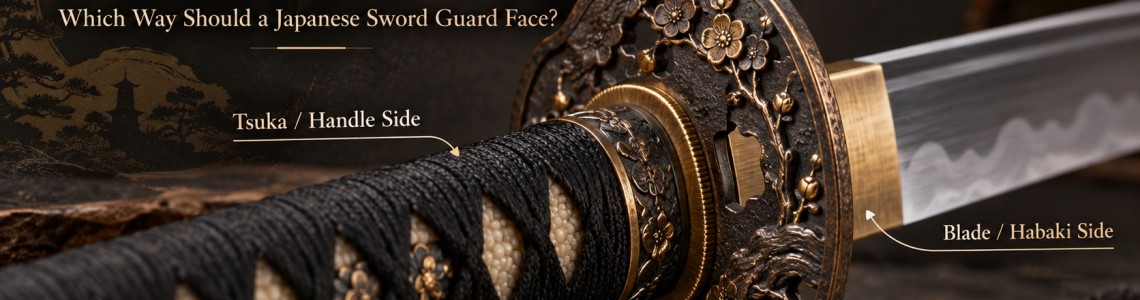
Katana Tsuba Orientation Guide: Which Way Should a Japanese Sword Guard Face?
By HanBon Forge Editorial Team | Published October 17, 2026 | Japanese Sword Fittings
The tsuba (鍔), or Japanese sword guard, is one of the most recognizable components of a katana. Beyond its protective role, it is an important expression of Japanese metalworking artistry, featuring designs such as dragons, cherry blossoms, samurai, tigers, and traditional patterns.
However, one important detail is frequently overlooked: the correct orientation of the tsuba.
Which side should face the handle? Should the decorated surface face the blade? Does a dragon's head need to point upward? And how can you tell whether a Japanese sword guard has been installed backward?
In this comprehensive guide, HanBon Forge explains the traditional conventions of katana tsuba orientation, including omote and ura, nakago-ana, kozuka and kogai openings, decorative motifs, and proper fitting.
Quick Answer: Which Way Should a Tsuba Face?
On a conventionally mounted katana or wakizashi, the omote (front) of the tsuba normally faces the tsuka (handle), while the ura (reverse) faces the habaki and blade.
When looking at the tsuba from the handle toward the blade, with the cutting edge pointing upward, the traditional kozuka opening is commonly on the viewer's left and the kogai opening on the right.
However, historical variations exist, and the decorative design, central tang opening, and actual mounting must all be considered before determining orientation.
1. What Is a Tsuba on a Japanese Sword?
A tsuba (鍔) is the guard fitted between the blade and handle of a Japanese sword. It forms part of the sword's complete mounting, known as koshirae.
Traditionally, the tsuba helps guard the hand and provides a physical boundary between the grip and the blade. Its weight and dimensions also contribute to the overall handling characteristics of the mounted sword.
Over centuries, Japanese craftsmen developed tsuba into an important form of decorative metalwork. Guards were produced from iron, copper, brass, shakudo, shibuichi, and other materials, with techniques including carving, piercing, engraving, and metal inlay.
Some tsuba are relatively simple and functional, while others are elaborate works of art.
Understanding their orientation is important because the tsuba was generally designed to be appreciated as part of a fully mounted sword, rather than as an isolated decorative object.
Important Parts of a Tsuba
| Japanese Term | Meaning | Function |
|---|---|---|
| Tsuba (鍔) | Sword guard | Guard between blade and handle |
| Nakago-ana (茎穴) | Central tang opening | Allows the sword tang to pass through |
| Seppa-dai (切羽台) | Washer seat | Contact area for the seppa |
| Kozuka-hitsu-ana | Accessory opening | Accommodates a kozuka |
| Kogai-hitsu-ana | Accessory opening | Accommodates a kogai |
| Mimi (耳) | Outer rim | Defines the guard's perimeter |
| Omote (表) | Front face | Normally oriented toward the handle |
| Ura (裏) | Reverse face | Normally oriented toward the blade |
2. Tsuba Omote vs. Ura: Which Side Is the Front?
The terms omote (表) and ura (裏) are essential to understanding traditional Japanese sword fittings.
For a conventional katana or wakizashi, the tsuba's omote normally faces the tsuka, and the ura faces the blade and habaki.
Omote: The Principal Face
The omote is generally considered the principal viewing surface of the sword guard.
It may feature the main decorative subject, such as a dragon, tiger, human figure, or detailed landscape.
However, not every tsuba has a more elaborate omote. Some examples have nearly identical decoration on both sides.
Ura: The Reverse Face
The ura is the opposite surface. It may be more simply decorated, or it may contain a continuation of the main artistic composition.
For historical pieces, signatures, accessory openings, mounting marks, and decorative arrangements may provide additional evidence about which face is which.


Do Not Confuse Tsuba Omote with Sword Omote
When discussing a complete katana, omote often refers to the outward-facing side of the sword when worn in the traditional manner.
When discussing the two flat surfaces of a tsuba, omote generally identifies the principal handle-facing surface.
These terms are related but describe different geometrical directions.
3. Why Does the Tsuba's Front Face the Handle?
The traditional mounting orientation is closely related to how Japanese swords were worn.
A conventional uchigatana, the sword type associated with the modern katana, was typically worn through the waist sash on the left side of the body, with its cutting edge facing upward.
From this position, the handle-facing surface of the guard could be seen from the traditional viewing angles.
This helps explain why the principal decoration was often intended to appear on the handle side.
The artwork was not necessarily designed to appear upright when the detached tsuba was placed randomly on a table.
Instead, its orientation often makes more sense when viewed as part of the fully mounted sword.
4. How to Identify the Top and Bottom of a Tsuba
After determining the correct front and back, the next step is identifying the cutting-edge side and spine side.
Two Japanese terms are especially important:
- Ha (刃): The cutting edge of the blade.
- Mune (棟): The back or spine of the blade.
For a conventionally worn katana, the cutting edge points upward.
Examine the Nakago-ana
The nakago-ana is the central opening for the tang. Its shape can help identify the intended position of the tsuba.
On many traditional examples, the opening has a narrower end corresponding to the cutting-edge side.
However, this is not a universal identification method. Historical tsuba may have been modified or adapted for different blades.
Some modern fittings also have simplified or unusually shaped openings.

Examine the Decorative Design
Human figures, architectural scenes, and certain plant motifs may provide clear visual clues.
A standing person is usually intended to be viewed upright, rather than upside down.
Animal designs and abstract patterns can be more difficult to interpret.
The decorative composition should be evaluated as a whole rather than relying on a single detail.
5. Kozuka and Kogai Holes: Which Side Is Left or Right?
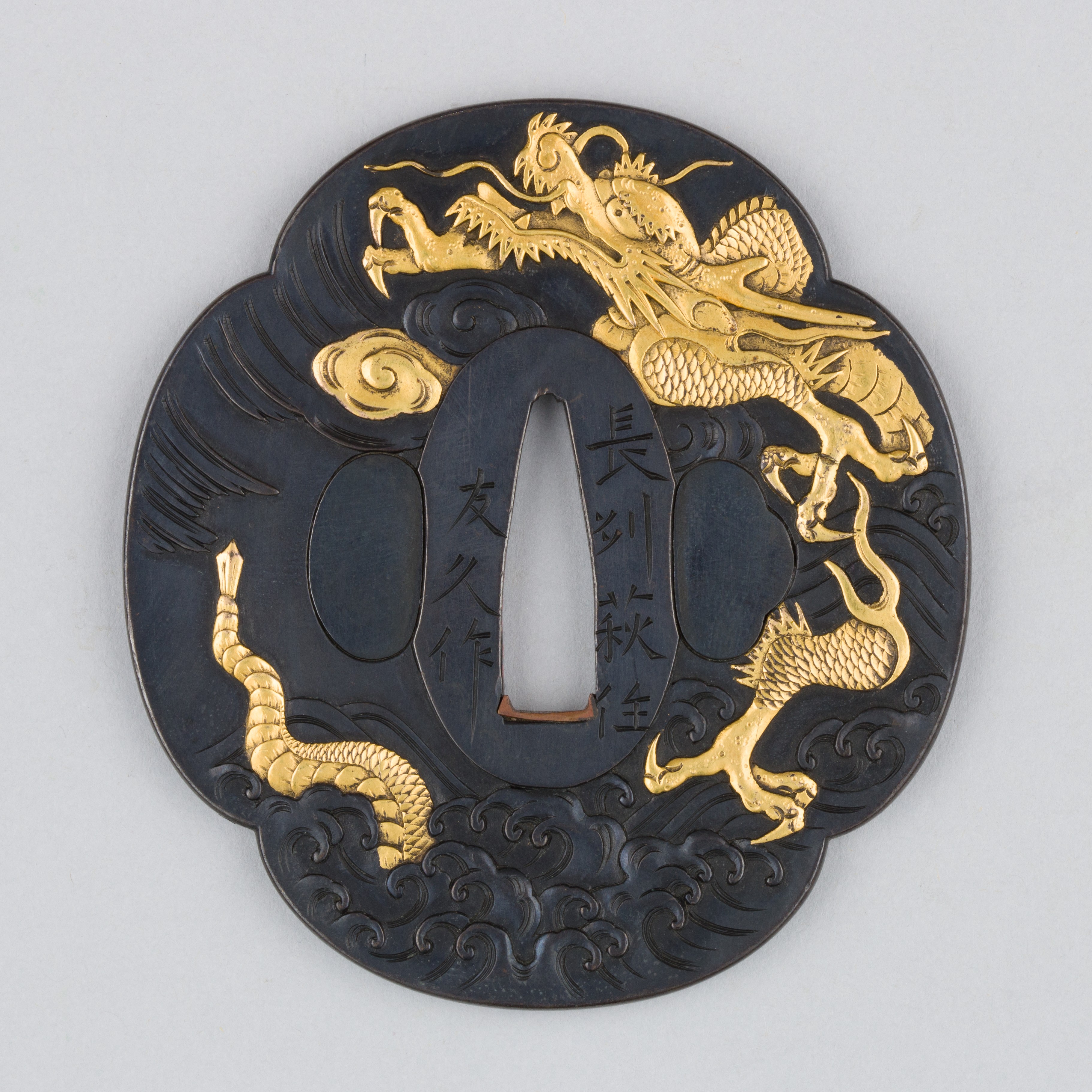
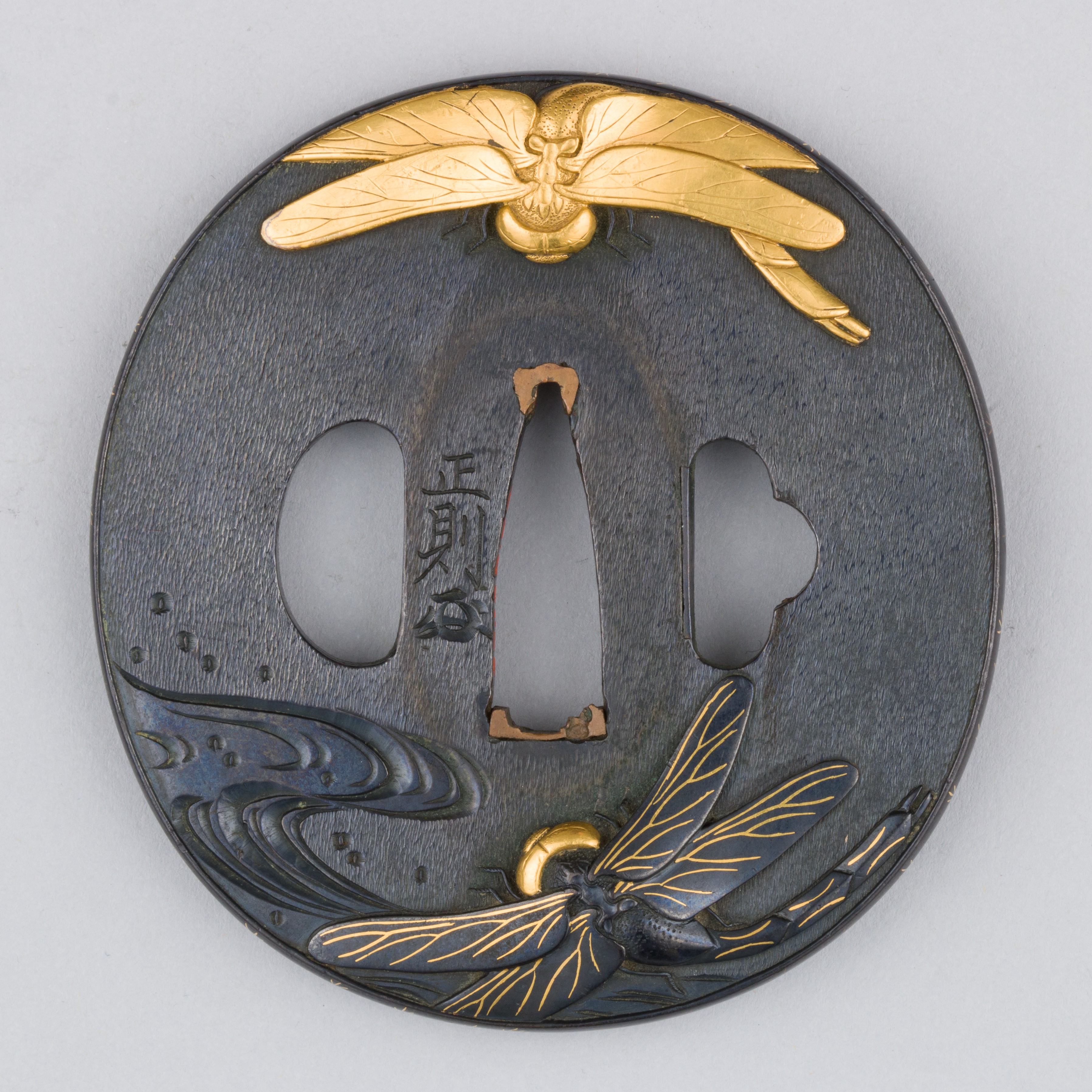
Many historical Japanese sword guards feature smaller openings beside the central nakago-ana.
These openings are known collectively as hitsu-ana.
The two most recognizable types are the kozuka-hitsu-ana and kogai-hitsu-ana.
Kozuka-hitsu-ana
The kozuka-hitsu-ana accommodates the handle of a small utility knife carried with certain Japanese sword mountings.
It commonly appears as an elongated or rounded opening.
Kogai-hitsu-ana
The kogai-hitsu-ana accommodates a kogai, a traditional implement associated with certain sword fittings.
It often has a distinctive three-lobed or irregular outline.
Traditional Left and Right Positions
When viewing the omote of a conventional katana tsuba from the handle toward the blade, with the cutting edge upward, a common arrangement is:
| Opening | Typical Position | Common Appearance |
|---|---|---|
| Kozuka-hitsu-ana | Viewer's left | Elongated or rounded |
| Nakago-ana | Center | Tang-shaped opening |
| Kogai-hitsu-ana | Viewer's right | Often three-lobed |
This traditional arrangement is a helpful reference, but it does not apply to every tsuba.
Some guards have only one accessory opening, some have none, and others have openings modified during their history.
Therefore, accessory-hole position should never be used as the only test for correct orientation.
6. How Should Dragon, Tiger, Sakura and Samurai Tsuba Designs Face?
Decorative orientation is one of the most interesting aspects of Japanese sword fittings.
Different motifs require different approaches. There is no single rule stating that every animal must face upward or that every decorative subject must point toward the sword tip.
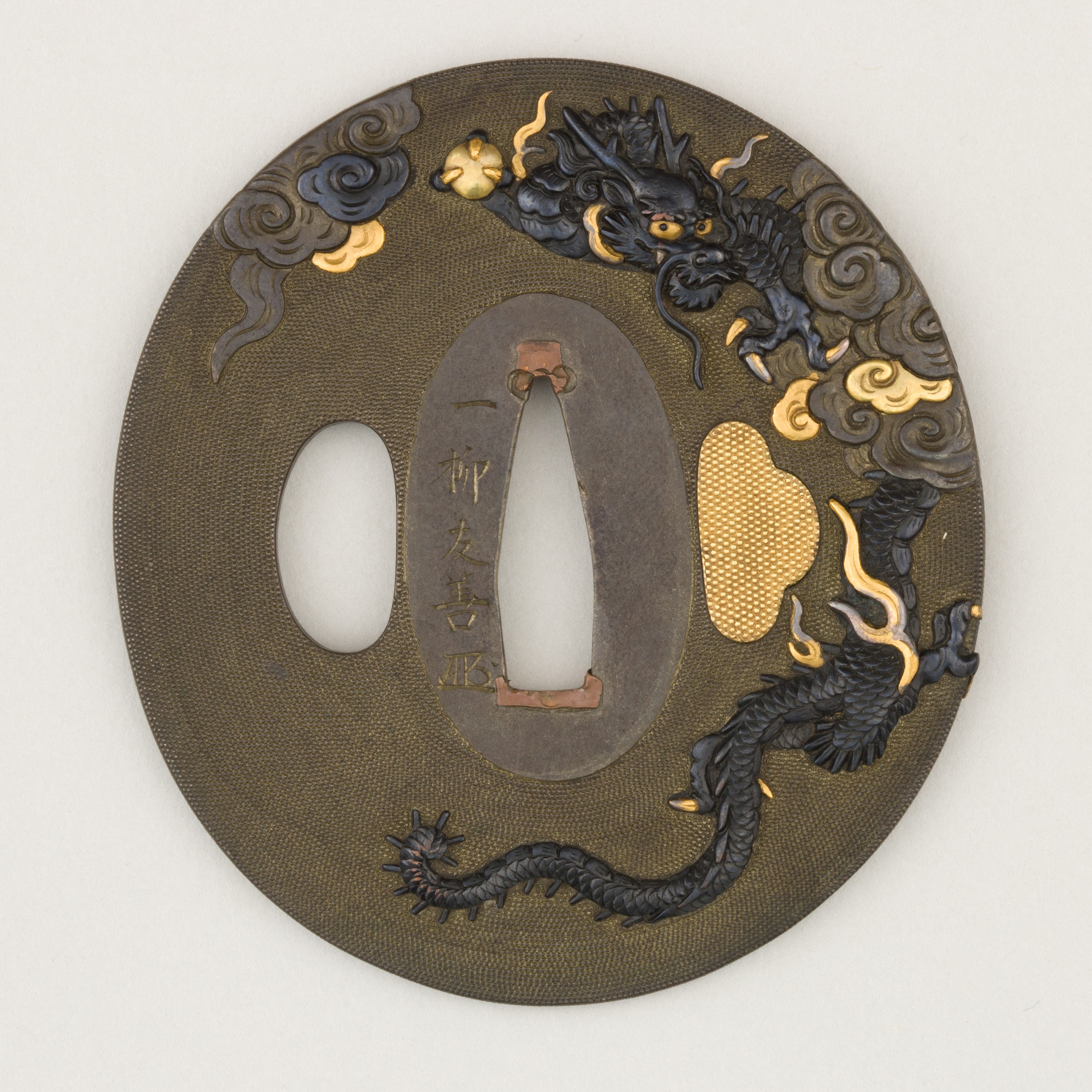
Dragon Tsuba Orientation
Dragon motifs are especially popular on katana fittings.
A dragon may be depicted coiling around the nakago-ana, flying through clouds, holding a pearl, or twisting its body while turning its head.
A dragon's head does not always need to point toward the ha, mune, or kissaki.
Instead, consider the direction of the entire composition and the intended viewing angle.
Tiger and Other Animal Motifs
Tigers, wolves, birds, and other animals may be shown standing, running, flying, crouching, or turning.
The animal's head direction alone is not enough to identify the correct orientation.
Its posture, surrounding scenery, and overall artistic balance should be considered.
Sakura and Floral Motifs
Cherry blossoms, known as sakura, are a popular symbol in Japanese decorative art.
A symmetrical arrangement of blossoms may have no obvious top or bottom.
However, a complete branch, flowering tree, or standing bamboo design may have a clear intended viewing direction.
Human Figures and Samurai Scenes
Standing human figures often provide clearer orientation clues.
For a conventionally viewed katana tsuba, an upright figure commonly has the head toward the cutting-edge side.
Nevertheless, historical compositions vary, and the complete scene should always be examined.
Geometric and Sukashi Designs
Some tsuba feature symmetrical geometric patterns or openwork designs known as sukashi.
When a pattern is symmetrical, there may be little visible difference between alternative orientations.
In such cases, fitting compatibility is particularly important.
7. Katana vs. Tachi: Is the Orientation the Same?
The katana and tachi have different historical wearing conventions.

| Feature | Katana / Uchigatana | Tachi |
|---|---|---|
| Traditional wear | Inserted through the waist sash | Suspended from the waist |
| Cutting edge | Usually facing upward | Usually facing downward |
| Mounting style | Uchigatana koshirae | Tachi koshirae |
| Decorative conventions | Evaluated for katana mounting | May follow different conventions |
Because their traditional wearing positions differ, the intended orientation of particular decorative fittings may also differ.
Antique tachi fittings should not automatically be judged using every convention associated with a modern katana.
It is also important to remember that historical fittings were sometimes reused or adapted for different mounting styles.
8. Common Tsuba Orientation Mistakes
Mistake 1: Placing the Principal Face Toward the Blade
For conventional katana mounting, the omote normally faces the handle, not the blade.
Mistake 2: Using Only the Dragon's Head as a Guide
Dragon designs may be intentionally asymmetrical. The entire artwork should be considered.
Mistake 3: Ignoring the Hitsu-ana
Kozuka and kogai openings provide useful evidence about traditional layouts, especially when the design itself is difficult to interpret.
Mistake 4: Ignoring the Central Tang Opening
The nakago-ana must be compatible with the tang. Changing orientation without checking the fit may create assembly difficulties.
Mistake 5: Assuming Every Historical Tsuba Is Identical
Japanese sword guards were produced over many centuries and reflect numerous artistic schools, regional traditions, and historical modifications.
Traditional conventions are useful, but individual objects may require closer examination.
9. Practical Tsuba Fitting and Inspection Checklist
At HanBon Forge, tsuba orientation is considered alongside the overall design and mechanical compatibility of custom Japanese sword fittings.
When evaluating a tsuba for a custom sword, the following checklist is useful.
| Inspection Point | What to Check |
|---|---|
| Omote / Ura | Confirm the intended front and reverse |
| Ha / Mune | Identify the intended cutting-edge direction |
| Decorative composition | Check that important motifs are not unintentionally inverted |
| Hitsu-ana | Review accessory-hole layout when present |
| Nakago-ana | Confirm compatibility with the tang |
| Seppa contact | Ensure correct and stable contact |
| Adjacent fittings | Check compatibility with the fuchi and habaki |
| Final stability | Check for looseness, movement, or unusual rattling |
If a tsuba appears visually reversed, it should not simply be forced into a different position without considering the fit of the surrounding components.
10. Choosing the Right Tsuba for Your Custom Katana
A well-chosen tsuba should complement the blade, handle, saya, and other fittings.
The visual theme is important, but proportion, material, and proper fitting also matter.
Material
Iron tsuba are especially associated with many traditional Japanese sword-fitting styles. Other metal alloys allow different colors, textures, and decorative effects.
Design
Popular themes include dragons, cherry blossoms, cranes, bamboo, waves, and traditional geometric patterns.

Proportion
The guard should suit the overall dimensions and intended use of the sword.
Compatibility
Not every tsuba will fit every katana without appropriate adjustment or fitting work.
Orientation and Customer Preferences
For non-symmetrical designs, customers should consider how the artwork will appear on the finished sword.
If you have a specific orientation preference, we recommend including clear instructions and, where possible, a reference image with your custom sword order.
Customize Your Katana with HanBon Forge
Select your preferred blade, tsuba, handle wrapping, saya, and other Japanese sword fittings to create a custom sword that reflects your personal style.
Our customization options include traditional, floral, dragon-themed, and other decorative sword guards.
For more guidance, read our How to Choose a Katana Tsuba article.
11. Frequently Asked Questions About Tsuba Orientation
Below are answers to common questions about Japanese sword guard orientation and installation.
12. Final Thoughts: The Correct Way to Orient a Katana Tsuba
Correct Japanese sword guard orientation involves more than deciding which side looks better.
For a conventional katana or wakizashi, the omote normally faces the handle, while the ura faces the blade.
The cutting-edge direction, accessory openings, central tang opening, and decorative composition provide additional clues.
However, centuries of Japanese sword-fitting history have produced numerous exceptions and variations.
The ideal approach combines historical understanding, artistic judgment, and secure mechanical fitting.
At HanBon Forge, we believe careful attention to these details helps create a more consistent, attractive, and well-assembled custom sword.
13. About This Guide & Editorial Experience
This educational guide was prepared by the HanBon Forge Editorial Team, drawing on our experience coordinating custom Japanese sword production, fitting selection, assembly reviews, and customer specifications.
HanBon Forge works with swordsmiths and assembly craftsmen in Longquan, Zhejiang, China, producing customized Japanese-style swords for collectors, enthusiasts, and martial arts practitioners.
Our discussion of historical tsuba orientation draws on published museum collections and specialist Japanese sword-fitting resources.
We distinguish traditional conventions from universal requirements because historical mountings and individual artifacts can vary.
This article is an educational reference, not an authentication report for an antique sword fitting or a substitute for professional inspection of an unsafe sword assembly.
Author: HanBon Forge Editorial Team
Published: October 17, 2026
Website:
www.hanbonforge.com
14. References & Further Reading
- The Metropolitan Museum of Art — Japanese Dragon Sword Guard. Historical decorated tsuba.
- The Metropolitan Museum of Art — Japanese Sword Guard. Historical sword-fitting example.
- The Metropolitan Museum of Art — Dragon-Themed Tsuba. Decorative metalwork.
- The Metropolitan Museum of Art — Early Japanese Sword Guard.
- HanBon Forge — How to Choose a Katana Tsuba.
- Wikimedia Commons — Tsuba with Gentian and Chrysanthemum Crests.
- Wikimedia Commons — 19th-Century Tsuba.
- Wikimedia Commons — Tachi Sword at Tokyo National Museum.
- Wikimedia Commons — Japanese Tsuba with Chrysanthemums.